200-year-old Vinayagar temple demolished citing 'encroachment' by authorities in Tamil Nadu; nearby church left untouched
 Thoothukudi, Tamil Nadu, India
  18 August, 2026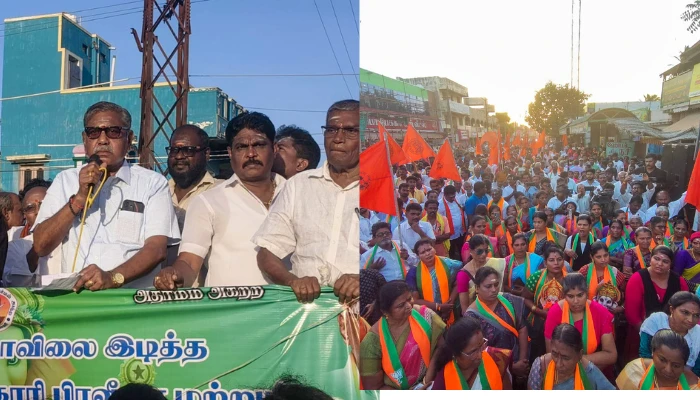
Case Summary
In Kurumbur, Thoothukudi district, Tamil Nadu, an ancient 200-year-old Railadi Vinayagar temple was demolished overnight near Kurumbur Railway Station, while a nearby church was left untouched. The matter came to light after railway authorities used an earthmover to demolish the temple during the intervening night of 19 and 20 August 2026, following a court order concerning alleged encroachment on Railway land. Hindu Munnani (Organisation) stated that its functionaries had met railway authorities on the morning of 19 August 2026 and appealed against the demolition, but the temple was subsequently razed during the night. Railway authorities maintained that the site was Railway property that had been encroached upon and that the demolition was carried out in accordance with the court order. Around 100 police personnel were deployed during the operation to prevent a law-and-order situation. Hindu Munnani cadres who attempted to stop the demolition were removed by the police. Hindu Munnani alleged that a nearby church associated with preacher Mohan C. Lazarus, who runs an NGO named Jesus Redeems, was left untouched. The organisation further alleged that a railway official in Madurai had played a role in ordering the demolition of the Hindu temple while leaving the church intact. Hindu Munnani also objected to the manner in which the temple idols were removed, stating that devotees had requested officials not to handle the idols while wearing footwear. The organisation further alleged that a nearby church associated with Christian preacher Mohan C. Lazarus and his NGO, Jesus Redeems, was left untouched despite the demolition of the Hindu temple. It also questioned the presence of Lazarus's name on a plaque connected with a railway platform extension. The organisation stated that the land had been donated to the Railways by a Hindu and maintained that the temple had existed at the location without obstructing public movement or traffic. It therefore demanded that the temple be rebuilt at the same place. On 22 August 2026, Hindu Munnani staged a demonstration condemning the demolition and sought action against Southern Railway Madurai Division Engineer D.N. Pramila and other officials whom it held responsible for the demolition. The protest was led by State Vice President T. Arasu Raja and State Vice President V.P. Jayakumar. State Executive Committee Member Sakthivelan, State Co-Organizer K.K. Ponnaiah, State Secretary K. Kuttalanathan, BJP State in-charge Rajakannan and Thoothukudi District President Chittarangathan also addressed the gathering. More than 1,000 Hindu Munnani and BJP functionaries, along with members of the public and spiritual organisations, participated in the demonstration. Hindu Munnani subsequently submitted a memorandum to Union Minister of State L. Murugan, demanding action against the railway officials and reconstruction of the Vinayagar temple at its original location. Murugan assured the delegation that appropriate action would be taken.
Why it is Hate Crime ?
This case has been added to the tracker under the primary category - Attack on Hindu religious representations. Within this, the subcategory selected is - Attack on temples. In Hinduism, a temple is the abode of the Deity. The Deity in the Temple is consecrated, thereby making it a real, breathing entity. Hindus believe that not just the Deity but the temple premises themselves are sacred to Hindus since Hindus hold the faith that the entire Temple space is an amalgamation of the divine energy of the deity. Given the central significance of Temples in Hindu Dharma, any attack against a Hindu Temple or its peripheral premises is an attack on the faith itself and is born out of animosity towards the faith, of which the Temple is a central tenet. Any manner of attack against a Temple and/or its premises would therefore be considered a religiously motivated hate crime. The other sub-category selected is - Desecration of Hindu religious symbols. Icons and symbols or a religious representation of a spiritual ideal are widely revered in Hinduism. Iconography is of vital significance in the Hindu milieu. It helps connect people’s spiritual beliefs with the real world. Iconography within the Hindu faith takes several shapes and forms. Murtis are of most significance to Hindus, to which daily rituals, prayers and offerings are done. Besides the murtis, there are several other symbols which have deep significance in the Hindu faith – the Om and Swastika, for example. Since these Hindu religious symbols hold paramount importance in Hinduism, any desecration of symbols, icons, murtis, religious representations and manifestations is driven by animosity towards the faith itself, which manifests itself through these murtis, icons and symbols. Therefore, any desecration of these Hindu religious symbols and representations is considered a religiously motivated hate crime under this category. This case constitutes a religiously motivated hate incident because the demolition targeted an ancient Hindu place of worship despite the Hindu organisation having specifically appealed to the railway authorities and highlighted the temple’s religious significance. The authorities proceeded with the demolition within hours of the appeal, during the night, without providing devotees reasonable time to explore an alternative arrangement. The use of an earthmover to remove a 200-year-old Hindu temple reduced a sacred place of worship to a physical encroachment without adequate consideration of its religious character. The temple's history further heightened the religious significance of the action. It had stood for approximately 200 years, while the land itself had been donated to the Railways by a Hindu. The existence of a court order concerning railway land did not, by itself, extinguish the religious significance of the consecrated temple or justify denying devotees an opportunity to find a solution that preserved the place of worship. The selective nature of the action also displayed bias towards the Hindu religion and temples. A nearby church associated with Christian preacher Mohan C. Lazarus remained untouched while the Hindu temple was demolished. This differential treatment, in the immediate vicinity of the demolished temple, strengthened concerns that Hindu religious interests had been treated with lesser consideration. The handling of the temple's idols added a further religious dimension. Hindu Munnani(organisation) objected to officials removing the idols while wearing footwear, despite devotees requesting that the sacred Murtis be handled in accordance with Hindu religious norms. A consecrated Murti represents the presence of the Deity for devotees; its treatment during the destruction of the temple therefore carried significance beyond the removal of a physical structure. The incident also occurred against a broader backdrop of disputes concerning the state's treatment of Hindu religious practices. In an earlier matter concerning the Karthigai Deepam at Thirupparankundram, the Madras High Court had directed that the traditional Hindu ritual be permitted, yet the government resisted its observance. The contrasting approach raised concerns that legal and administrative authority was being applied more readily to restrict Hindu religious expression than to accommodate it. Importantly, a temple is not merely a building for Hindus. It is the consecrated abode of the Deity and a central space for worship and religious continuity. The destruction of such a historic temple, coupled with the insensitive handling of its sacred representations and the differential treatment of a nearby church, therefore affected the religious identity and sentiments of the Hindu community. These circumstances form the basis for categorising the incident as a religiously motivated hate crime under the Hinduphobia tracker.


Case Status
Unknown


Perpetrators Details
Perpetrators
State and Establishment
Perpetrators Range
Unknown
Perpetrators Gender
unknown
 Sources




