Hindu deity Murugan misrepresented as Jesus in Tamil book aimed at conversion
 Tamil Nadu, India
  17 August, 2026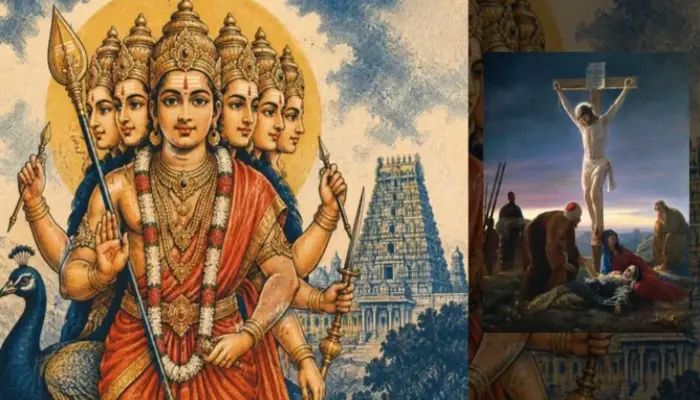
Case Summary
A 400-page Tamil-language evangelical handbook published in Tamil Nadu depicted Hindu beliefs and traditions through a Christian theological framework, equating Bhagwan Murugan with Jesus, in an apparent effort to weaken Hindus' connection with their own faith, reshape their understanding of Hindu traditions, and ultimately facilitate religious conversion. The publication stated that St Thomas brought Jesus to India, that Jesus was "Tamil Indianised", and that Murugan represented Jesus. The book described Devasena as representing Jewish Christians and Valli as representing Gentiles awaiting conversion. The text further stated that Murugan’s 12 hands represented the 12 apostles, and that the Hindu practice of kavadi was a forgotten reenactment of Christ carrying the Cross. These claims triggered a sharp reaction on social media. One netizen questioned the book's internal logic, asking, "If Murugan is Jesus, does that make Shiva the Father in Heaven?" Another described Murugan as a Hindu deity whose identity was being reduced to that of a Christian figure and argued that the reinterpretation formed part of a wider missionary effort. Other users also pointed to what they described as repeated attempts to separate Tamil religious and cultural traditions from their Hindu roots. Notably, this was not an isolated attempt to separate Tamil heritage from its Hindu roots. This initiative was, in fact, a part of a decades-long evangelical effort to reinterpret Hindu deities and traditions in a manner aimed at facilitating the conversion of Hindus. By presenting Hindu gods and practices as versions of Christian beliefs, the evangelists have sought to blur the distinction between Hinduism and Christianity and make the transition from Hinduism to Christianity easier to promote. In 1992, John Samuel, then director of the Institute of Asian Studies, organised the first international conference on Skanda-Murugan in Chennai. He stated that researchers believed Murugan had been elevated to the status of a historical figure. In 2005, Samuel wrote that the Somaskanda icon depicting the Hindu deities Shiva, Uma, and Skanda was a revelation of the Christian Trinity. In May 2026, the Hinduphobia Tracker documented another instance in Tamil Nadu involving Thiruvalluvar and the Thirukkural. Tamil Nadu Health Minister K. G. Arunraj objected to the revered saint-poet being depicted in saffron robes and claimed that the Thirukkural was not rooted in Hindu religious tradition. He also argued that the text contained no references to Hindu deities. By rejecting the Hindu cultural and religious associations of Thiruvalluvar and the Thirukkural, the remarks sought to detach a deeply revered part of Tamil heritage from its Sanatan roots.
Why it is Hate Crime ?
The primary category selected in this case is: Predatory Proselytisation. The sub-category selected is: Attempting to convert/converting by denigrating Hinduism. In several cases, Hindus are converted or an attempt is made to convert Hindus by denigrating their faith, Hinduism. In such cases, the Hindus associate with the non-Hindu perpetrators often by choice and then, the attempt to convert them by insulting their faith, showing the faith down etc begins. An example of this would be a non-Hindu gathering where the Hindus are attending the gathering of their own free will. However, once they attend the gathering, there is an explicit attempt to convert them by abusing their faith and hailing the faith of the perpetrator. The denigration of the Hindu faith is often based on misrepresentation of the Hindu faith, its doctrine and scriptures and insult to espoused traditions if not blatant lies about Hindu beliefs and ways. Such conversions or attempts at conversions are driven by animosity towards the Hindu faith and are therefore documented as religiously motivated hate crimes. The other sub-category selected here is: Proselytisation by grooming, brainwashing, manipulation or subtle indoctrination. Religious brainwashing essentially means the often subtle and forcible indoctrination to induce someone to give up their religious beliefs to accept contrasting regimented ideas. Religious grooming or brainwashing also involves propaganda and manipulation. It involves the systematic effort, driven by religious malice and indoctrination, to persuade “non-believers’ to accept allegiance, command, or doctrine to and of a contrasting faith. Cases of such grooming or brainwashing are far more nuanced than direct threats, coercion, inducement and violence. In such cases, it is often seen that there is repeated, subtle and continual manipulation of the victim to induce disaffection towards their own faith and acceptance of the contrasting faith of the perpetrator. While subtle indoctrination is widely acknowledged as predatory, an element which is often understated in such conversions or the attempts of such conversion is the role of loyalty and trust which might develop between the perpetrator and the victim. Fiduciary relationships are often abused to affect such religious conversion. For example, an educator transmitting religious doctrine of a competing faith to a Hindu student. The Hindu student is likely to accept what the teacher is transmitting owing to existence of the fiduciary relationship. The exploitation of the fiduciary relationship to religiously indoctrinate victims would also be included in this category. Since the underlying animosity towards the victim’s faith forms the basis of predatory proselytization, such cases are considered religiously motivated hate crimes. The other primary category selected in this case is Hate speech against Hindus. The sub-category selected is: Subversion of scriptures. Subverting the religious scriptures of Hindus has particularly devastating consequences. Subversion of the scriptures of Hindus is often done to justify or promote hatred, discrimination, or violence against specific individuals or groups of Hindus. Religious scriptures are often nuanced and those who harbour religious animosity towards Hindus often misquote or misrepresent the scripture to legitimise their animosity and hate towards the faith and its adherents. Any such misquoting of scriptures or subversion to justify hate, violence and discrimination against Hindus owing to religious animosity is hate speech and is categorised as such. The other sub-category selected here is - Anti-Hindu subversion and prejudice Hate speech is defined as any speech, gesture, conduct, writing, or display that is prejudicial against a specific individual and/or group of people, which is leading to or may lead to violence, prejudicial action or hate against that individual and/or group. Media plays a specific and overarching reach in perpetuating prejudicial attitudes towards a community owing to unfair, untrue coverage and/or misrepresentation/misinterpretation, selective coverage and/or omission of facts of/pertaining to issues affecting a specific religious group. This type of bias can dehumanise the victim group, making it easier for others to justify harmful actions against them, which aligns with the objectives of hate speech laws aimed at preventing such harm. It is often observed that the media takes a prejudicial stand against the Hindu community driven by their need to shield the aggressor community which happens to be a numeric minority, however, is the one perpetrating violence against Hindus. For example, the media is often quick to contextualise religiously motivated crimes against Hindus, omit or misrepresent facts that point towards religiously motivated hate crimes, justify and/or downplay religiously motivated hate crimes or simply present fake news to stereotype Hindus. Such media bias leads to the denial of persecution and is often used to dehumanise Hindus, leading to justification for violence against them. For example, the media covered several fake allegations of Hindus targeting Muslims and forcing them to chant Jai Shree Ram. Most of these cases were proved false and fabricated after police investigation. These fake news reports were subsequently never retracted or clarified. Such fake news led to the justification of violence and dehumanisation of Hindus based on the argument that since Hindus targeted Muslims and forced them to chant Jai Shree Ram, the dehumanisation of Hindus and violence against them was par for the course and merely a retaliation. Such media bias leads to prejudicial portrayal of Hindus and offers a justification for violence against them and therefore, is considered hate speech under this category. The religious motivation in this case lies in the deliberate attempt to reinterpret Hindu deities, symbols, and traditions as Christian concepts in a manner intended to distance Hindus from their own faith, weaken their connection to its religious and cultural roots, and create conditions conducive to future conversion. The publication did not merely compare Hinduism and Christianity or discuss similarities between the two faiths. It reassigned the identity and meaning of revered Hindu figures to fit a Christian theological framework. Bhagwan Murugan was presented as Jesus, Devasena as representing Jewish Christians, Valli as representing Gentiles awaiting conversion, and Murugan's twelve hands as the twelve apostles. The practice of kavadi was similarly reinterpreted as a forgotten reenactment of Christ carrying the Cross. Through these reinterpretations, Hindu deities and traditions were stripped of their original religious meaning and recast as expressions of Christian theology. While the material did not involve direct conversion attempts, its purpose was clearly conversion-oriented. By presenting familiar Hindu beliefs as distorted, incomplete, or forgotten versions of Christianity, the material sought to make Christian doctrine appear familiar while weakening the distinct identity of Hindu traditions. The reinterpretation therefore functioned as a means of creating doubt about the authenticity and independent origins of Hindu beliefs rather than engaging with them on their own terms. The use of extensive literature and associated conferences gave this effort an additional layer of influence. Presenting such claims through books, research, and academic forums could give them an appearance of scholarly legitimacy while gradually introducing Christian interpretations into the understanding of Hindu traditions. When such ideas are repeatedly presented to a community through supposedly authoritative material, they can condition people to view their own religious traditions through an external theological framework. The deliberate reinterpretation of sacred Hindu elements such as Murugan, Devasena, Valli, Somaskanda, and kavadi therefore went beyond ordinary religious comparison. It involved taking established Hindu symbols and assigning them meanings derived from another faith, thereby weakening their distinct Hindu identity and obscuring their original theological significance. Such treatment trivialised the religious heritage attached to these traditions and presented Hindu beliefs as concepts awaiting reinterpretation through Christianity. The underlying approach reflects hostility towards the Hindu faith because it treated Hindu beliefs and traditions as something to be appropriated, rewritten, and redirected towards another religion. By weakening their distinct Hindu identity and using that reinterpretation in a conversion-oriented framework, the material sought to erode Hindus' connection with their own faith. It is this deliberate religious appropriation, denigration, and conversion-oriented messaging that gives the incident its character as a religiously motivated hate crime.


Case Status
Unknown


Perpetrators Details
Perpetrators
Unknown
Perpetrators Range
Unknown
Perpetrators Gender
unknown
 Sources




