Revered Hindu poet Thiruvalluvar's Hindu portrayal challenged by TN minister; Thirukkural's Dharmic roots dismissed
 Tamil Nadu, India
  29 May, 2026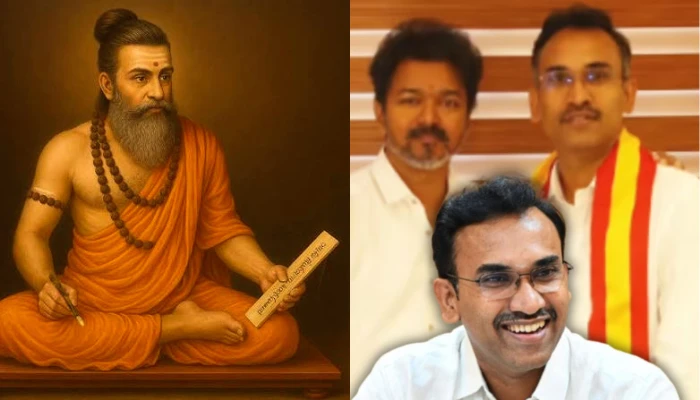
Case Summary
Hindu religious symbols and the Sanatan roots of the Thirukkural came under attack in Tamil Nadu after Health Minister K.G. Arunraj objected to the depiction of the revered Tamil saint-poet Thiruvalluvar in saffron robes. The Christian minister also claimed that the Thirukkural was not rooted in Hindu religious tradition. He stated that Thirukkural contained no references to Hindu deities. The remark came after a portrait of Thiruvalluvar, dressed in a saffron robe and wearing other traditional Hindu identity markers such as vibhuti and rudraksha, was displayed during an event organised on May 30, 2026, to celebrate Vaikasi Anusham, a day observed by many as the birth anniversary of Thiruvalluvar, at Lok Bhavan, where Tamil Nadu Governor Rajendra Arlekar paid tribute to the Tamil saint-poet. Arunraj objected to the depiction of Thiruvalluvar in traditional Hindu identity markers, arguing that associating him with a specific religious identity was contrary to the universal philosophy of the Thirukkural. Arunraj publicly criticised the depiction, claiming that presenting Thiruvalluvar in saffron attire was "fundamentally wrong". In a detailed statement, the minister stated that Thiruvalluvar should not be associated with any particular religious identity. "Thiruvalluvar gave the world a universal scripture. Reducing him to a narrow identity or portraying him within the confines of a particular religion diminishes his global philosophy," he claimed, further stating, "Draping Thiruvalluvar in saffron robes at Lok Bhavan or any government and public space is fundamentally wrong." After objecting to Thiruvalluvar's Hindu portrayal, the minister claimed that the Thirukkural was a universal moral text meant for all humanity and that reducing Thiruvalluvar to a particular religious or cultural identity diminished the global relevance of his teachings. He added that Thiruvalluvar did not restrict himself to any religion and asserted that the Thirukkural employed universal terms such as "Adi Bhagavan", "Malarmisai Yeginan", and "Aravaazhi Andhanan" rather than specific deity names. He maintained that the poet-philosopher transcended religious, caste, racial, and national identities and therefore should not be represented through Hindu symbols. He also warned against what he termed the "saffronisation" of Thiruvalluvar for political purposes. The remarks drew criticism from those who pointed out that Thiruvalluvar has historically been represented with Hindu deities and Hindu religious symbols in several traditions and artistic depictions. Critics argued that objecting specifically to saffron robes, vibhuti, and rudraksha effectively treated visible markers of Hindu identity as inappropriate or objectionable. They further contended that the comments ignored longstanding interpretations linking the Thirukkural and Thiruvalluvar to Hindu philosophical traditions. The controversy sparked a broader public and political debate in Tamil Nadu over the religious identity of Thiruvalluvar, the significance of Hindu symbols such as saffron attire and sacred ash, and whether depicting the Tamil saint-poet with such markers constituted cultural recognition or ideological appropriation.
Why it is Hate Crime ?
This case has been added to the tracker under the primary category of - Hate speech against Hindus. Within it, the sub-category selected is - Anti-Hindu subversion and prejudice. Hate speech is defined as any speech, gesture, conduct, writing, or display that is prejudicial against a specific individual and/or group of people, which is leading to or may lead to violence, prejudicial action or hate against that individual and/or group. Media plays a specific and overarching reach in perpetuating prejudicial attitudes towards a community owing to unfair, untrue coverage and/or misrepresentation/misinterpretation, selective coverage and/or omission of facts of/pertaining to issues affecting a specific religious group. This type of bias can dehumanise the victim group, making it easier for others to justify harmful actions against them, which aligns with the objectives of hate speech laws aimed at preventing such harm. It is often observed that the media takes a prejudicial stand against the Hindu community driven by their need to shield the aggressor community which happens to be a numeric minority, however, is the one perpetrating violence against Hindus. For example, the media is often quick to contextualise religiously motivated crimes against Hindus, omit or misrepresent facts that point towards religiously motivated hate crimes, justify and/or downplay religiously motivated hate crimes or simply present fake news to stereotype Hindus. Such media bias leads to the denial of persecution and is often used to dehumanise Hindus, leading to justification for violence against them. For example, the media covered several fake allegations of Hindus targeting Muslims and forcing them to chant Jai Shree Ram. Most of these cases were proved false and fabricated after police investigation. These fake news reports were subsequently never retracted or clarified. Such fake news led to the justification of violence and dehumanisation of Hindus based on the argument that since Hindus targeted Muslims and forced them to chant Jai Shree Ram, the dehumanisation of Hindus and violence against them was par for the course and merely a retaliation. Such media bias leads to prejudicial portrayals of Hindus and offers a justification for violence against them and, therefore, is considered hate speech under this category. The other sub-category selected is- Subversion of scriptures. Subverting the religious scriptures of Hindus has particularly devastating consequences. Subversion of the scriptures of Hindus is often done to justify or promote hatred, discrimination, or violence against specific individuals or groups of Hindus. Religious scriptures are often nuanced and those who harbour religious animosity towards Hindus often misquote or misrepresent the scripture to legitimise their animosity and hate towards the faith and its adherents. Any such misquoting of scriptures or subversion to justify hate, violence and discrimination against Hindus owing to religious animosity is hate speech and is categorised as such. The other primary category selected here is- Attack on Hindu religious representation and within this, the subcategory selected is- Desecration of Hindu religious symbol. Icons and symbols or a religious representation of a spiritual ideal are widely revered in Hinduism. Iconography is of vital significance in the Hindu milieu. It helps connect people’s spiritual beliefs with the real world. Iconography within the Hindu faith takes several shapes and forms. Murtis are of most significance to Hindus, to which daily rituals, prayers and offerings are done. Besides the murtis, there are several other symbols which have deep significance in the Hindu faith – the Om and Swastika for example. Since these Hindu religious symbols hold paramount importance in Hinduism, any desecration of symbols, icons, murtis, religious representations and manifestations, is driven by animosity towards the faith itself which manifests itself through these murtis, icons and symbols. Therefore, any desecration of these Hindu religious symbols and representations is considered religiously motivated hate crimes under this category. This case has been added to the tracker because the controversy was not merely about how Thiruvalluvar should be portrayed. It involved objections to the depiction of the revered Tamil saint-poet with Hindu religious symbols such as saffron robes, vibhuti, and rudraksha, along with claims that sought to sever the well-established connection between Thiruvalluvar, the Thirukkural, and the broader Hindu and Dharmic tradition. By arguing that Thiruvalluvar has universal appeal, which makes Hindu representations of him inappropriate, Arunraj advanced a false and historically unsustainable narrative that attempted to disconnect one of Tamil culture's most revered figures from the religious and philosophical tradition that has long recognised and preserved his legacy. His remarks ignored the extensive Hindu and Dharmic concepts embedded within the Thirukkural and instead presented Hindu associations with Thiruvalluvar as misleading or illegitimate. Firstly, the claim that the Thirukkural has no meaningful connection to Hinduism turns completely false when one examines the text. The text contains concepts that are central to Hindu philosophy, including dharma, karma, rebirth, moksha, asceticism, devotion to God, and the pursuit of liberation from the cycle of birth and death. For example, Kural 38 states that righteous deeds performed throughout one's life serve as a barrier against rebirth, reflecting the distinctly Dharmic belief in multiple births and the consequences of one's actions across lifetimes. The concept of rebirth is foundational to Hindu thought and stands in contrast to the linear conception of life and the afterlife found in Abrahamic traditions. The Thirukkural also contains numerous references to Hindu deities, cosmology, and religious concepts that are deeply embedded in the broader Sanatana tradition. Across different verses, Thiruvalluvar refers to Indra, Yama, Lakshmi, Vishnu, Shiva, devas, pitrus, amritam, and Moodhevi, the goddess of misfortune. These are not generic spiritual references but figures and concepts that occupy a well-established place within Hindu scriptures and Puranic tradition. In several instances, the references mirror traditional Hindu understandings of these deities and beings. For example, Thiruvalluvar refers to devas in a manner consistent with Hindu scriptural descriptions and invokes concepts such as amritam, offerings made in yajnas, and reverence towards ancestors. The ethical framework of the Thirukkural likewise closely parallels broader Sanatana teachings. Kural 323, for instance, places non-violence before truthfulness, reflecting the traditional ordering of Ahimsa and Satyam found in discussions of Samanya Dharma. Such references and parallels demonstrate that the Thirukkural was composed within a Hindu and Sanatana intellectual milieu and cannot reasonably be portrayed as detached from the religious tradition whose concepts, deities, ethics, and worldview it repeatedly invokes. For centuries, Thiruvalluvar has been revered within the Hindu tradition, and the Thirukkural itself has often been described as the "Tamil Veda". The text's universal appeal does not negate these foundations. Many Hindu scriptures and philosophical works are regarded as universal in their message while remaining firmly rooted in the Hindu worldview. Furthermore, the controversy was not merely a disagreement over historical interpretation. Arunraj did not simply argue that Thiruvalluvar belongs to all people. He specifically objected to representations of Thiruvalluvar that reflected his long-recognised association with Hindu traditions and symbols. In doing so, he effectively portrayed Hindu representations of the saint-poet as inconsistent with his legacy. This transformed what could have been a discussion about interpretation into an attempt to delegitimise the Hindu understanding of Thiruvalluvar that has existed for centuries. Secondly, the remarks treated Hindu symbols themselves as objectionable. Saffron is one of the most sacred colours in Hinduism and has for centuries symbolised renunciation, wisdom, sacrifice, spirituality, and the pursuit of truth. Hindu saints, sages, monks, and ascetics have traditionally worn saffron robes as a visible expression of their spiritual path. Likewise, vibhuti and rudraksha occupy an important place in Hindu religious practice and devotion. By portraying the use of these symbols as inappropriate or contrary to Thiruvalluvar's legacy, the remarks implicitly treated revered Hindu religious symbols as something problematic. Since these symbols derive their significance from Hindu belief and practice, denigrating their association with Thiruvalluvar amounted to denigrating the Hindu religious tradition from which those symbols originate. Thirdly, the remarks cannot be viewed in isolation from the wider ideological context in which they were made. Similar attacks on Hindu traditions and Sanatana Dharma have repeatedly emerged from sections of Tamil Nadu's political landscape. TVK leaders themselves have previously made hostile remarks about Sanatana Dharma. TVK MLA V.M.S. Mustafa publicly declared that the party had "entered the fray to abolish Sanatana", echoing earlier statements made by DMK leader Udhayanidhi Stalin. Against this backdrop, Arunraj's comments appeared less like a neutral historical observation and more like part of a broader pattern of hostility towards Hindu beliefs, symbols, and traditions. Seen in its entirety, the incident was not merely a debate over iconography or historical interpretation. It involved the rejection of Hindu religious symbols, the denial of the Hindu and Dharmic foundations of a revered cultural figure, and the promotion of a narrative that portrayed Hindu associations with Thiruvalluvar as inappropriate or misleading. By seeking to detach Thiruvalluvar from his Hindu roots while simultaneously treating Hindu symbols as objectionable, the remarks targeted Hindu religious identity, beliefs, and traditions. For this reason, the incident has been included in the tracker as a case of anti-Hindu hate speech.


Case Status
Unknown


Perpetrators Details
Perpetrators
State and Establishment
Perpetrators Range
One Person
Perpetrators Gender
male
 Sources




