Hindu family attacked, land seized and threatened with expulsion by Muslims amidst rising attacks on Hindu minorities in Bangladesh
 Pirojpur District, Bangladesh
  3 August, 2026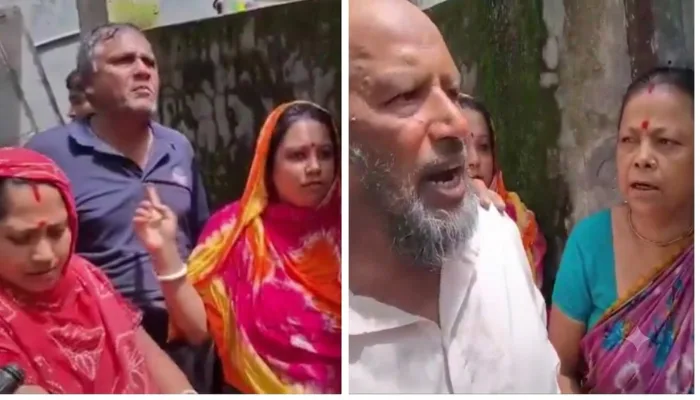
Case Summary
In Bhandaria Municipality of Pirojpur district, Bangladesh, a Hindu family was specifically targeted and attacked because of their religious identity by members of Jamaat-e-Islami. The Muslim perpetrators attempted to seize the family's home and land and also assaulted the local Hindu population, including Hindu women. According to reports, Shordul Islam, a local secretary of Jamaat-e-Islami, along with his supporters, targeted the Hindu family's property and attempted to take control of their land. Under the cover of night, they broke the wall of the Hindu family's property and attempted to occupy the land. They also attempted to break the gate of the Hindu family's home. When the Hindu family resisted, the Muslim perpetrators attacked them and also attacked local Hindus, including Hindu women. The perpetrators had also demanded money from the Hindu family and threatened them with being forced to leave the country. Shordul Islam further attempted to sabotage the Hindu family and their homes to show support of Anwar, another member of Jamaat-e-Islami. The attack therefore extended to the family's residential property and targeted their ability to occupy and safely protect their home and land. Following the incident, local residents protested against the land seizure and attack, raising slogans calling for honest governance and the implementation of Jamaat-e-Islami's version of Islam. The victim subsequently submitted a written complaint to the police, seeking legal action against those responsible. The events occurred against the backdrop of escalating hostility towards Hindus in Bangladesh. The recent escalation unfolded in three distinct phases: following the ouster of Sheikh Hasina’s government in August 2024; after the death of Sharif Osman Bin Hadi in December 2025; and in the immediate aftermath of the 13th National Parliamentary Election in 2026. Following the ouster of Sheikh Hasina, multiple reports documented attacks on Hindu homes, temples and religious institutions, alongside intimidation campaigns, arson and mob assaults targeting minority neighbourhoods. The Hinduphobia Tracker recorded 336 incidents against the Hindu minority during this period. A further escalation occurred following the death of Sharif Osman Bin Hadi, a Muslim political activist and student leader known for his anti-Hindu and anti-India rhetoric. Hadi had been involved in political unrest after the fall of the Hasina government and was killed in Dhaka on 18 December 2025 during clashes. In the aftermath of his death, Hindu communities were blamed and targeted in retaliatory violence. Hindu homes were set ablaze in multiple localities, forcing families to flee and leaving many displaced. Muslim mobs targeted Hindu neighbourhoods, properties and religious symbols. Among the victims was Dipu Chandra Das, who was lynched to death and whose body was set ablaze by a Muslim mob over false blasphemy allegations. The Hinduphobia Tracker documented 51 incidents of anti-Hindu violence following Hadi’s death. Posters and written materials calling for the extermination of Hindus were also displayed in public spaces. Other reported incidents included arson, vandalism, assault, intimidation and organised anti-Hindu mobilisation. The third phase emerged after the 13th National Parliamentary Election in 2026. Within days of the announcement of results, Hindu families in Noakhali, Rangpur, Nilphamari, Sylhet, Thakurgaon and Dinajpur faced attacks involving arson, looting, assault and vandalism of temples and homes. In several instances, Hindu homes were selectively targeted, looted, and families were threatened with displacement.
Why it is Hate Crime ?
The primary category for this case is: Attack not resulting in death. The subcategory for this case is: Attacked for Hindu identity. In several cases, Hindus are attacked merely for their Hindu identity without any perceived provocation. A classic example of this category of religiously motivated hate crime is a murder in 2016. 7 ISIS terrorists were convicted for shooting a school principal in Kanpur because they got ‘triggered’ seeing the Kalava on his wrist and the tilak that he had put. In this, the Hindu victim had offered no provocation except for his Hindu religious identity. The motivation for the murder was purely religious, driven by religious supremacy. Such cases where Hindus are targeted merely for their religious identity would be documented as a hate crime under this category. This case has been included in the tracker because a Hindu family was specifically targeted by members of Jamaat-e-Islami because of their Hindu religious identity. The attack was directed not only at individual members of the family but also at their home and land, making their religious identity central to the harm inflicted upon them. While some may argue that the case details do not explicitly state a religious motive, the broader context of anti‑Hindu persecution in Bangladesh remains relevant for classification. During periods of sustained violence against Hindus based on religious identity, the Hinduphobia Tracker applies a contextual presumption that attacks on Hindu victims are likely faith‑targeted, even when the immediate report does not record a specific religious marker. In such periods, the normalisation of religious hostility and the dehumanisation of minorities can contribute to crimes against them without perpetrators openly stating a motive. For the purpose of documenting the 2024 to 2026 ethnic cleansing of Hindus in Bangladesh and the subsequent persecution after the political exile of Sheikh Hasina, the death of Sharif Osman Hadi, and the 13th National Parliamentary Election 2026, the Hinduphobia Tracker records such incidents as likely religiously motivated at the point of entry. If any case is later established through credible investigation or court findings to stem from motivations other than religious hostility, it will be revised or removed from the hate crime database. Many such cases have been added to the tracker, including this, as the chain of events shows that the ethnic cleansing of Hindus has been part of the action taking place in Bangladesh for a very long time, without any interference from international media and human rights organisations. The targeting of a Hindu family's home and land carries a significance beyond an ordinary property dispute. For a Hindu family, the home is a place of safety, while the land is part of the family's ability to remain rooted within its community. Attempts to interfere with both, accompanied by physical violence against local Hindus, including Hindu women, constitute a direct attack on the security and dignity of the Hindu community. The perpetrators' demand for money and threat that the Hindu family would be forced to leave the country further strengthened the religious dimension of the incident. Threatening Hindu victims with expulsion from Bangladesh is not merely a threat of financial loss or physical harm; it directly undermines their right to remain in the country as members of a religious minority. Such threats can create an atmosphere in which Hindu families are made to feel that their continued presence is conditional and that refusal to comply with the demands of perpetrators could result in their displacement. When such conduct is accompanied by explicit religious targeting and threats to drive victims out of the country, the property element becomes part of a broader pattern of intimidation against a religious minority. The incident must also be viewed within Bangladesh's broader anti-Hindu environment, where Hindu minorities continue to face insecurity, intimidation, violence, and criminal targeting. Attacks on Hindus can be attributed to ostensibly non-religious causes such as robbery, extortion, property disputes, personal disagreements, or other local conflicts, thereby making it difficult to establish a religious motive from the immediate circumstances alone. However, such explanations do not negate the broader pattern of insecurity and violence experienced by Hindu minorities. The assault on this Hindu family, despite a court ruling in their favour, contributed to feelings of insecurity within the local Hindu community and reinforced the reality of their vulnerability, irrespective of whether the perpetrators explicitly stated a religious motive. Given the prevailing anti-Hindu persecution environment in Bangladesh and the continuing pattern of violence affecting vulnerable Hindu minorities, this case meets the threshold for inclusion in the Hinduphobia Tracker's hate crime database. The attack therefore represents more than an isolated act of violence against particular individuals. The perpetrators targeted Hindu victims as Hindus and sought to interfere with their home, land and security because they belonged to the Hindu community. Such conduct directly victimises Hindus based on their religious identity and constitutes a religiously motivated hate crime under the category “Attacked for Hindu identity.” Disclaimer: Hinduphobia Tracker records incident dates based on when the offence occurred rather than when it was reported by the media. However, in this case, the available information does not specify the exact date of the incident. Therefore, 4 August 2026, the date on which the incident was reported on social media, has been recorded as the indicative incident date for documentation purposes only. The specific number of victims was also not mentioned in the available information. Therefore, based on the video presented, the victim count has been recorded as four, comprising one man and three women.
Victim Details
Total Victim
4
Deceased
0
Gender
- Male 1
- Female 3
- Third Gender 0
- Unknown 0
Caste
- SC/ST 0
- OBC 0
- General 0
- Unknown 4
Age Group
- Minor 0
- Adult 3
- Senior Citizen 1
- Unknown 0


Case Status
Complaint filed


Perpetrators Details
Perpetrators
Muslim Extremists
Perpetrators Range
One Person
Perpetrators Gender
male
 Sources




