Hindu men brutally attacked over their ‘Om’ and Shivaji Maharaj tattoos by Christian individuals in Bhayandar, Maharashtra
 Bhayandar, Maharashtra, India
  8 August, 2026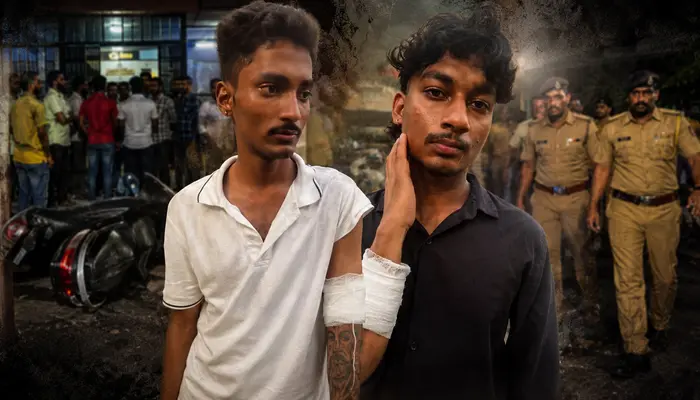
Case Summary
Two Hindu men were brutally assaulted and attacked by a group of Christian individuals after they noticed their tattoos depicting the sacred Om symbol and Chhatrapati Shivaji Maharaj. The incident happened near the Bhayandar West police outpost in Mira Bhayandar, Maharashtra, where the two Hindu men were beaten and seriously injured by Christian perpetrators. In the viral video, the victims stated that they went shopping, during which their vehicle was stopped by Christian individuals. Subsequently, the Hindu men were attacked and struck repeatedly; a scooter or vehicle was thrown at them during the assault, and they sustained severe injuries including heavily bandaged arms, facial swelling, and bruising across their bodies. They were kept inside the police outpost while the attackers remained outside, and police personnel physically assaulted them. The incident occurred amidst tensions over a large religious-conversion gathering in the Bhayandar area. Members of a local Hindu organisation assembled after receiving reports that a gathering of approximately 1500-2000 people was taking place for religious conversion. A confrontation broke out between organisation members and attendees, and the dispute later escalated at the Bhayandar Police Station.
Why it is Hate Crime ?
The selected primary category in this case is: Attack not resulting in death, with the subcategory selected as: Attacked for Hindu identity In several cases, Hindus are attacked merely for their Hindu identity without any perceived provocation. A classic example of this category of religiously motivated hate crime is a murder in 2016. 7 ISIS terrorists were convicted for shooting a school principal in Kanpur because they got ‘triggered’ seeing the Kalava on his wrist and the tilak that he had put. In this, the Hindu victim had offered no provocation except for his Hindu religious identity. The motivation for the murder was purely religious, driven by religious supremacy. Such cases where Hindus are targeted merely for their religious identity would be documented as hate crimes under this category. In this case, the brutal assault on two Hindu men by Christian individuals in Mira Bhayandar, Maharashtra, for overtly expressing their religious identity through sacred tattoos of the Om symbol and Chhatrapati Shivaji Maharaj, is a clear indicator of deep-seated religious intolerance towards Hindus. This case indicates a deliberate attempt to intimidate and suppress visible expressions of Hinduism. The Om (ॐ) symbol is one of the most sacred symbols in Hinduism and is regarded as the primordial sound of the universe, representing spiritual consciousness, creation, and divine presence. It is widely used in prayers, meditation, and religious rituals. On the other hand, Chhatrapati Shivaji Maharaj is widely acknowledged as one of the greatest Hindu rulers and a civilisational icon who upheld Dharma during a period of sustained conflict. He is remembered for defending Hindu places of worship, protecting his kingdom against multiple invading powers, and refusing to abandon his faith despite immense political and military pressure. For generations of Hindus, he has remained a source of inspiration for preserving Hindu identity, resisting religious oppression, and upholding Dharma. Thus, targeting individuals for wearing these symbols on their bodies signifies an attack not just on personal freedom but on collective Hindu cultural identity. The assault was directly triggered by the attackers' aversion to Hindu religious symbols, indicating a premeditated intent to harm Hindu faith. The severity and public nature of the violence create fear among Hindus about expressing their beliefs openly. The perpetrators' mindset behind this attack reveals several disturbing elements. The conversion gathering itself represents a supplanting of native faiths with Christianity, often using coercive means. The incident is not merely a physical assault but an attack directed at their visible Hindu identity. The two men were targeted after their Om tattoo and the tattoo of Chhatrapati Shivaji Maharaj were noticed. These symbols are seen as explicit markers of Hindu faith and cultural identity, and the assault is motivated by hostility toward those symbols rather than by a random or personal dispute. The selection of the victims based on religious and civilizational markers is what gives the incident the character of a hate crime. If individuals are attacked because they display Hindu religious symbols, express Hindu beliefs, or publicly identify as Hindu, then the violence targets a protected aspect of their identity. The motive, rather than the severity of the injuries alone, is considered the defining feature of a hate-based attack on Hindus. The brutality of the assault, including that the victims were beaten, a scooter or vehicle was thrown at them, and they suffered serious injuries, reinforces that the violence was intended to terrorise rather than merely injure. Such violence can create fear among other Hindus who openly display religious symbols, tattoos, pendants, flags, or other visible expressions of faith. The incident is presented as part of a broader concern about the safety of Hindus who visibly express their religious identity in public. The Hindu individuals were attacked because of an Om tattoo or Shivaji Maharaj tattoo; thus, the incident represents an attack on Hindu identity itself rather than only a criminal assault.
Victim Details
Total Victim
2
Deceased
0
Gender
- Male 2
- Female 0
- Third Gender 0
- Unknown 0
Caste
- SC/ST 0
- OBC 0
- General 0
- Unknown 2
Age Group
- Minor 0
- Adult 0
- Senior Citizen 0
- Unknown 2


Case Status
Unknown


Perpetrators Details
Perpetrators
Christian Extremists
Perpetrators Range
Unknown
Perpetrators Gender
unknown
 Sources




