Hindu devotees attacked and assaulted, vehicle vandalised while travelling to the Sri Sri Radha-Gobinda and Kali temple in Gaibandha, Bangladesh
 Gaibandha District, Bangladesh
  13 July, 2026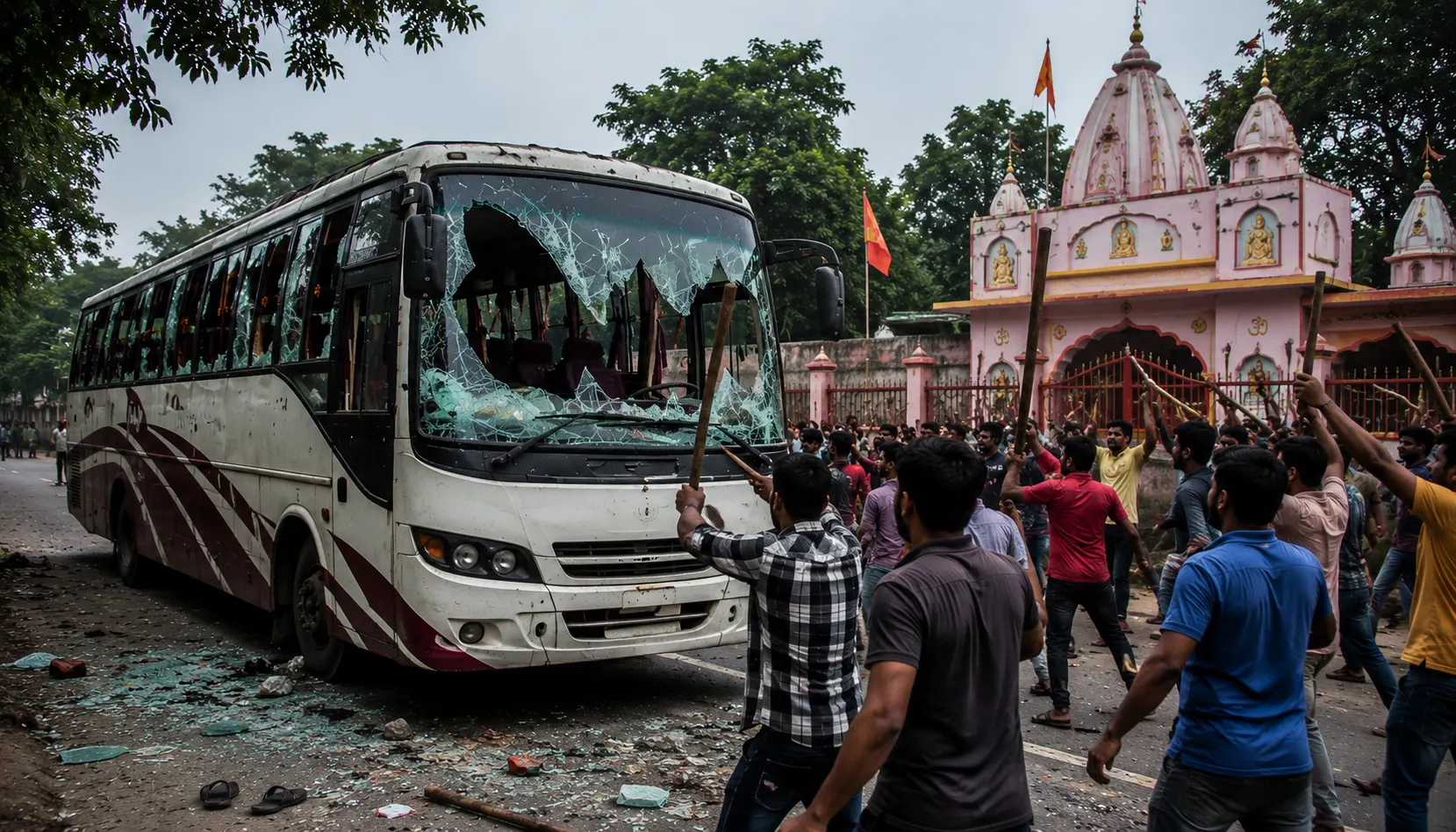
Case Summary
In Gaibandha, Bangladesh, a group of Hindu devotees travelling to the Sri Sri Radha-Gobinda and Kali Temple were attacked while on their way to the temple for worship. According to reports, a group of Muslims intercepted the bus carrying the devotees, shouted provocative slogans, vandalised the vehicle, and physically assaulted several passengers. The attack left multiple devotees injured, some of whom sustained serious injuries and were admitted to a local hospital for treatment. The report states that police reached the scene after the incident, but many of the attackers had already fled before law enforcement arrived. No information was provided regarding arrests, the identities of the attackers, or the registration of a criminal case. One injured devotee stated that repeated attacks have left many Hindu families living in fear and have contributed to social instability. Human rights activists quoted in the article emphasised that expressions of concern alone are inadequate and called for effective security measures, prompt investigations, accountability for perpetrators, and stronger legal protections to safeguard minority communities and prevent similar incidents in the future. This incident is not an isolated incident, but a part of the organised hostility directed against the Ram statue project in Bangladesh's Gaibandha district, which has been halted following pressure from the Muslim community and various Islamist organisations within the country. In the months preceding the Rath Yatra, the Hinduphobia Tracker documented a sustained campaign against the construction of the 82-foot idol of Bhagwan Shri Ram and the Sanatan Complex at the Shri Shri Radha Govinda and Kali Temple in Palashbari. In earlier incidents linked to the same controversy, radical Islamist figures publicly called for the desecration and demolition of the under-construction idol of Bhagwan Shri Ram and the temple complex itself. The present call to attack the Rath Yatra, therefore, represented a continuation of this broader campaign directed against Hindu places of worship, Hindu religious symbols, and the public manifestation of the Hindu faith. The events occurred against the backdrop of escalating hostility towards Hindus in Bangladesh. This escalation of violence against Hindus in Bangladesh has unfolded in three distinct phases: first, following the ouster of Sheikh Hasina's government in August 2024; second, after the death of Sharif Osman Bin Hadi in December 2025; and third, in the immediate aftermath of the 13th National Parliamentary Election in 2026. Following the ouster of Sheikh Hasina, multiple reports documented attacks on Hindu homes, temples, and religious institutions, alongside intimidation campaigns, arson, and mob assaults targeting minority neighbourhoods. The Hinduphobia Tracker recorded 336 such incidents against the Hindu minority, underscoring the scale and persistence of anti-Hindu violence during this period. A further escalation occurred following the death of Sharif Osman Bin Hadi, a Muslim political activist and student leader known for his anti-Hindu and anti-India rhetoric. Hadi had been involved in political unrest after the fall of the Hasina government and was killed in Dhaka on 18th December 2025 during clashes. In the aftermath of his death, Hindu communities were blamed and subsequently targeted in retaliatory violence. Hindu homes were selectively set ablaze in multiple localities, forcing families to flee and leaving many displaced. The attacks appeared patterned rather than sporadic, with Muslim mobs focusing on Hindu neighbourhoods, properties, and religious symbols. Among the victims was Dipu Chandra Das, who was lynched to death and his body was set ablaze by a Muslim mob over false blasphemy allegations. The Hinduphobia Tracker documented 51 incidents of anti-Hindu violence in the period following Hadi's death alone. Reports further indicated that posters and written materials calling for the extermination of Hindus were displayed in public spaces. Alongside incidents of arson, vandalism, assault, intimidation, and organised anti-Hindu mobilisation, these developments contributed to a climate of increasing insecurity for the Hindu minority. The third phase of violence emerged after the 13th National Parliamentary Election in 2026. Within days of the announcement of results, Hindu families in districts including Noakhali, Rangpur, Nilphamari, Sylhet, Thakurgaon, and Dinajpur reported attacks involving arson, looting, assault, and vandalism of temples and homes. In several instances, Hindu homes were selectively targeted, looted, and families were threatened with displacement.
Why it is Hate Crime ?
The primary category for this case is: Attack not resulting in death. The subcategory for this case is "Attack against Hindu devotees." Hindu devotees are among the easiest targets of religiously motivated hate crimes because, during the festival/procession/puja, etc, for non-Hindus it is easy to profile their victims based on religion. Hindu devotees come under attack on several occasions by individual non-Hindus or mobs of non-Hindus owing to their animosity against Hinduism, its symbols and tradition/practices. There are several instances of Hindu devotees being attacked while they worship in temples or temporary religious structures, during religious processions, doing bhajan/kirtan/puja in their own homes, in the residential society, etc. These attacks are perpetrated by non-Hindus primarily because of their animosity towards Hindus and their faith. In some cases, the trigger for the violence may be non-religious; however, two elements make these hate crimes. First, the Hindus who come under attack are attacked violently while indulging in religious activity. Whether they are in a place of worship or not is immaterial to the crime. When individuals are attacked while indulging in religious practices, the attack in itself is a hindrance to their freedom to practice religion and therefore constitutes a hate crime. Secondly, religious supremacist doctrines and ideologies deem religious practices of Hindus to be offensive ab initio since they are considered “sinful” by these ideologies, worthy to be annihilated by force or coercion. Driven by these religious supremacist ideologies and doctrines, the attacks against Hindu devotees stem from intrinsic animosity towards Hinduism. In some cases, the trigger for the violence may be non-religious; however, it develops into a religiously motivated crime during the course of the violence. Since these attacks stem from animosity towards Hindus and Hinduism, they are considered religiously motivated hate crimes under this category. The attack bears the clear markers of a religiously motivated hate crime. The victims were not targeted at random but because they were Hindu devotees travelling to the Sri Sri Radha-Gobinda and Kali Temple to offer prayers. Intercepting a vehicle carrying worshippers, vandalising it, and assaulting its passengers was not simply an act of public violence but a direct attempt to intimidate Hindus while they were exercising their religious beliefs. Such attacks undermine the community's ability to freely assemble for worship and create fear around the public observance of Hindu religious practices. Another important aspect is that the attack was completely unprovoked. The Hindus did nothing but were peacefully going to the temple when they were targeted. The unprovoked attack was driven by intrinsic and doctrinal religious animosity, which stemmed from the fact that the Hindu devotees were trying to exercise their religious rights in a Muslim-majority country, which has a history of hostility towards non-muslims, especially Hindus. In countries with a majority Muslim population, Hindus often face hostility since the tenets of Islam harbour antagonism towards the Hindu faith and the adherents of Hinduism. Such religious and doctrinal animosity manifests in violence against Hindu devotees when Hindus dare to follow their faith. Further, the circumstances of the attack demonstrate that the violence formed part of a broader campaign directed against the Shri Shri Radha-Gobinda and Kali Temple in Palashbari, Gaibandha. The temple has already been at the centre of sustained Islamist opposition over the proposed construction of the 82-foot idol of Bhagwan Shri Ram and the Sanatan Complex. In the months preceding this incident, Hinduphobia Tracker documented repeated calls by radical Islamist figures to halt the project, demolish the under-construction idol, and desecrate the temple complex. Against this backdrop, the assault on devotees travelling to the same temple cannot be viewed as an isolated act of violence. It reflects a continuation of organised hostility towards Hindu places of worship and the public manifestation of Hindu faith. By targeting devotees on their way to worship, the perpetrators sought to intimidate Hindus, discourage participation in religious activities, and reinforce the message that open expressions of Hindu identity would be met with hostility and violence. The fact that this incident occurred in Bangladesh is also significant. Hindus constitute a religious minority in the country and have faced a sustained pattern of targeted violence, intimidation, and discrimination, particularly since the ouster of Sheikh Hasina's government in August 2024. Hinduphobia Tracker documented 336 incidents during the first wave of anti-Hindu violence, followed by 51 additional incidents after the death of Sharif Osman Bin Hadi in December 2025. A third wave emerged after the 2026 parliamentary elections, during which Hindu homes, temples, businesses, and religious gatherings were again subjected to arson, looting, vandalism, and assault across multiple districts. Viewed against this continuing pattern of persecution, the assault on Hindu devotees travelling for worship reflects the broader climate of religious intolerance and insecurity confronting the Hindu minority in Bangladesh. Rather than an isolated episode of violence, it exemplifies a sustained pattern in which Hindu religious institutions, symbols, festivals, and devotees are repeatedly targeted because of their religious identity. Since the violence was a product of religious animosity, this case is being categorised as a religiously motivated hate crime. Disclaimer: This case has been documented on the Hinduphobia Tracker based on the available report on Hindus News, Bangladesh. The identities of the attackers have not been officially established at the time of publication. Keeping in mind that the Hindu devotees were attacked by extremists in Bangladesh for their religious beliefs, it is accurate to establish that the perpetrators were of the Abrahamic/Islamic beliefs. Many such cases in the post-Sheikh Hasina regime, which resulted in the never-ending brutalities against the minority Hindu community of Bangladesh, have been explicitly recorded in the Hinduphobia tracker and can act as a reference to the violence and gore happening in the state by the Muslim extremists.


Case Status
Unknown


Perpetrators Details
Perpetrators
Muslim Extremists
Perpetrators Range
Unknown
Perpetrators Gender
unknown
 Sources




