Massacre of Hindus in Pahalgam terror attack celebrated by Muslim man; accused called for Islamisation of Kashmir and violence against Hindu community
 Malappuram, Kerala, India
  4 July, 2026
Case Summary
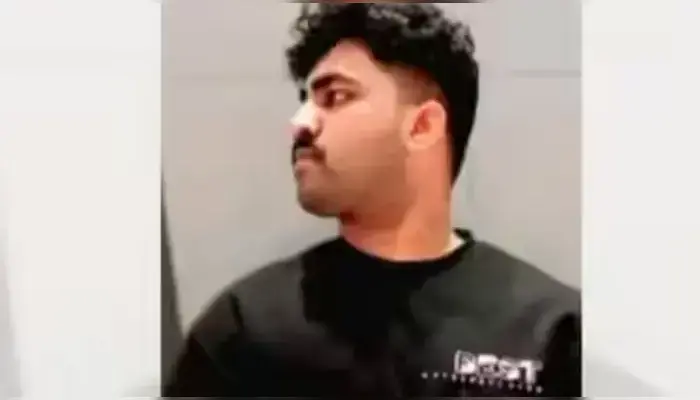
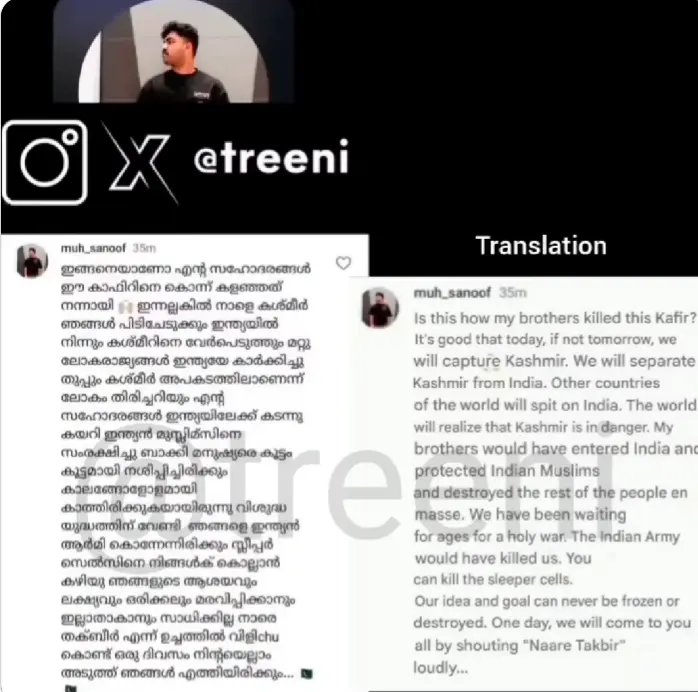
In Kerala, deep-rooted hatred towards Hindus was on display when a Muslim man celebrated the massacre of Hindus in the Pahalgam terror attack carried out by Islamic terrorists. He called for the Islamisation of Kashmir and invoked Islamic brotherhood while endorsing the killing of non-Muslims, particularly Hindus, in India. In a horrific act of terror in the Baisaran Valley of Pahalgam, Anantnag district, Jammu and Kashmir, on 22 April 2025, Islamic terrorists systematically identified and targeted Hindu victims. The terrorists demanded names and religious identities, inspected identity cards, coerced tourists to recite the Kalma, and even forcibly pulled down their trousers to check for circumcision, all to single out non-Muslims. Once identified, the Hindus were shot at point-blank range. The attack, carried out by Islamic terrorists of The Resistance Front, a proxy of the Pakistan-based Islamic terrorist organisation Lashkar e Taiba, claimed the lives of 24 Hindu tourists and one local resident, while leaving several others critically injured. Following the Pahalgam terror attack, several Muslims publicly celebrated the massacre of Hindus. One such case involved a Muslim man named Muhammad Sanoof, a native of Aikkarappadi in Kerala's Malappuram district. The case stemmed from comments posted by Sanoof under a social media post made by the daughter of N. Ramachandran, one of the Hindu victims of the Pahalgam terror attack. According to the police, Sanoof's comments justified and celebrated the attack carried out by Islamic terrorists in which Hindu tourists were singled out and murdered. Screenshots of his comments went viral on social media. In the comments, he wrote: "Is this how my brothers killed this Kafir? It's good that today, if not tomorrow, we will capture Kashmir. We will separate Kashmir from India. Other countries of the world will spit on India. The world will realise that Kashmir is in danger. My brothers (terrorists) would have entered India, protected Indian Muslims and destroyed the rest of the people en masse. We have been waiting for ages for a holy war. The Indian Army would have killed us. You can kill the sleeper cells. Our idea and goal can never be frozen or destroyed. One day, we will come to you all by shouting 'Naare Takbir' loudly." Following the circulation of the screenshots, a leader of the Bharatiya Janata Yuva Morcha filed a complaint, based on which a First Information Report was registered against Sanoof. On the basis of a lookout circular issued against him in 2025, Sanoof was detained upon his arrival from Saudi Arabia at Karipur Airport in Kozhikode on 5 July 2026 and was subsequently arrested. Officials at the Muttam Police Station questioned Sanoof, examined his mobile phone, and invoked provisions of the Unlawful Activities (Prevention) Act (UAPA). Besides the provisions of the UAPA, Sanoof was also booked for promoting enmity between different religious groups. He was remanded to judicial custody. The police stated that they would seek his custodial interrogation and added that the investigation could later be transferred to either the Crime Branch or the Anti Terrorism Squad. Reacting to the arrest, Rajeev Chandrasekhar, President of the Bharatiya Janata Party in Kerala, questioned how "a young Malayali gets brainwashed into celebrating the brutal, cold-blooded murder of a fellow Keralite in the Pahalgam terror attack." Calling the arrest a "wake-up call", Chandrasekhar said that the incident was not an isolated case but the result of "years of Muslim appeasement, radicalisation and Congress Communist Party of India (Marxist)'s political hypocrisy." He further stated that Kerala's future lay in "deeper integration with India's growth story" and called for an end to what he termed "dangerous politics" in favour of the "politics of performance."
Case Images
Why it is Hate Crime ?
This case is categorised under the primary category- Hate Speech against Hindus. Under that, the relevant sub-category is- Denial or mocking of genocide/large-scale persecution. Denial or mocking of genocide/large-scale persecution/ethnic cleansing refers to the act of denying or minimizing the fact of the ethnic cleansing and/or genocide and/or religious persecution of Hindus. This often involves denying the scale, mechanisms, religious intent, or even the occurrence of the ethnic cleansing and/or genocide and/or religious persecution of Hindus. Hate speech of this kind involves the dissemination of falsehoods that deny or distort established historical facts or mock the suffering of Hindus by saying that they deserved the persecution, motivated by Hinduphobia. Denying such atrocities is not only about the denial of facts or rewriting/revising history, but it also delegitimises the religiously motivated persecution of Hindus, the religious hate/motivation/animosity that led to the persecution, and dehumanises Hindus as a religious group. Such denial of ethnic cleansing and/or genocide and/or religious persecution of Hindus not only denies the suffering but also paves the way for future/present atrocities and hate speech, inciting prejudice and violence against Hindus. It also provides a justification for violence by delinking religious animosity from religiously motivated crimes committed against Hindus. Since such denial and/or mocking of genocide/ethnic cleansing/atrocities motivated by religious animosity leads to present and future ramifications of creating more hate speech, violence, dehumanisation and delegitimisation, it would be considered hate speech under this category. The other relevant sub-category is- Violent threats. Violent threats, explicit, implicit or implied, is the most dangerous form of hate speech since it goes beyond discriminatory and prejudicial language to express the intent of causing harm to an individual or a group of people based on their religious identity and faith. There could be several different kinds of threats that are issued to Hindus based on religious animosity. An explicit threat would mean the direct threat of violence towards an individual Hindu, a group of Hindus or Hindus at large. Physical violence, death threats, threats of destruction of property belonging to Hindus and threats of genocide would mean explicit threats against Hindus for their religious identity. Implicit threats may not be a direct threat but implied through the use of symbols of actions – for example – in the Nupur Sharma case, other than explicit threats, there were also implicit threats when Islamists took to the streets to burn and beat her effigies. It implies that they want to do the same to Nupur Sharma – thereby is considered an implicit threat. Violent threats can be delivered in person, through letters, phone calls, graffiti, or increasingly through social media and other online platforms. It would be important to understand that a threat – explicit or implicit, online or offline – to an individual who happens to be a Hindu does not qualify as a religiously motivated threat. Such a threat, while vile and dangerous, could be owing to non-religious reasons and/or personal animosity. To qualify as a religiously motivated threat, it would need to exhibit an indication that the individual is being targeted for religious reasons and/or owing to his/her religious identity as a Hindu. The other subcategory selected is: Anti-Hindu slurs, mocking faith. Anti-Hindu slurs and the deliberate mocking of the Hindu faith owing to religious animosity involve the usage of derogatory terms, stereotypes, or offensive references to religious practices, symbols, or figures. One of the common anti-Hindu slurs used against Hindus is “cow-worshipper” and “cow piss drinker”. The intention of using this term is to demean and mock Hindus as a group and their religious beliefs since Hindus consider the cow holy. Additionally, some symbols and the slurs attached to them have a historical context that exacerbates the insult, hate, stereotyping, dehumanisation and oppression against Hindus. Cow worship has been used for centuries to denigrate Hindus, insult their faith and oppress Hindus specifically as a religious group. There has been overwhelming documentation about how cow slaughter has been used to persecute Hindus with cow meat being thrown in temples and places of worship. There has also been overwhelming documentation where cow meat (beef) has been force-fed to Hindus to either forcefully convert them to Islam or denigrate their faith. Apart from cow worship, the Swastika – which holds deep religious significance for the Hindus – has also been misinterpreted and distorted to use as a slur against Hindus. Similarly, the worship of the Shivling has been used by supremacist ideologies and religions to denigrate Hindus owing to religious animosity. Such slurs and denigration stem out of inherent animosity and hate towards Hindus and their faith, therefore, it is categorised as hate speech targeted at Hindus specifically owing to their religious identity. This case constitutes a clear example of a religiously motivated hate incident because the accused publicly celebrated and justified the Pahalgam terror attack, an attack in which Islamic terrorists selectively identified Hindu victims on the basis of their religious identity before killing them. The attack was directed at Hindu tourists after they were subjected to religious profiling through demands for their names, religious identity, identity documents, recitation of the Kalma, and checks for circumcision. By expressing approval for an attack in which individuals were targeted because they were Hindus, the accused demonstrated support for violence directed at a community on the basis of its religion. Rather than condemning the religiously targeted killings, he praised them and referred to the victims as "kafirs", indicating that the victims' religious identity formed the basis of his approval of the violence. His statements, therefore, endorsed and celebrated the violence against Hindus because they were Hindus, making this a clear instance of religiously motivated hate speech. In this context, the accused’s specific usage of the term "kafir" (infidel) while celebrating the massacre of Hindus in the Pahalgam terror attack serves as an explicit manifestation of deep-seated religious hostility. Within this framework, the term functions as a highly derogatory anti-Hindu slur, stripped of any abstract theological nuance and deployed purposefully to dehumanise the victims on account of their faith. By branding the victims as "kafirs" amidst the glorification of a deadly attack, the perpetrator actively operationalises this theological categorisation into an act of violent "othering". This rhetoric establishes a clear hierarchy where the Hindu community is not merely viewed as different, but is explicitly cast as an existential enemy stripped of human worth, whose elimination is justified. Ultimately, the deployment of this language in the immediate aftermath of a massacre demonstrates that the perpetrator views Hindus through a lens of absolute religious animosity, categorising an entire community as a collectivity inherently deserving of violence and death. The accused did not merely express support for the terrorist attack. His comments also called for the Islamisation of Kashmir and the separation of Kashmir from India. Kashmir occupies a central place in Hindu civilisation and history. It has been an important centre of Hindu philosophy, learning, and spirituality for centuries and is associated with numerous ancient temples, pilgrimage sites, and the indigenous Kashmiri Pandit community, whose presence in the region stretches back many centuries. The accused's endorsement of the Islamisation of Kashmir, viewed alongside his celebration of the massacre of Hindus in Pahalgam, conveyed support for replacing the region's historic Hindu heritage with exclusive Islamic dominance. Read in its entirety, his statements reflected hostility towards the continued presence, identity, and heritage of Hindus in Kashmir and reinforced the religious nature of his comments. The accused also described the terrorists responsible for the Pahalgam attack as "my brothers" and stated that they would come to India to protect Indian Muslims while killing the remaining population, particularly Hindus. In doing so, he openly expressed solidarity with those who had carried out an attack targeting Hindus because of their religion. His repeated identification with the perpetrators, endorsement of their actions, and support for further violence against non-Muslims, particularly Hindus, demonstrated ideological affinity with those responsible for the attack. These statements extended beyond praise for a past incident and expressed approval for further religiously targeted violence, strengthening the conclusion that the hostility expressed was directed at people on the basis of their Hindu identity. It is also important to note that the accused's decision to call the terrorists his brothers is rooted in a specific religious and ideological framework. Muslim extremists harbour a distinct animosity towards Hindus and their faith, viewing India as a Hindu collectivity. Indeed, the very basis for the partition of India and the creation of Pakistan was the belief among pan-Islamists and common Muslims that they constituted a distinct nation that could not coexist within a Hindu-majority collectivity like India. Furthermore, this ideology is reinforced by the concept of transnational unity, or the Ummah (the global Muslim brotherhood), the belief that all Muslims worldwide form a single, borderless nation. Consequently, under this doctrine, political and religious loyalty belongs strictly to the Islamic collectivity rather than to a Hindu majority nation-state like India. Against this backdrop, the perpetrator's allegiance to the Islamic terrorists behind the Pahalgam attack, and his reference to them as his brothers, clearly stems from deeply held religious and ideological motivations. It demonstrates explicit support for acts of terror targeting Hindus on account of their faith. Within this framework, any expression of allegiance to the Ummah concept becomes inherently anti-Hindu, as it systematically 'otherises' Hindus, casting them as eternal enemies who are deemed deserving of death. This was not the first instance in which the Pahalgam terror attack or its Hindu victims were mocked, the massacre was justified, or support was openly expressed for the perpetrators. The Hinduphobia Tracker has previously documented 62 incidents of hate speech targeting the Hindu victims of the Pahalgam terror attack. These incidents included the justification and glorification of the massacre of Hindus, attempts to whitewash or downplay the religiously targeted nature of the attack, instances in which the killings were celebrated, as well as multiple cases in which several Muslim individuals publicly expressed support for Pakistan in the aftermath of the attack, and even attacked Hindus who condemned the terror attack. For example, following the Pahalgam terror attack, three Muslim men in Indore, Madhya Pradesh, raised "Pakistan Zindabad" slogans and threatened that India would be destroyed overnight. The incident occurred amid heightened tensions between India and Pakistan. One of the three accused was identified as Mohammad Javed. Similarly, in another incident, a Muslim youth named Aman, who ran a barber shop in Kheda village of Pilkhuwa, Uttar Pradesh, justified the Pahalgam terror attack. In a video that went viral on social media, Aman stated that those killed in the terrorist attack deserved their fate. The video triggered widespread public outrage. Similarly, in Hasangarh village of Aligarh district, Uttar Pradesh, a 19-year-old Muslim man named Faizan Khan posted a comment reading "Pakistan Zindabad" along with Pakistani flag emojis on Instagram. The comment was posted during heightened tensions between India and Pakistan following the anti-Hindu Pahalgam terror attack. Therefore, the present case forms part of this broader documented pattern of hate speech directed at the Hindu victims of the Pahalgam terror attack. Rather than being an isolated instance, it reflects a recurring trend in which the religiously targeted massacre of Hindus was celebrated, justified, or trivialised, while support was expressed for the Islamic terrorists responsible for the attack. Such repeated expressions of approval for violence against Hindus because of their religious identity contribute to a wider pattern of anti-Hindu hate speech and reinforce the communal hostility that followed the Pahalgam terror attack. Taken together, the accused's celebration of the selective killing of Hindus, his endorsement of the ideology of the perpetrators, his references to the victims as "kafirs", his call for the Islamisation of Kashmir, and his support for further violence against Hindus collectively demonstrate religious hostility directed at the Hindu community. Therefore, this case satisfies the parameters for inclusion in the Hinduphobia Tracker's hate crime database. Disclaimer: The Hinduphobia Tracker records incident dates based on when the crime occurs rather than when it is reported by the media. However, in this case, media reports have not stated the exact date on which the accused made the comments. Hence, 5 July 2026, the date on which the accused was arrested, has been selected as the indicative incident date. This date is recorded for documentation purposes only.


Case Status
Arrested


Perpetrators Details
Perpetrators
Muslim Extremists
Perpetrators Range
One Person
Perpetrators Gender
male
 Sources




