Hindu family assaulted, pregnant woman kicked, and casteist abuse hurled by armed Muslims over a minor dispute in Begumpur, Delhi
 Rohini, Delhi, India
  29 June, 2026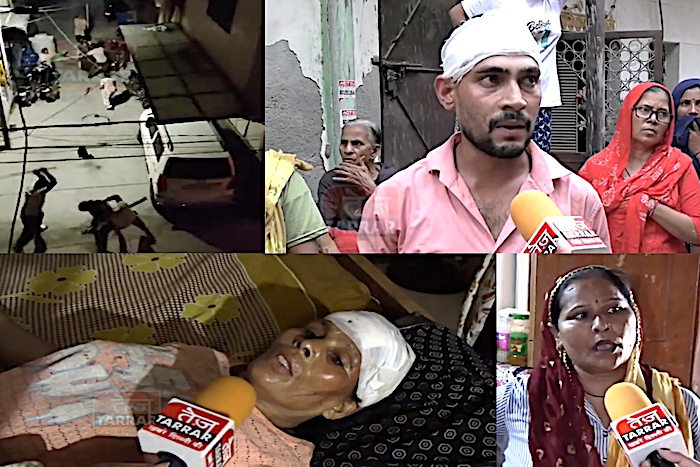
Case Summary
In Begumpur, Delhi, a Hindu family belonging to the Dalit community, including a woman who was nine-and-a-half months pregnant, was violently assaulted by members of a neighbouring Muslim family. Before the assault, the victims were subjected to casteist abuse with slurs such as “Chamaari”. The attack occurred over a minor dispute after the Hindu family intervened to protect a five-year-old Hindu girl from being attacked by one of the Muslim family's pet dogs. During the assault, the pregnant Hindu woman was kicked and beaten on her stomach with sticks, while other members of her family, including her mother-in-law, husband and relatives, were also brutally attacked with lathis, iron rods, sticks, bricks and stones. The victims stated that the Muslim family had routinely targeted them with casteist slurs, intimidated other Hindu residents, disrupted Hindu religious programmes, and invoked their religious identity during previous disputes. The incident occurred in Begum Vihar under the jurisdiction of Begumpur Police Station in Delhi. According to the injured family and eyewitnesses, the Muslim family, headed by Dilshad, kept several pet dogs outside their residence. Local Hindu residents stated that the dogs frequently chased and attacked children in the locality and that complaints had previously been raised regarding the issue. On the day of the incident, one of the dogs rushed towards a five-year-old Hindu girl. The child's mother objected and attempted to drive the dog away to protect her. This immediately led to a confrontation with members of the Muslim family, who abused the Hindu family using casteist slurs, including “Chamaari”, before launching a physical assault. As the argument escalated, members of the Muslim family emerged carrying sticks and began assaulting the Hindu family. The pregnant Hindu woman, who was approximately nine-and-a-half months pregnant, came outside after witnessing the dog attack. She was struck repeatedly with sticks, sustaining injuries that required multiple stitches. Witnesses and family members stated that she was also kicked and beaten on her stomach despite her advanced pregnancy, raising concerns about the safety of her unborn child. When the pregnant woman's mother-in-law attempted to shield her, she too was attacked by all five members of the Muslim family. The elderly woman was beaten until she lost consciousness, yet the assault continued even after she had fallen to the ground. The family's son and other relatives who rushed to intervene were similarly attacked with sticks and iron rods. Multiple neighbours stated that anyone attempting to rescue the victims was assaulted in the same manner. Eyewitnesses stated that bricks and stones were thrown from the roof of the Muslim family's house during the attack, resulting in further injuries. Blood was seen across the street where the victims had collapsed. One neighbour who attempted to help lift the injured woman stated that his clothes became soaked in her blood while stones continued to be hurled from above. Several local residents also sustained injuries while attempting to intervene. The injured family stated that four members of their household suffered serious injuries, including the pregnant woman, another daughter-in-law, the elderly mother and the son. The victims were initially taken for medical treatment before being transferred to the hospital for further care. The pregnant woman's condition was described as serious due to the blows inflicted on her abdomen and head. During interviews following the incident, the victims and several neighbours described a prolonged pattern of harassment by the Muslim family. Residents stated that Dalit Hindu families were routinely abused using casteist slurs such as “Chamaari”, “Chamar” and “Chuhre”. They further stated that the family objected to Hindu religious activities, including Ganesh Puja, bhajan, kirtan, jagran and bhandara, repeatedly complained to the authorities to disrupt such programmes, intimidated residents from celebrating Hindu festivals, and frequently invoked their Muslim identity during disputes. Neighbours stated that the family had created an atmosphere of fear in the locality for several years. Local Hindu residents also stated that they had repeatedly complained about the family's dogs and previous incidents of violence, but the problem had persisted. They further stated that the Muslim family had a history of violent altercations with multiple households in the locality and that several earlier complaints had been lodged. According to the victims, the family kept sticks, iron rods, bricks and other objects at their residence, which were used during the assault. Several eyewitnesses criticised the police response, stating that repeated emergency calls were made while the victims lay bleeding on the road, but the police and ambulance services arrived after a significant delay. Residents stated that Begumpur Police Station was located only a short distance away, yet assistance did not reach the scene promptly. They further stated that the delay forced neighbours to transport the injured to the hospital themselves. Following the incident, local residents gathered outside Begumpur Police Station demanding strict action against those involved. The police subsequently detained five members of the Muslim family, comprising three men and two women, and initiated legal proceedings. The investigation into the incident remained ongoing.
Why it is Hate Crime ?
This case has been added to the tracker under the primary category - Attack resulting in death. Within this, the subcategory is - Communal clash/attack. Communal clash is a form of collective violence that involves clashes between groups belonging to different religious identities. For a communal clash between Hindus and non-Hindus to qualify as a religiously motivated hate crime, the trigger of the violence itself would have to be anti-Hindu in essence. For example, if there is a Hindu religious procession that comes under attack from a non-Hindu mob and after the initial attack, Hindus retaliate in self-defence, leading to a communal clash between the two religious communities. While at a later stage, both communities are involved in the clash/violence, the initial trigger of the violence was by the non-Hindu mob against the Hindus and therefore, it could safely be termed as an anti-Hindu violence. Further, the trigger would also have to be religiously motivated. In the cited example, the attack by the non-Hindu mob was against religious processions and therefore, can be concluded to be religiously motivated. In some cases, the trigger may be non-religious, however, it develops into religious violence against Hindus at a later stage. In such cases too, the foundational animosity towards Hindus becomes the motivating factor of the crime and therefore, it would be classified as a religiously motivated hate crime against Hindus under this category. The other subcategory selected for this case is - Attacked for opposing radicals or trying to save a victim. In several cases, Hindus are attacked for opposing religiously motivated crimes being committed against a fellow Hindu or simply for voicing an opinion opposing radical elements, who either have in the past or continue to persecute Hindus. In such cases, the initial attack against the victim, against which the Hindu was trying to defend the victim, would also need to be classified as a religiously motivated hate crime. Since the initial crime itself was religiously motivated and the subsequent crime of attempting to save the victim or speaking against the radical elements ends up inviting a violent attack, it would also be classified as a religiously motivated hate crime under this category. The other subcategory selected is: Attacked for Hindu identity. In several cases, Hindus are attacked merely for their Hindu identity without any perceived provocation. A classic example of this category of religiously motivated hate crime is a murder in 2016. 7 ISIS terrorists were convicted for shooting a school principal in Kanpur because they got ‘triggered’ seeing the Kalava on his wrist and tilak that he had put. In this, the Hindu victim had offered no provocation except for his Hindu religious identity. The motivation for the murder was purely religious, driven by religious supremacy. Such cases where Hindus are targeted merely for their religious identity would be documented as a hate crime under this category. Another primary category selected for this case is - Hate speech against Hindus. The selected subcategory is - Anti-Hindu slurs, mocking faith. Anti-Hindu slurs and the deliberate mocking of the Hindu faith owing to religious animosity involve the usage of derogatory terms, stereotypes, or offensive references to religious practices, symbols, or figures. One of the common anti-Hindu slurs used against Hindus is “cow-worshipper” and “cow piss drinker”. The intention of using this term is to demean and mock Hindus as a group and their religious beliefs since Hindus consider the cow holy. Additionally, some symbols and the slurs attached to them have a historical context that exacerbates the insult, hate, stereotyping, dehumanisation and oppression against Hindus. Cow worship has been used for centuries to denigrate Hindus, insult their faith and oppress Hindus specifically as a religious group. There has been overwhelming documentation about how cow slaughter has been used to persecute Hindus with cow meat being thrown in temples and places of worship. There has also been overwhelming documentation where cow meat (beef) has been force-fed to Hindus to either forcefully convert them to Islam or denigrate their faith. Apart from cow worship, the Swastika – which holds deep religious significance for the Hindus – has also been misinterpreted and distorted to use as a slur against Hindus. Similarly, the worship of the Shivling has been used by supremacist ideologies and religions to denigrate Hindus owing to religious animosity. Such slurs and denigration stem out of inherent animosity and hate towards Hindus and their faith, therefore, it is categorised as hate speech targeted at Hindus specifically owing to their religious identity. This incident has been categorised as a hate crime due to the communal nature of the violence and the grossly disproportionate, religion-driven response by the Muslim perpetrators. The dispute itself was trivial and arose after the Hindu family intervened to protect a five-year-old Hindu girl from being attacked by one of the Muslim family's pet dogs. Such neighbourhood disagreements are common and are ordinarily resolved through dialogue. Instead, members of the Muslim family emerged armed with sticks, iron rods and other objects, launched a coordinated assault on the entire Hindu family, brutally attacked a woman who was nine-and-a-half months pregnant by kicking and beating her on the stomach, assaulted elderly family members and relatives who tried to intervene, and continued the attack by hurling bricks and stones from the roof. The scale and severity of the violence bore no reasonable relationship to the minor dispute that triggered it. This extreme and disproportionate response demonstrates that the assault was not a spontaneous outburst of anger but reflected deep-seated hostility towards the victims because they were Hindus. Such a severe escalation over a trivial issue reveals clear communal undertones and indicates that the Hindu identity of the victims played a significant role in motivating the attack, making it a religiously motivated hate crime. As seen in many previous cases of hate crimes against Hindus, the initial trigger is often non-religious. However, when perpetrators respond with grossly disproportionate violence against Hindus over minor disputes, it underscores the presence of religious prejudice and underlying communal tensions. Targeting individuals because they belong to a particular community is a defining characteristic of hate crimes. The manner in which the assault unfolded also indicates that it was not an impulsive reaction but a premeditated act of violence. Members of the Muslim family quickly emerged carrying sticks and iron rods, while bricks and stones were hurled from the roof of their house throughout the attack. According to the victims, such objects were already kept at the residence and were readily used during the assault. The immediate availability and coordinated use of multiple weapons against several members of the Hindu family point to prior preparedness rather than a spontaneous loss of temper. This level of preparedness, coupled with the sustained nature of the assault, demonstrates that the perpetrators were equipped and willing to inflict serious harm, reinforcing the conclusion that the attack was deliberate rather than an isolated moment of rage. Notably, to understand how minor disputes can escalate into identity-based communal violence, often leaving Hindus as victims, it is important to recall the 2019 Hauz Qazi incident. The incident illustrates how a seemingly ordinary, non-communal altercation escalated into a targeted communal attack once religious identity became the focal point. What began as a minor dispute over parking was rapidly transformed through mobilisation, rumour circulation, and identity-based consolidation into a large-scale attack directed at a Hindu locality and its place of worship. The congregation of a large mob at the entrance of the Hindu-dominated lane, the stone pelting, desecration of the Durga Mandir, and the targeting of residents indicate that the conflict was no longer about the original dispute but about asserting dominance over a religious minority within a Muslim-majority area. The shift was further evident in the use of religious slogans, the confinement of Hindus to a single lane, and allegations of repeated prior targeting, all of which pointed towards a pattern where demographic imbalance creates an environment of vulnerability. In such contexts, even trivial triggers can be communalised, with religious identity becoming the basis for collective mobilisation and violence, reflecting deeper underlying tensions and hostility that manifest when an opportunity arises. The Hinduphobia Tracker has documented numerous similar instances where communal attacks on Hindus began over non-religious disputes but quickly escalated, leaving Hindu victims seriously injured. For example, on 22nd June 2025, in Ghongade Basti, Solapur, Maharashtra, a Hindu man and his brother were brutally attacked by a Muslim mob following a minor road dispute. The incident quickly escalated into targeted communal violence against the local Hindu community. Another such instance occurred on 6th June 2025, in Kadabin Jinsi Haat Maidan, Indore, Madhya Pradesh, where a Dalit Hindu family was brutally attacked by a group of Muslims over a minor water dispute. The assailants also hurled caste-based slurs, and even women and a child were severely beaten. A similar case of communal attack occurred on 2nd June 2025, in Saraiya, Varanasi, Uttar Pradesh, a Dalit Hindu man named Vishal Sonkar was brutally assaulted by a group of Muslim youths after a minor disagreement over road space. He suffered severe head injuries from rods and sticks. The above-mentioned cases clearly demonstrate a pattern of attacks against Hindus. Even if the conflict is a result of a non-communal issue, it often takes on a communal nature where Hindus are frequently targeted and brutally attacked by a Muslim mob. These attacks are not random or spontaneous acts of violence. What happened in this case is part of a larger pattern where Hindus are targeted not just out of personal anger, but because of deep-rooted religious hatred and an Islamic supremacist mindset. In this current case, the religiously aggravating nature of the attack is also further strengthened by the casteist slurs directed at the Dalit Hindu victims, including the use of the term "Chamaari". It can be argued that such abuses were aimed at the victims' micro identity as members of the Dalit community rather than their Hindu identity itself. However, as far as hostility emanating from adherents of Abrahamic faiths towards Hindus is concerned, distinctions of caste, region, or language often become secondary, while the victim's broader Hindu identity remains central. In this case, the casteist insults were not used in isolation but formed part of a larger pattern of intimidation, violence, and humiliation directed at Hindu victims. The derogatory references to their Dalit background were employed to demean, subordinate, and degrade them for their Hindu identity. The slurs were therefore not merely personal insults but identity-based attacks aimed at a section of the Hindu community. When viewed alongside the subsequent assault on multiple members of the family, including a heavily pregnant woman, and the broader pattern of intimidation described by residents, the caste-based abuse demonstrates that the perpetrators targeted the victims not only as individuals but as Hindu Dalits whose identity was treated with contempt. Such acts are intended not only to harm the immediate Hindu victims but also to instil fear and hostility within the wider Hindu community. In this case, the assault did not occur in isolation but formed part of an established pattern of hostility directed at Hindus in the locality. The victims and local residents stated that the Muslim family had routinely subjected Hindus to casteist abuse, intimidated Hindu residents, obstructed and disrupted Hindu religious programmes such as Ganesh Puja, bhajan, kirtan, jagran and bhandara, discouraged the celebration of Hindu festivals, and repeatedly invoked their Muslim identity during disputes. The repeated targeting of Hindu religious practices and Hindu residents demonstrates that the hostility extended beyond personal disagreements and was directed at the victims because of their Hindu identity. Such sustained acts of intimidation and interference with the religious life of the Hindu community reflect identity-based targeting, which is a defining feature of hate crimes. Viewed in this broader context, the brutal assault was not merely an isolated act of violence but the culmination of an ongoing pattern of anti-Hindu hostility. The disproportionate and targeted nature of the attack, when considered alongside the previous harassment of Hindus in the locality, clearly indicates that this incident constitutes a hate crime against Hindus. Therefore, since this case meets several different parameters of a religiously motivated attack, it is being added to the hate crime database of the Hinduphobia Tracker. Disclaimer: The Hinduphobia Tracker records incident dates based on when a crime occurs rather than when it is reported in the media. However, in this case, the available media reports do not specify the exact date of the incident. Accordingly, the earliest date on which the incident was published in the media, 30th June 2026, has been adopted as the indicative incident date for documentation purposes only. The Hinduphobia Tracker also acknowledges that multiple members of the Hindu family were subjected to violence, intimidation, and identity-based abuse during this incident. However, as only the pregnant Hindu woman, her husband, her mother-in-law, and the five-year-old Hindu girl were explicitly identified as victims in the available reports, the victim count has been recorded as 4, while noting that several other unnamed relatives and family members were also subjected to physical assault, threats, and anti-Hindu abuse during the attack.
Victim Details
Total Victim
4
Deceased
0
Gender
- Male 1
- Female 3
- Third Gender 0
- Unknown 0
Caste
- SC/ST 4
- OBC 0
- General 0
- Unknown 0
Age Group
- Minor 1
- Adult 3
- Senior Citizen 0
- Unknown 0


Case Status
Complaint filed


Perpetrators Details
Perpetrators
Muslim Extremists
Perpetrators Range
From 2 To 5
Perpetrators Gender
both
 Sources




