Hindu sentiments outraged; Indian politicians portray Lord Krishna in a derogatory manner and mock Hindu beliefs
 Varanasi, Uttar Pradesh, India
  1 July, 2026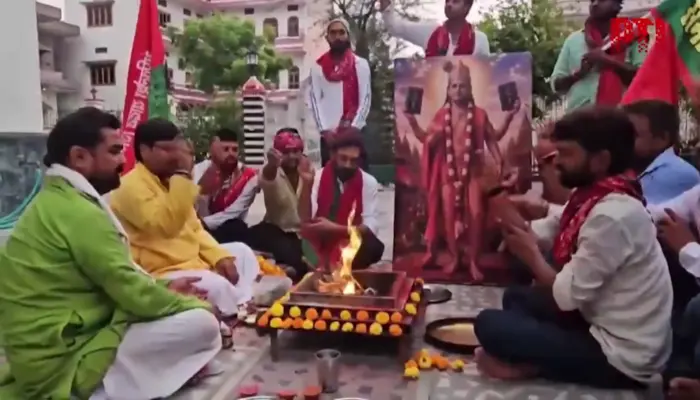
Case Summary
In Varanasi, Uttar Pradesh, Hindu sentiments were outraged by the workers of the Samajwadi Party (SP). They derogatorily portrayed an image of Lord Krishna by morphing his face with that of Samajwadi Party leader Akhilesh Yadav. They also mocked Hindu beliefs by describing Akhilesh Yadav as an ansh (manifestation) and descendant of Lord Krishna, and conducted Hindu yajnas in his name using the distorted image. This occurred on 1 July 2026, during Akhilesh Yadav's birthday celebrations, when Samajwadi Party workers organised a yajna (sacred fire ritual) for him. During the event, they distorted an image of Lord Krishna by replacing his face with that of Akhilesh Yadav and depicted him holding two copies of the Constitution of India in his hands. Speaking on the occasion, Samajwadi Party leader Ajay Fauji said that, just as Lord Krishna fought against injustice during the Dwapara Yuga, Akhilesh Yadav was raising his voice for public issues and social justice in the present era. Videos of the incident went viral, showing Samajwadi Party workers conducting yajnas for Akhilesh Yadav, who was presented as Lord Krishna. They simultaneously raised slogans of "Akhilesh Yadav Zindabad" ("Long Live Akhilesh Yadav"). As the videos spread across social media, many Hindu users expressed outrage over the disrespectful portrayal of Lord Krishna as a political leader. Bharatiya Janata Party leader Pradeep Bhandari also criticised this derogatory political stunt on his X account. Bhandari wrote: "Samajwadi Party Congress yet again insults Hindus! Samajwadi Party mocks Hindus by portraying Akhilesh Yadav as Bhagwan Krishna! Will Akhilesh Yadav and Samajwadi Party openly accept - 'A grand temple at Mathura on Krishna Janmabhoomi'?! Hindus will respond to these 'Kaalnemis'!"
Why it is Hate Crime ?
This case has been added to the tracker under the primary category of - Attack on Hindu religious representations. Within it, the sub-category selected here is - Iconoclastic representation of Hindu Gods/Goddesses. An icon is a symbol of someone or something that is revered, or a religious representation of a spiritual ideal. Iconography is of vital significance in the Hindu milieu. It helps connect people’s spiritual beliefs with the real world. Iconography within the Hindu faith takes several shapes and forms. Murtis are of most significance to Hindus, to which daily rituals, prayers and offerings are done. Besides the murtis, there are several other symbols which have deep significance in the Hindu faith – the Om and Swastika for example. Any iconoclastic representation of these symbols, images and murtis is an affront to the religious beliefs and faith of the Hindu community itself since the symbols and icons are deeply religious in nature. In this sub-category of crime, we would record hate crimes and iconoclastic representations, in words, art, or any other form of representations of symbols that hold religious significance for the Hindu community. Since these symbols, icons and murtis are central to the Hindu faith, any iconoclastic representation of these symbols is born out of animosity towards the faith itself, manifesting itself through these symbols and therefore, these representations would be considered religiously motivated hated crimes. The other primary category selected here is - Hate speech against Hindus. Within it, the sub-category selected here is - Anti-Hindu slurs, mocking faith. Anti-Hindu slurs and the deliberate mocking of the Hindu faith owing to religious animosity involve the usage of derogatory terms, stereotypes, or offensive references to religious practices, symbols, or figures. One of the common anti-Hindu slurs used against Hindus is “cow-worshipper” and “cow piss drinker”. The intention of using this term is to demean and mock Hindus as a group and their religious beliefs since Hindus consider the cow holy. Additionally, some symbols and the slurs attached to them have a historical context that exacerbates the insult, hate, stereotyping, dehumanisation and oppression against Hindus. Cow worship has been used for centuries to denigrate Hindus, insult their faith and oppress Hindus specifically as a religious group. There has been overwhelming documentation about how cow slaughter has been used to persecute Hindus with cow meat being thrown in temples and places of worship. There has also been overwhelming documentation where cow meat (beef) has been force-fed to Hindus to either forcefully convert them to Islam or denigrate their faith. Apart from cow worship, the Swastika – which holds deep religious significance for the Hindus – has also been misinterpreted and distorted to use as a slur against Hindus. Similarly, the worship of the Shivling has been used by supremacist ideologies and religions to denigrate Hindus owing to religious animosity. Such slurs and denigration stem out of inherent animosity and hate towards Hindus and their faith, therefore, it is categorised as hate speech targeted at Hindus specifically owing to their religious identity. This case was added to the Hinduphobia tracker because the actions of the Samajwadi Party workers amounted to a direct affront to Hindu religious beliefs by equating a revered Hindu deity with a contemporary political leader, thereby reducing a sacred form to a vehicle for political glorification. First and foremost, Lord Krishna occupies one of the highest positions within Hindu theology and is worshipped as the eighth avatar of Bhagwan Vishnu. His image, attributes, and iconography hold profound religious significance for millions of Hindus and are inseparable from the spiritual traditions of the faith. By replacing Lord Krishna's face with that of Akhilesh Yadav while retaining the deity's traditional iconography, the organisers diminished the distinction between a revered divine figure and a temporal political personality. They further described Akhilesh Yadav as an ansh (manifestation) and descendant of Lord Krishna, reinforcing the equivalence between the two. Such representations reduced a sacred religious icon to a political instrument, thereby undermining the sanctity associated with Lord Krishna. The appropriation of a deity's sacred image for partisan messaging disregarded the religious sentiments attached to that image and was offensive to Hindu devotees. Secondly, the nature of the event aggravated the offence. The organisers did not merely circulate a digitally altered image. They publicly conducted a Hindu yajna in honour of Akhilesh Yadav while displaying the distorted image of Lord Krishna with Akhilesh Yadav's face. They also raised slogans praising Akhilesh Yadav during the ceremony, treating the altered image as the focal point of the ritual. Performing a yajna, a sacred Hindu religious ritual ordinarily dedicated to deities and performed for religious purposes, before such a distorted representation blurred the line between genuine religious worship and political propaganda. The appropriation of Hindu rituals to glorify a political leader trivialised practices regarded as sacred by Hindus and amplified the insult to their religious beliefs. Thirdly, the justification offered by the organisers reinforced the deliberate nature of the act. Samajwadi Party leader Ajay Fauji explicitly compared Akhilesh Yadav to Lord Krishna by stating that, just as Lord Krishna fought against injustice during the Dwapara Yuga, Akhilesh Yadav was fighting for public issues and social justice in the present era. This was not an incidental resemblance or symbolic expression but a conscious attempt to draw a direct equivalence between a revered Hindu deity and a contemporary political leader. Such comparisons diminished the unique religious significance of Lord Krishna by subordinating his divine role to a modern political narrative. The act also carried a broader societal impact because it was performed publicly during Akhilesh Yadav's birthday celebrations and was intended for widespread visibility. Videos of the event were recorded and widely circulated on social media, ensuring that the altered depiction of Lord Krishna and the accompanying religious rituals reached a broad audience. The public dissemination of the imagery exposed Hindu devotees to representations that were disrespectful towards one of the most revered deities in Hinduism. By superimposing the face of a contemporary political figure onto the sacred image of Lord Krishna, the organisers reduced a revered deity into an object of political comparison and glorification, thereby mocking Hindu beliefs and striking directly at the faith of devotees. Such a comparison stripped the deity of sanctity, trivialised beliefs held sacred by millions of Hindus, and caused deep emotional and spiritual injury. This is not the first time such an incident has occurred. The Hinduphobia Tracker previously documented a similar incident that took place in Varanasi, Uttar Pradesh. In this case, the Youth Congress workers derogatorily morphed the image of the Hindu deity Lord Parashurama by replacing his face with that of Rahul Gandhi and portraying him as the deity. In the depiction, Rahul Gandhi was shown in the form of Lord Parashurama, holding the deity’s traditional axe in one hand and a copy of the Constitution of India in the other, and the altered image was used in a manner that mimicked ritualistic reverence. Taken together, the depiction of Akhilesh Yadav as Lord Krishna, the performance of a Hindu yajna before the distorted image, the portrayal of him as an ansh and descendant of Lord Krishna, and the explicit comparison between the political leader and the revered deity amounted to an iconoclastic appropriation of a sacred religious figure. Since the incident involved the distortion of Lord Krishna's image, the misuse of Hindu religious symbolism and rituals, and conduct that offended Hindu religious sentiments, it has been included in the tracker under the aforementioned category.


Case Status
Unknown


Perpetrators Details
Perpetrators
Others
Perpetrators Range
Unknown
Perpetrators Gender
unknown
 Sources




