Hindu faith mocked: Indian politicians depicted Lord Parashurama in derogatory manner for political propaganda
 Varanasi, Uttar Pradesh, India
  18 June, 2026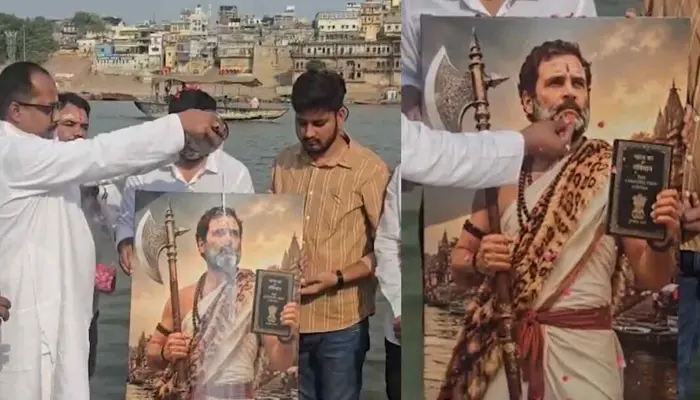
Case Summary
In Varanasi, Uttar Pradesh, Hindu religious sentiments were outraged after Youth Congress workers morphed the image of the Hindu deity Lord Parashurama. They morphed the image of Congress leader and Leader of the Opposition Rahul Gandhi by depicting him as Lord Parashurama, a revered warrior-sage avatar of Lord Vishnu in Hindu tradition. The event took place along the banks of the River Ganga in Kashi on 19 June 2026, where Congress workers unveiled a large portrait portraying Rahul Gandhi in the form of Lord Parashurama, holding a parashu (axe) in one hand and a copy of the Constitution of India in the other. As part of the celebration, the workers travelled by boat to the middle of the river carrying the portrait and conducted a ritual in which milk was poured over the image while Vedic chants and prayers were recited. Rose petals were also scattered into the river during the ceremony. Additionally, an 11-kilogram laddu cake was prepared and cut as part of the 56th birthday celebrations of Congress Leader Rahul Gandhi, organised by local Congress leaders and Youth Congress members. Youth Congress District President Vikas Singh claimed that Rahul Gandhi had been portrayed as Lord Parashurama because, in their view, he fought against injustice, corruption, anti-democratic forces and those opposed to constitutional values. Drawing a parallel between the Hindu deity and the Congress leader, Singh said that just as Lord Parashurama had destroyed demons and oppressors, Rahul Gandhi would defeat forces that did not believe in the Constitution and democratic principles. Defending the portrayal, he stated that it reflected the sentiments of Congress workers and fell within the scope of democratic expression. The event drew strong criticism from several Bharatiya Janata Party leaders. Union Minister Giriraj Singh criticised the comparison and stated that Lord Parashurama should not be equated with a political leader. Uttar Pradesh Deputy Chief Minister Brajesh Pathak condemned the depiction, emphasising that Lord Parashurama was an avatar of Lord Vishnu and stating that comparing him with Rahul Gandhi was inappropriate. He further questioned how individuals whom he described as being opposed to Sanatan Dharma could make such a comparison. Minister Anil Rajbhar also criticised the organisers and described the act as lacking judgment and sensitivity. Congress leaders defended the celebration and rejected the criticism. Uttar Pradesh Congress President Ajay Rai claimed that the workers had attempted to honour Rahul Gandhi because they viewed him as someone who stood against oppression and injustice. He said that Rahul Gandhi carried both an axe and the Constitution symbolically in this struggle and added that Congress workers stood firmly with him in that spirit.
Why it is Hate Crime ?
This case has been added to the tracker under the primary category of - Attack on Hindu religious representations. Within it, the sub-category selected here is - Iconoclastic representation of Hindu Gods/Goddesses. An icon is a symbol of someone or something that is revered, or a religious representation of a spiritual ideal. Iconography is of vital significance in the Hindu milieu. It helps connect people’s spiritual beliefs with the real world. Iconography within the Hindu faith takes several shapes and forms. Murtis are of most significance to Hindus, to which daily rituals, prayers and offerings are done. Besides the murtis, there are several other symbols which have deep significance in the Hindu faith – the Om and Swastika for example. Any iconoclastic representation of these symbols, images and murtis is an affront to the religious beliefs and faith of the Hindu community itself since the symbols and icons are deeply religious in nature. In this sub-category of crime, we would record hate crimes and iconoclastic representations, in words, art, or any other form of representations of symbols that hold religious significance for the Hindu community. Since these symbols, icons and murtis are central to the Hindu faith, any iconoclastic representation of these symbols is born out of animosity towards the faith itself, manifesting itself through these symbols and therefore, these representations would be considered religiously motivated hated crimes. The other sub-category selected here is - Hate speech against Hindus. Within it, the sub-category selected here is - Anti-Hindu slurs, mocking faith. Anti-Hindu slurs and the deliberate mocking of the Hindu faith owing to religious animosity involve the usage of derogatory terms, stereotypes, or offensive references to religious practices, symbols, or figures. One of the common anti-Hindu slurs used against Hindus is “cow-worshipper” and “cow piss drinker”. The intention of using this term is to demean and mock Hindus as a group and their religious beliefs since Hindus consider the cow holy. Additionally, some symbols and the slurs attached to them have a historical context that exacerbates the insult, hate, stereotyping, dehumanisation and oppression against Hindus. Cow worship has been used for centuries to denigrate Hindus, insult their faith and oppress Hindus specifically as a religious group. There has been overwhelming documentation about how cow slaughter has been used to persecute Hindus with cow meat being thrown in temples and places of worship. There has also been overwhelming documentation where cow meat (beef) has been force-fed to Hindus to either forcefully convert them to Islam or denigrate their faith. Apart from cow worship, the Swastika – which holds deep religious significance for the Hindus – has also been misinterpreted and distorted to use as a slur against Hindus. Similarly, the worship of the Shivling has been used by supremacist ideologies and religions to denigrate Hindus owing to religious animosity. Such slurs and denigration stem out of inherent animosity and hate towards Hindus and their faith, therefore, it is categorised as hate speech targeted at Hindus specifically owing to their religious identity. This case was added to the Hinduphobia tracker because the derogatory act by the Youth Congress workers amounted to a direct affront to Hindu religious beliefs, as it equated a revered deity with a contemporary political figure, reducing a sacred form to a subject of mockery. First and foremost, Lord Parashurama occupies a sacred position within Hindu theology and is worshipped as the sixth avatar of Bhagwan Vishnu. His image, attributes, and iconography carry deep religious significance for millions of Hindus and are inseparable from the spiritual traditions of the faith. Depicting a contemporary political leader in the exact form of Lord Parashurama, complete with the deity's traditional attributes and symbolism, diminished the distinction between a revered divine figure and a temporal political personality. By equating a living politician with a deity worshipped by millions, the act reduced a sacred religious icon to a political instrument, thereby undermining the sanctity associated with the deity. Such representations are offensive because they appropriate objects of worship and transform them into vehicles for political messaging, disregarding the religious sentiments attached to them. Secondly, the nature of the event aggravated the offence. The organisers did not merely circulate a graphic or symbolic image. They carried the portrait into the middle of the Ganga, performed ritualistic ceremonies, poured milk over the image, chanted Vedic prayers, and showered it with flower petals in a manner resembling religious worship. These acts replicated sacred Hindu rituals ordinarily reserved for deities and objects of genuine religious veneration. Conducting such rituals before the image of a political leader portrayed as a Hindu deity blurred the line between devotion and political propaganda, thereby trivialising practices that Hindus regard as sacred. The use of ritual worship in this context amplified the insult because it appropriated religious customs for partisan glorification. Thirdly, the justification offered by the organisers reinforced the deliberate nature of the act. Congress leaders explicitly compared Rahul Gandhi's political activities to the divine mission of Lord Parashurama, claiming that just as the deity destroyed oppressors and forces of injustice, Rahul Gandhi would defeat his political opponents. This was not an incidental resemblance or artistic expression but a conscious attempt to draw a direct equivalence between a revered Hindu deity and a contemporary political figure. Such comparisons inevitably diminish the religious significance of the deity by subordinating it to political narratives and electoral symbolism. The act also carried a broader societal impact because it was performed publicly and was intended for widespread visibility. The event was organised in one of Hinduism's holiest cities and conducted on the banks of the sacred River Ganga, a site of immense spiritual significance. The public nature of the ceremony ensured that the iconoclastic representation reached a wide audience and exposed Hindu devotees to imagery that was disrespectful towards their religious beliefs. By superimposing the face of a contemporary political figure onto a sacred form, the post reduced a revered deity into an object of comparison and ridicule, thereby mocking Hindu beliefs and striking directly at the faith of devotees. Drawing such a comparison stripped the deity of sanctity and trivialised beliefs held sacred by millions, thereby causing deep emotional and spiritual injury. Taken together, the depiction of Rahul Gandhi as Lord Parashurama, combined with the performance of ritualistic worship before the image and the explicit comparison between a political leader and a revered Hindu deity, amounted to an iconoclastic representation of a sacred religious figure. Since the incident involved the appropriation and trivialisation of a Hindu deity's image and religious symbolism in a manner that offended Hindu religious sentiments, it has been included in the tracker under the aforementioned category.


Case Status
Complaint not filed


Perpetrators Details
Perpetrators
Others
Perpetrators Range
Unknown
Perpetrators Gender
unknown
 Sources




