Hindu family brutally assaulted and stone pelted by group of Muslim men over a trivial issue in Sambhal district, Uttar Pradesh
 Sambhal, Uttar Pradesh, India
  27 June, 2026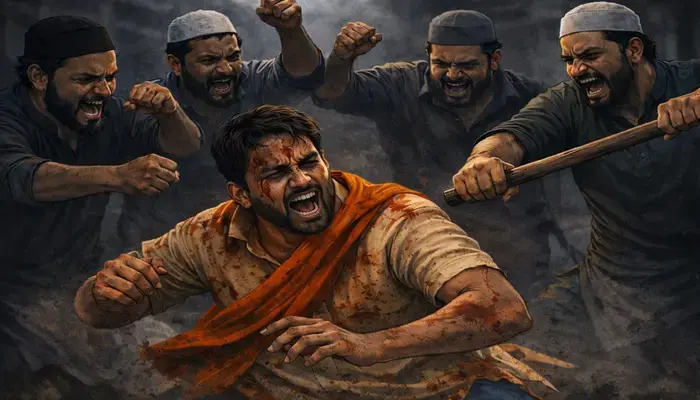
Case Summary
In the Mirzapur Nasrullahpur village of Sambhal district, Uttar Pradesh, a Hindu family was brutally assaulted and stone pelted by a group of Muslim men on 28 June 2026, over a minor issue. According to reports, the confrontation began when a Hindu man named Sunil, the grandson of local resident Ramkishore, objected to a Muslim man named Samim, son of Shabbir, on removing a mare from the road. The disagreement quickly escalated after members of Samim's side gathered and engaged in a physical altercation with Sunil. The Muslim group then went to Sunil's residence in search of him. When Ramkishore questioned their actions, they threatened to kill him. As the confrontation intensified, the Muslim attackers pelted stones and assaulted those present, injuring Ramkishore, Ratan Singh, Sumit, and Kailavati. Kailavati, whose wedding procession was scheduled for 1 July 2026, also had her clothes torn during the assault. According to the complaint filed by Ramkishore, the accused used iron rods, axes, and knives during the attack, while one of the accused, identified as Shan, fired a pistol with the intention of killing. The injured were taken to the Bahjoi Community Health Centre for medical examination. Based on Ramkishore's complaint, police began investigating individuals, including Samim, Shabbir, Shamim, Kashid, Rashid, Raja, Javed, Shohil, Shahid, Dilshad, and Dilshad's son. The Station House Officer confirmed that the clash stemmed from a dispute over the removal of a mare from the road and stated that the matter was under investigation and appropriate legal action was being taken.
Why it is Hate Crime ?
This case has been added to the tracker under the primary category of - Attack not resulting in death. Within it, the sub-category selected is - Communal clash/attack. Communal clash is a form of collective violence that involves clashes between groups belonging to different religious identities. For a communal clash between Hindus and non-Hindus to qualify as a religiously motivated hate crime, the trigger of the violence itself would have to be anti-Hindu in essence. For example, if there is a Hindu religious procession that comes under attack from a non-Hindu mob and after the initial attack, Hindus retaliate in self-defence, leading to a communal clash between the two religious communities. While at a later stage, both communities are involved in the clash/violence, the initial trigger of the violence was by the non-Hindu mob against the Hindus and therefore, it could safely be termed as an anti-Hindu violence. Further, the trigger would also have to be religiously motivated. In the cited example, the attack by the non-Hindu mob was against religious processions and therefore, can be concluded to be religiously motivated. In some cases, the trigger may be non-religious, however, it develops into religious violence against Hindus at a later stage. In such cases too, the foundational animosity towards Hindus becomes the motivating factor of the crime and therefore, it would be classified as a religiously motivated hate crime against Hindus under this category. The other sub-category selected here is - Attacked for opposing radicals or trying to save victim. In several cases, Hindus are attacked for opposing religiously motivated crimes being committed against a fellow Hindu or simply for voicing an opinion opposing radical elements, who either have in the past or continue to persecute Hindus. In such cases, the initial attack against the victim, against which the Hindu was trying to defend the victim, would also need to be classified as a religiously motivated hate crime. Since the initial crime itself was religiously motivated and the subsequent crime of attempting to save the victim or speaking against the radical elements ends up inviting a violent attack, it would also be classified as a religiously motivated hate crime under this category. The other sub-category selected here is - Attacked for Hindu identity. In several cases, Hindus are attacked merely for their Hindu identity without any perceived provocation. A classic example of this category of religiously motivated hate crime is a murder in 2016. 7 ISIS terrorists were convicted for shooting a school principal in Kanpur because they got ‘triggered’ seeing the Kalava on his wrist and tilak that he had put. In this, the Hindu victim had offered no provocation except for his Hindu religious identity. The motivation for the murder was purely religious, driven by religious supremacy. Such cases where Hindus are targeted merely for their religious identity would be documented as a hate crime under this category. This case has been categorised as a hate crime due to the communal nature of the violence, in which Hindu victims were subjected to a coordinated and disproportionate attack by a group of Muslim men following a minor dispute over the removal of a mare from a public road. The initial disagreement between Sunil, a Hindu man, and Samim, a Muslim man, concerned a trivial issue that ordinarily could have been resolved through discussion or police intervention. Instead, the Muslim perpetrator escalated a trivial dispute by calling his friends, gathering in large numbers, and launched a violent assault on the Hindu family. The transformation of an ordinary disagreement into a collective attack by Muslim perpetrators demonstrates that the violence was rooted in religious animosity. The sequence of events further reinforced the disproportionate nature of the attack. After the initial altercation, the Muslim group did not disengage or seek any lawful means of resolving the dispute. Instead, they proceeded to the residence of the Hindu victim, the group threatened to kill him before launching a coordinated assault involving stone pelting and the use of iron rods, axes, knives, and even the firing of a pistol. The scale of the violence, the mobilisation of multiple assailants, and the use of deadly weapons were grossly disproportionate to the minor disagreement that triggered the incident and demonstrate that the objective extended far beyond resolving a personal quarrel. When a trivial dispute is met with organised collective violence directed at members of another religious community, it proves that the immediate disagreement served merely as the trigger, while underlying communal hostility contributed significantly to the scale and intensity of the attack. The use of overwhelming force also reinforces this conclusion. Resorting to stone pelting, deadly weapons, and threats to kill over such a trivial issue represented an extreme and irrational escalation. Such conduct cannot be explained solely by the immediate disagreement. The willingness of multiple individuals to participate in coordinated violence over an otherwise insignificant dispute reflects an underlying environment in which communal identity became a basis for collective mobilisation and aggression. It is also significant that lawful avenues for resolving the disagreement were readily available. If any party believed they had been wronged, they could have approached the police or sought intervention from local authorities. Instead, the decision to respond through collective violence against a Hindu family underscored a deliberate choice to use intimidation rather than legal mechanism. Such a disproportionate response to a minor altercation highlights the underlying animosity the members of the Muslim community hold against Hindus. These actions reflect a dangerous mindset of religious supremacy that demands dominance and submission through violence. In such cases, even minor, non-religious provocations are met with aggressive retaliation when the victim is Hindu, revealing an alarming pattern of identity-driven hostility that defines such hate crimes. This pattern of disproportionate retaliation, driven by identity-based hostility, is what qualifies the incident as a hate crime. This violent overreach stems from an Islamic supremacist ideology within Muslim extremist circles, which views Hindus as socially and religiously inferior. This toxic belief breeds contempt and aggression, especially when Hindus resist submission or refuse to yield in disputes. The readiness to use violence under the pretext of minor issues exposes the continuing threat Hindu communities face, as these incidents are not isolated or spontaneous but part of an ongoing pattern of religiously motivated violence. Similarly, the Hinduphobia Tracker has previously documented numerous instances where non-religious triggers sparked communal violence against Hindus by Muslims. For example, on 30th May 2025, in Dewran Garhiya village, Farrukhabad, Uttar Pradesh, a minor verbal altercation between two Hindu men and a Muslim man escalated into a violent assault by a large Muslim mob, inflaming communal tensions. In another incident on 7th July 2025 in Bhavna Nagar, Raipur, Chhattisgarh, a Hindu family was brutally attacked by a Muslim mob of nearly 80 people following a simple dispute over garbage disposal. Victims suffered severe injuries from sharp weapons. Similarly, on 22nd June 2025 in Ghongade Basti, Solapur, Maharashtra, a minor road dispute led to a targeted communal assault on Hindus by a large Muslim mob, sparking widespread clashes. Taken together, the collective mobilisation of multiple Muslim assailants, the targeting of an entire Hindu family rather than only the individual involved in the original dispute, the use of dangerous weapons, the death threats, and the grossly disproportionate nature of the violence establish that this incident went beyond an ordinary neighbourhood quarrel. The attack exhibited characteristics consistent with a religion-driven communal assault in which Hindu victims were subjected to organised violence following a trivial dispute. Accordingly, this case meets the criteria for inclusion in the Hinduphobia Tracker as a hate crime.
Victim Details
Total Victim
4
Deceased
0
Gender
- Male 3
- Female 1
- Third Gender 0
- Unknown 0
Caste
- SC/ST 0
- OBC 0
- General 4
- Unknown 0
Age Group
- Minor 0
- Adult 4
- Senior Citizen 0
- Unknown 0


Case Status
Complaint filed


Perpetrators Details
Perpetrators
Muslim Extremists
Perpetrators Range
From 10 to 100
Perpetrators Gender
male
 Sources




