Hindu students asked to remove Tulsi mala, kanthi, and kalava but hijabs allowed at Ahmedabad NEET re-test centre; parents stage protest
 Ahmedabad, Gujarat, India
  20 June, 2026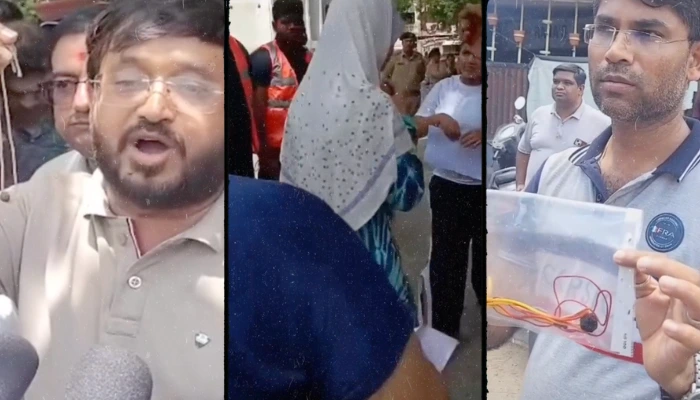
Case Summary
During the NEET re-test conducted at an examination centre in Ahmedabad, Hindu students were instructed to remove religious symbols such as Tulsi malas, kanthis, and kalavas before entering the examination hall. At the same time, Muslim students wearing hijabs were permitted to appear for the examination without being asked to remove their religious attire. The incident occurred at R.J. Tibrewal Commerce College in the Vastrapur area, one of the designated centres conducting the National Eligibility-cum-Entrance Test (NEET) re-examination ordered following the controversy surrounding the alleged paper leak. The issue began when a Muslim candidate wearing a hijab underwent security checks during the entry process. According to officials and eyewitnesses, the hijab was temporarily removed for inspection. The candidate's mother objected and requested that her daughter be allowed to take the examination while wearing the religious attire. Following discussions between examination authorities, the college administration, and police personnel, the student was permitted to re-enter the examination hall wearing the hijab. The decision prompted objections from several Hindu parents present outside the centre, who questioned whether examination regulations were being applied uniformly to students of all faiths. The protesting parents stated that Hindu students had been asked to remove religious items such as kalavas, kanthis, and other sacred symbols during frisking and security checks. They argued that if such restrictions were being imposed on Hindu religious symbols, similar standards should apply to all religious attire and markers. As the disagreement intensified, supporters of Bajrang Dal and AIMIM gathered near the examination centre, leading to a heated exchange and a brief scuffle. Police intervened to disperse the crowd and restore order, preventing the situation from escalating further. The incident sparked a controversy over the consistency and fairness of examination guidelines and led to allegations of religious bias in the implementation of the dress code at the examination centre. Notably, the controversy mirrors several incidents reported during the original NEET-UG 2026 examination conducted in May 2026. On 3 May 2026, a Hindu girl appearing for the examination at a centre in Surat, Gujarat, was required by security personnel to remove her Kanthi mala before being allowed to enter the examination hall. At the same centre, Muslim candidates wearing burqas were permitted to enter without being asked to remove their religious attire. A similar incident was reported from Kalaburagi, Karnataka, where a Hindu candidate, Sripad Patil, was instructed to remove his Janivara (sacred thread before entering the examination hall at St. Mary's examination centre. These incidents prompted concerns among some parents and students regarding the uniform application of examination security and dress code regulations across different religious groups.
Why it is Hate Crime ?
This case has been added to the tracker under the primary category- Restriction/Ban on Hindu Practices. Under this the sub-category selected is- Restriction on expression of Hindu identity. An example of the state-affected prejudicial and targeted orders against the Hindu community would be a government denying the right of a Hindu or a group of Hindus to hold a religious procession owing to the animosity of non-Hindu groups. Denial of the religious right of the Hindus to assuage the non-Hindu group which harbours animosity to a point where it could lead to violence against Hindus is not only a failure of law and order but is a prejudicial order against Hindus, denying them their fundamental rights to express their religious identity. An example of a hate crime against Hindus by a non-Hindu would be a non-Hindu institution forcing its Hindu employees to abandon religious symbols that a Hindu would wear as an expression of faith owing to inherent prejudice against the faith professed by the victim or a non-Hindu group of people restricting a Hindu group from constructing a place of worship simply because the demography of the area in which the temple is being built is dominated by non-Hindus. Such actions are driven by religious animosity and/or prejudice against Hindus and their faith and would therefore be categorized as a hate crime. The other primary category selected is- Attack not resulting in death. Under this, the sub-category selected is- Attacked for Hindu identity. In several cases, Hindus are attacked merely for their Hindu identity without any perceived provocation. A classic example of this category of religiously motivated hate crime is a murder in 2016. 7 ISIS terrorists were convicted for shooting a school principal in Kanpur because they got ‘triggered’ seeing the Kalava on his wrist and tilak that he had put. In this, the Hindu victim had offered no provocation except for his Hindu religious identity. The motivation for the murder was purely religious, driven by religious supremacy. Such cases where Hindus are targeted merely for their religious identity would be documented as a hate crime under this category. The controversy at the Ahmedabad NEET re-test centre was not merely about the enforcement of a neutral security protocol. It was a case of selective religious discrimination where Hindu students were required to remove religious symbols such as kalavas, kanthis, and Tulsi malas during frisking, while a Muslim candidate was ultimately permitted to take the examination wearing a hijab after objections were raised by her family. The differential treatment was not incidental. It stemmed from the unequal application of examination rules, where Hindu religious markers were subjected to removal while Islamic religious attire received accommodation. The Tulsi mala, kanthi, kalava, and janeu occupy a specific place in Hindu religious life. They are not fashion accessories or ornamental objects. They are visible expressions of faith, devotion, and religious identity. For many Hindus, these sacred items carry deep spiritual significance and are worn as an extension of their religious commitment. Being compelled to remove them as a precondition for accessing an important public examination places Hindu students in a position where they must temporarily abandon a visible marker of their faith in order to exercise their educational rights. Such a demand goes beyond a routine administrative inconvenience and becomes a matter of religious dignity and equal treatment. The most significant religious marker in this case is the contrast between the treatment of Hindu religious symbols and Islamic religious attire. Authorities permitted a candidate to enter the examination hall wearing a hijab after discussions involving officials, college authorities, and police personnel. At the same time, Hindu students were not extended a similar accommodation for their religious symbols. If the objective was the uniform enforcement of security and dress code regulations, then all religious expressions should have been subjected to the same standards. The inconsistency in enforcement affirms the perception that Hindu religious practices were being treated as more expendable than those of another faith. The pattern dimension of this case is particularly significant. Similar controversies surfaced during the original NEET-UG 2026 examination. At a centre in Surat, Gujarat, a Hindu girl was required to remove her Kanthi mala before entering the examination hall, while Muslim candidates wearing burqas were permitted entry without being asked to remove their religious attire. Likewise, at St. Mary's examination centre in Kalaburagi, Karnataka, Hindu candidate Sripad Patil was instructed to remove his Janeu or Janivara before being allowed to enter the examination hall. The recurrence of such incidents across different examination centres, involving various Hindu religious symbols, indicates a broader pattern in which Hindu devotional markers are repeatedly subjected to scrutiny and restriction. The coercion did not just cause emotional and spiritual distress to the victims; it imposed a condition where their faith was forced to yield to administrative authority, reinforcing the perception that Hindu religious symbols can be overridden, disrespected, and discarded without any accountability. It reflects not only religious bias but deep disdain towards the religion, which is why this case becomes worthy of being documented under this category of the hate tracker. Here, it is important to mention that in 2022, a massive controversy had erupted in Karnataka, which took a national form, after Muslim women had insisted that they should be allowed to wear Burqas and Hijabs in their schools and classrooms. That time, the argument that was given by several politicians, social commentators, Hindu activists and even the Judiciary was that schools have the right to enforce uniform rules, since wearing uniforms brings harmony and equality in the classroom, and therefore, schools not allowing girls to wear hijab in the classroom is not religious discrimination, but merely an enforcement of widely accepted uniform norms. The pseudo-seculars and leftist groups may argue that a similar line of reasoning should be applied in this case. However, it is important to note that the Tulsi Mala neither violates the NTA exam dress code nor poses any security risk. Examination authorities may regulate outer clothing for uniformity and security, but what a student wears beneath their attire, especially something as personal and concealed as the Janeu, should not be subject to such control. Forcing its removal without any valid or written justification is a clear violation of religious freedom. It sends a deeply exclusionary message, singling out Hindu customs for unnecessary scrutiny and desecration. More broadly, this reflects a disturbing pattern where expressions of Hindu identity are marginalised, even in supposedly neutral, secular spaces like NTA exam centres. In this case, the enforcement of rules appears selective and rooted in a disregard for Hindu sentiments rather than any genuine procedural necessity. The staff targeted a visible Hindu religious symbol, the janeu, worn by a Hindu student, while no similar restrictions were imposed on other forms of visible religious identity. Given that this case met the parameters of a religiously motivated hate crime, the conduct of the NTA security personnel reflected more than procedural inconsistency. By compelling a Hindu girl to remove a sacred devotional item as a condition of accessing a public examination, while simultaneously permitting Muslim candidates to enter wearing full Islamic religious dress, their actions demonstrated a structural subordination of Hindu religious identity within an institution that is required by law to treat all candidates equally. The Hindu girl in Surat was subjected to religious discrimination specifically because she was Hindu, and the removal of her Kanthi mala was demanded because her Hindu religious identity was treated as subject to institutional restriction in a way that Islamic religious identity was not. This reflects an underlying institutional hostility toward Hindu religious expression that cannot be characterised as anything other than religiously motivated. Given that this case met the parameters of a religiously motivated hate crime, it was added to the hate crime database of the tracker.


Case Status
Unknown


Perpetrators Details
Perpetrators
Others
Perpetrators Range
Unknown
Perpetrators Gender
unknown
 Sources




