Hindu girl forced to remove sacred Kanthi mala at NEET exam centre in Surat while Muslim candidates in burqa allowed entry without objection
 Surat, Gujarat, India
  2 May, 2026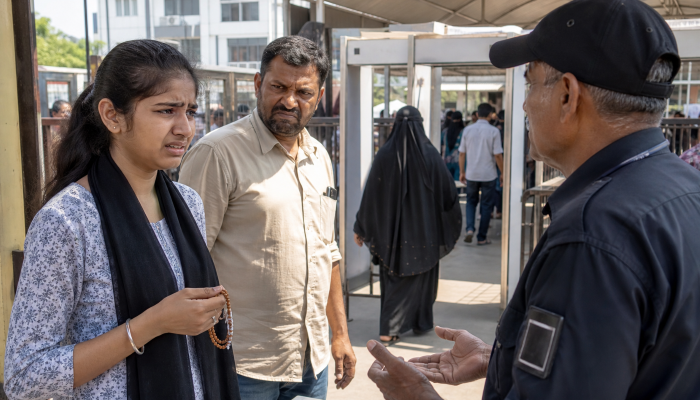
Case Summary
A Hindu girl appearing for the National Eligibility cum Entrance Test [NEET]-UG 2026 examination at a centre in Surat, Gujarat, was forced by security personnel to remove her Kanthi mala [a sacred Tulsi bead necklace worn by devotees of Lord Vishnu as a mark of faith and devotional identity] before being permitted to enter the examination hall on 3 May 2026. Muslim candidates wearing burqa [full Islamic face and body covering] were allowed to enter the same examination centre without any objection or restriction. The Kanthi mala is not a decorative accessory. It is a sacred devotional item worn by Vaishnava Hindus as a direct expression of their faith and their relationship with Bhagwan Vishnu and his avatars, including Bhagwan Ram and Bhagwan Shri Krishna. Its removal is experienced by a devout Hindu as a violation of their religious identity, not merely an inconvenience. The girl's father protested outside the examination centre. He stated: "I am the son of a Hindu and I am standing in Surat, not in Lahore, Karachi, or Pakistan. You people cannot remove hijab and burqa, but you have the guts to remove the Tulsi mala from my daughter's neck." The incident was captured on video and went viral on social media platform X, drawing widespread outrage from Hindu communities across India. On the same date, a parallel incident was reported from Barmer, Rajasthan, where a candidate wearing a burqa was checked at the security gate but was still permitted to keep it on and enter the examination centre. A prior incident from NEET 2024 was also brought to light, in which a Hindu girl had her kalava [sacred red thread tied on the wrist during Hindu religious rituals] physically cut from her wrist at an exam security gate. She too raised the question of why hijab and burqa were permitted while Hindu sacred threads were banned. The examination was conducted by the National Testing Agency [NTA], which administers NEET-UG across 552 cities in India and 14 international locations. Over 85,000 candidates from Gujarat appeared for the examination on 3 May 2026. No official response from the NTA was confirmed in the source material at the time of publication.
Why it is Hate Crime ?
The primary category for this case is "Restriction/ban on Hindu practices". The sub-category for this case is "Restriction on expression of Hindu identity". An example of the state-affected prejudicial and targeted orders against the Hindu community would be a government denying the right of a Hindu or a group of Hindus to hold a religious procession owing to the animosity of non-Hindu groups. Denial of the religious right of the Hindus to assuage the non-Hindu group which harbours animosity to a point where it could lead to violence against Hindus is not only a failure of law and order but is a prejudicial order against Hindus, denying them their fundamental rights to express their religious identity. An example of a hate crime against Hindus by a non-Hindu would be a non-Hindu institution forcing its Hindu employees to abandon religious symbols that a Hindu would wear as an expression of faith owing to inherent prejudice against the faith professed by the victim or a non-Hindu group of people restricting a Hindu group from constructing a place of worship simply because the demography of the area in which the temple is being built is dominated by non-Hindus. Such actions are driven by religious animosity and/or prejudice against Hindus and their faith and would therefore be categorized as a hate crime. Another sub-category for this case is "Administration restricting religious practice". In several cases, it is seen that the administration/state disallows a religious practice owing to prejudicial orders and concerns, targeted specifically against the Hindu community. Such restriction/prohibition would be considered documented as a hate crime because the orders are often a result of pressure by groups that harbour animosity towards Hinduism and Hindus. Often, the restriction by the authorities is driven by bias, hostility, or prejudice against the specific community being stopped from holding a religious practice, by pressure groups that harbour animosity towards Hindus, intrinsic to their faith. Since practices are intrinsic to the faith of the Hindus, such prejudicial restriction is considered a curtailing of the fundamental rights of the Hindu community. In several cases, for example, the authorities ban a Hindu religious practice due to pressure from groups opposed to the religion. In other instances the prohibition is selectively enforced against one religious group (Hindus) while others are allowed to proceed. There are still other cases where the authorities preemptively restrict a religious practice by Hindus because those who hold animosity towards Hindus may get “provoked” leading to them being violent, thereby assuaging the sentiments of those who hold animosity towards Hindus by curtailing the religious rights of Hindus. Such acts and orders are prejudiced, indicating discriminatory motives owing to the capitulation to groups that harbour animosity towards Hindus and therefore, would be categorized as a religiously motivated hate crime since the original pressure leading to the order itself is a result of hatred/bias/prejudice/religious hate against Hindus. The other primary category selected is- Attack not resulting in death. Under this, the sub-category selected is- Attacked for Hindu identity. In several cases, Hindus are attacked merely for their Hindu identity without any perceived provocation. A classic example of this category of religiously motivated hate crime is a murder in 2016. 7 ISIS terrorists were convicted for shooting a school principal in Kanpur because they got ‘triggered’ seeing the Kalava on his wrist and tilak that he had put. In this, the Hindu victim had offered no provocation except for his Hindu religious identity. The motivation for the murder was purely religious, driven by religious supremacy. Such cases where Hindus are targeted merely for their religious identity would be documented as a hate crime under this category. The forced removal of the Kanthi mala at the Surat examination centre was not an isolated application of a neutral security rule. It was an act of selective religious discrimination that treated Hindu devotional identity as a security risk while extending institutional accommodation to Islamic religious dress. The differential treatment was not incidental. It was the product of an institutional framework that applied its rules asymmetrically along religious lines, with Hindu sacred items subject to removal and Islamic coverings permitted without objection. The Kanthi mala occupies a specific position in Vaishnava Hindu devotional life. It is not worn as jewellery or personal adornment. It is worn as a direct expression of the wearer's consecrated relationship with Bhagwan Vishnu. For a devout Vaishnava, the Kanthi mala is a marker of spiritual identity, its presence on the body a continuous act of devotion and surrender to the divine. Its forced removal in a public institutional setting is not merely an inconvenience. It is a compelled act of religious self-erasure, in which a Hindu student was required to visibly abandon a marker of her faith in order to access a public examination. The NTA's security personnel did not merely enforce a rule. They enforced a rule that applied exclusively to a Hindu religious item while exempting Islamic religious dress from the same scrutiny. The contrast with the treatment of burqa-wearing candidates is the most explicit religious marker in this case. The burqa is an Islamic religious garment that covers the entire face and body. If the NTA's concern was the concealment of prohibited items or the verification of candidate identity, the burqa presented a considerably greater security consideration than a Tulsi bead necklace. The security personnel's decision to permit burqa-wearing candidates entry without objection while demanding the removal of a Kanthi mala establishes that the rule being applied was not a neutral security protocol but a discriminatory one that privileged Islamic religious expression over Hindu religious expression. The pattern dimension of this case is a further and significant religious marker. The NEET 2025 incident, in which a Hindu candidate, Sripad Patil, was asked to remove his Janeu or Janivara (the sacred thread worn by several Hindus, largely by Brahmins) before entering the exam hall. The incident occurred at St Mary’s exam centre in Karnataka. Similarly, in the 2024 NEET incident, a Hindu girl had her kalava physically cut from her wrist at an examination security gate, establishing that the discrimination against Hindu religious items at NTA examination centres is not a one-off failure but a documented institutional pattern. The recurrence of the same differential treatment across two consecutive years, at different locations, involving different Hindu sacred items, and in each case contrasted with the accommodation of Islamic religious dress, demonstrates that the NTA's application of its security rules produces a structurally anti-Hindu outcome. That this pattern has not been addressed institutionally between 2024 and 2026 reflects either deliberate indifference to Hindu religious discrimination or an institutional culture that does not recognise Hindu devotional identity as deserving of the same protection extended to Islamic religious practice. The coercion did not just cause emotional and spiritual distress to the victim; it imposed a condition where his faith was forced to yield to administrative authority, reinforcing the perception that Hindu religious symbols can be overridden, disrespected, and discarded without any accountability. Here, it is important to mention that in 2022, a massive controversy had erupted in Karnataka, which took a national form, after Muslim women had insisted that they should be allowed to wear Burqas and Hijabs in their schools and classrooms. That time, the argument that was given by several politicians, social commentators, Hindu activists and even the Judiciary was that schools have the right to enforce uniform rules, since wearing uniforms brings harmony and equality in the classroom, and therefore, schools not allowing girls to wear hijab in the classroom is not religious discrimination, but merely an enforcement of widely accepted uniform norms. The pseudo-seculars and leftist groups may argue that a similar line of reasoning should be applied in this case. However, it is important to note that the Tulsi Mala neither violates the NTA exam dress code nor poses any security risk. Examination authorities may regulate outer clothing for uniformity and security, but what a student wears beneath their attire, especially something as personal and concealed as the Janeu, should not be subject to such control. Forcing its removal without any valid or written justification is a clear violation of religious freedom. It sends a deeply exclusionary message, singling out Hindu customs for unnecessary scrutiny and desecration. More broadly, this reflects a disturbing pattern where expressions of Hindu identity are marginalised, even in supposedly neutral, secular spaces like NTA exam centres. In this case, the enforcement of rules appears selective and rooted in a disregard for Hindu sentiments rather than any genuine procedural necessity. The staff targeted a visible Hindu religious symbol, the janeu, of a Hindu student, while no similar restrictions were applied to other forms of visible religious identity. Given that this case met the parameters of a religiously motivated hate crime, the conduct of the NTA security personnel reflected more than procedural inconsistency. By compelling a Hindu girl to remove a sacred devotional item as a condition of accessing a public examination, while simultaneously permitting Muslim candidates to enter wearing full Islamic religious dress, their actions demonstrated a structural subordination of Hindu religious identity within an institution that is required by law to treat all candidates equally. The Hindu girl in Surat was subjected to religious discrimination specifically because she was Hindu, and the removal of her Kanthi mala was demanded because her Hindu religious identity was treated as subject to institutional restriction in a way that Islamic religious identity was not. This reflects an underlying institutional hostility toward Hindu religious expression that cannot be characterised as anything other than religiously motivated. Given that this case met the parameters of a religiously motivated hate crime, it was added to the hate crime database of the tracker.
Victim Details
Total Victim
1
Deceased
0
Gender
- Male 0
- Female 1
- Third Gender 0
- Unknown 0
Caste
- SC/ST 0
- OBC 0
- General 0
- Unknown 1
Age Group
- Minor 0
- Adult 0
- Senior Citizen 0
- Unknown 1


Case Status
Unknown


Perpetrators Details
Perpetrators
Others
Perpetrators Range
Unknown
Perpetrators Gender
unknown
 Sources




