Poor Hindu villagers targeted with financial inducements for conversion to Christianity under the guise of prayer meeting in Sitapur, Uttar Pradesh
 Sitapur, Uttar Pradesh, India
  6 June, 2026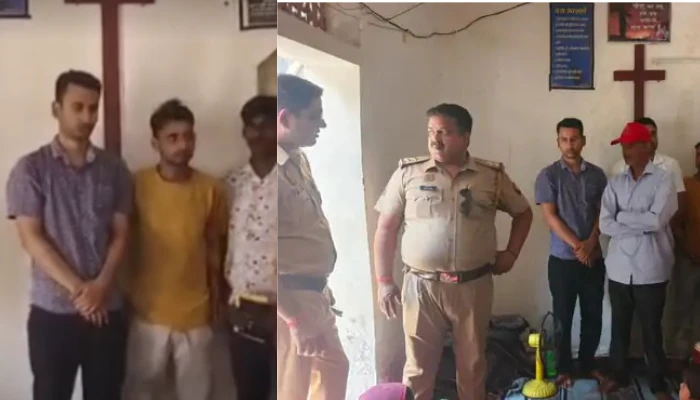
Case Summary
In Ramnagar Khatkari village, Sitapur district, Uttar Pradesh, poor Hindu villagers were lured and induced by monetary benefits in a Christian prayer gathering to convert to Christianity. The three accused were caught conducting the gathering, namely Manjeet Kumar, Vishnu, and Nand Kishore Maurya, on 7th June 2026. On 7th June 2026, police in Sitapur district received information that a prayer gathering linked to conversion activities had taken place in Ramnagar Khatkari village under the Ramkot police station area. A police team was dispatched to the location, and a raid was carried out. Three people conducting the gathering were taken into custody at the spot. The arrested individuals were identified as Manjeet Kumar, Vishnu, and Nand Kishore Maurya. Preliminary investigations revealed that resident Vishnu invited Manjeet Kumar and Nand Kishore Maurya to the village specifically to organise the prayer gathering. The trio held a Christian prayer meeting at the time of the police operation. As per the investigation, the accused attempted to influence Hindu villagers to embrace Christianity by offering monetary benefits and other financial incentives. Residents were promised financial support and assistance in return for changing their faith. The programme targeted economically vulnerable members of the community, with financial inducements used as a means of persuading them to convert. During the search operation, police recovered a Bible, a large wooden cross, and several books and pamphlets related to religious conversion activities. The seized material was taken into custody and sent for examination as part of the investigation. Police officials stated that the recovered items formed an important part of the evidence being scrutinised to determine whether provisions of the Uttar Pradesh Prohibition of Unlawful Conversion of Religion Act had been violated. The incident triggered widespread discussion in Ramnagar Khatkari and surrounding villages. Following the police action, residents gathered in the area, and the matter became a subject of public attention in the locality. Ramkot Station House Officer Piyush Singh stated that a detailed investigation was underway and that all relevant facts were being collected. An FIR was registered under the relevant provisions of law, and the process of producing the accused before a court for remand to judicial custody was initiated. The Ramnagar Khatkari incident was not an isolated occurrence within Sitapur district. Police records showed that over the preceding four years, the district saw multiple cases involving charges of conversion attempts conducted through prayer meetings, financial inducements, and missionary activities. One of the largest such cases surfaced in 2022 in Shahbazpur Pokhra village under the Sadarpur police station limits, where authorities stated that nearly 400 people converted following the establishment of a church in the area. An FIR was registered against 37 people, including Pastor David and his wife, Rohini. In the same year, police registered a case in Saidapur village under Sakran police station against three persons, and a separate inquiry was initiated in Chakpurwa village under Tambaur police station following local complaints. Laharpur police also registered a case against Govardhan of Khurwaliya village and Vinod of Pakariya Purwa in Lakhimpur Kheri in connection with conversion-related activities that year. On 12th December 2024, police arrested a pastor identified as Elgin in Sidhauli on allegations of attempting to convert residents. In February 2025, Kamalapur police arrested Ram Baran and his wife Mona, residents of Lakhanapur village, in connection with a further conversion case. Investigators claimed that the couple had links to a church in the Bakshi Ka Talab area of Lucknow and were involved in persuading residents to change their faith. The Hinduphobia Tracker also recorded several cases where poor and vulnerable Hindus were targeted. On 5th June 2026, a Hindu community in Misrikh, Sitapur, was found at the centre of a religious conversion operation conducted from a rented house in Uttar Pradesh. The gathering included multiple individuals who assembled for a prayer meeting during which conversion activities took place. The incident came to light after information was passed to local authorities, leading to a police intervention that halted the programme. Similarly, in December 2024, police arrested five individuals, Santosh Bauddh, Mishrilal, Gangaram, Surendra, and Shivkumar, on charges of attempting to convert poor and Dalit Hindus to Christianity. The arrests took place in Dubai village, Tambaur police station area. Authorities recovered Bibles, musical instruments, and diaries from the accused. The accumulation of conversion-related cases across Sitapur district over four years showed a sustained pattern of organised activity targeting Hindu villagers, and raised broader questions about the protection of religious autonomy in rural communities and the enforcement of the state's anti-conversion legislation.
Why it is Hate Crime ?
This case has been added to the tracker under the primary category- Predatory Proselytisation. Within this, the subcategory selected is - Conversion/attempts to convert by inducements. Predatory Proselytisation is not just limited to threat, harassment, force and violence, but it also has contours of stealth. In several cases, the Hindu victim is exploited to convert, with non-Hindus taking advantage of their poverty. In such cases, the Hindu victim who is suffering financially is offered monetary benefits, including lucrative offers for jobs, health treatment, education, etc, to induce the victim into changing his/her religion. In such cases, the religious identity of the victim and the aim to disenfranchise him from his faith form the heart of the crime. Also, taking advantage of and exploiting an individual’s economic vulnerabilities is widely acknowledged as exploitation, forms of which are often penalised by law. Such cases, therefore, are considered religiously motivated hate crimes since the victim’s religious identity forms the very heart of the crime itself. This case was included in the tracker because it involved a deliberate and organised effort to persuade Hindu villagers to abandon their faith and adopt Christianity through the offer of financial inducements and material benefits. The conduct was directed specifically at members of the Hindu community and was aimed at securing a change in their religious identity. The issue was therefore not merely the expression of Christian belief, but the use of incentives and promised benefits to encourage the abandonment of Hinduism and the adoption of another religion. The religious motivation was evident from the nature of the inducements that were offered. The benefits were not presented as unconditional acts of charity available irrespective of religious affiliation. Instead, they were linked to the acceptance of Christianity and the rejection of Hindu beliefs and practices. This demonstrated that the objective was not social welfare or community assistance, but religious conversion. The fact that material benefits were tied to a change of faith revealed a deliberate attempt to influence the religious choices of Hindu individuals through external incentives rather than personal spiritual conviction. Conversion through inducements was particularly significant because it targeted individuals at points of vulnerability. The accused directed their efforts at economically disadvantaged residents of a rural village, persons with limited access to healthcare, stable employment, and financial security. When financial assistance and material benefits were offered as incentives to adopt a different religion, the decision to convert became shaped by external pressure rather than genuine spiritual belief. Such methods sought to weaken a person's attachment to their ancestral faith by creating material reasons to abandon it. In this case, the inducements were directed at Hindus specifically, which demonstrated that their religious identity was the reason they were selected as targets. The use of Christian religious texts, books, and pamphlets, all of which were recovered by police from the site, further indicated that the gathering was not a passive social meeting but an active effort to indoctrinate Hindu attendees. Christian religious literature was employed as a tool to sow doubt about Hindu beliefs, normalise Christian doctrine, and prepare the ground for conversion. When the scriptures and literature of one faith are used to deliberately target and manipulate members of another, with the clear intention of securing a change of religion, it constitutes a direct assault on the religious identity of those targeted. The recovery of a large wooden cross and multiple pamphlets from the premises reinforced the organised and premeditated character of the programme. The conduct also reflected a broader religious objective of reducing adherence to Hinduism and increasing adherence to Christianity. The intended outcome was not religious coexistence or mutual understanding, but the replacement of one religious identity with another. By encouraging Hindus to leave their faith in return for promised benefits, the organisers treated Hindu religious affiliation as something to be discarded and replaced. The success of the entire effort depended upon the abandonment of Hindu beliefs and practices, which revealed a clear and deliberate religious motive. The targeting of Hindu villagers through organised prayer meetings also carried a pattern dimension. Resident Vishnu had invited the two other accused specifically to conduct the gathering, indicating planning and coordination rather than spontaneous evangelism. The gradual nature of such efforts, repeated meetings, the use of religious literature, the cultivation of trust, and the progressive introduction of conversion messaging reflected a process of grooming and psychological conditioning rather than informed spiritual choice. Hindu practices were systematically discouraged within the space of these gatherings, Christian doctrine was progressively normalised, and emotional dependency was cultivated through claims of divine benefit. This slow and sustained process was designed to replace inherited belief systems by eroding resistance over time rather than by inviting genuine voluntary reflection. This case was therefore recorded in the Hinduphobia Tracker because the accused deliberately targeted Hindu individuals on account of their Hindu identity, employed financial inducements to weaken their attachment to their faith, used Christian religious material as instruments of indoctrination, and operated through an organised structure designed to achieve religious conversion. The victims were chosen because they were Hindus, and the methods employed were designed to ensure that their Hindu identity was the very thing surrendered in the process. Further, a broad group of families from the village were targeted, demonstrating premeditated planning and an intent to convert multiple Hindus at once, rather than an isolated or spontaneous act. This reveals a clear pattern of targeting large numbers of Hindus for forced Christian conversions, making it a religiously motivated offence. Such predatory conversion efforts stem from Abrahamic doctrines like Christianity that view non-believers with disdain until they convert, fostering contempt that manifests in targeted crimes against Hindus. Therefore, this case has been added to the Hinduphobia Tracker's hate crime database.


Case Status
Arrested


Perpetrators Details
Perpetrators
Christian Extremists
Perpetrators Range
From 2 To 5
Perpetrators Gender
male
 Sources




