Hindu women's suffering trivialised; Muslim journalist and leftist professor dismiss 'Love Jihad' as propaganda
 Delhi, India
  22 February, 2026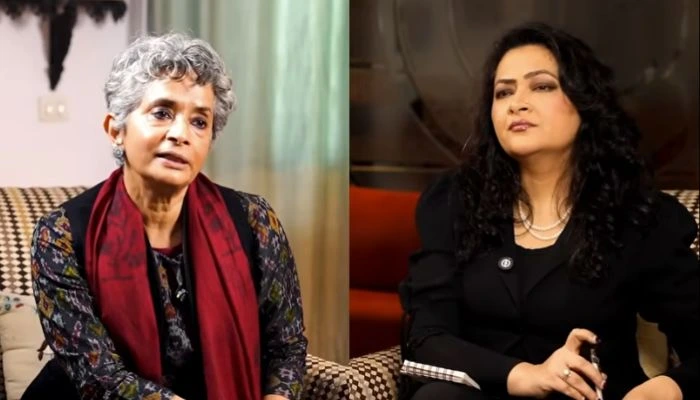
Case Summary
An anti-Hindu rhetoric was propagated by Muslim journalist Arfa Khanum Sherwani and left-wing professor Nivedita Menon, both of whom have a history of promoting anti-Hindu and anti-India narratives. During a podcast, the pair dismissed 'Love Jihad' as a crime and mocked the suffering of Hindu women who had been targeted by it. They then proceeded to demean Hindu men in a derogatory manner while simultaneously praising Muslim men. 'Love Jihad' or 'Grooming Jihad' is a commonly used term in public discourse that refers to crimes in which Hindu women and minor Hindu girls are profiled on the basis of their religious identity and then lured into relationships or marriage for the purpose of forced conversion or sexual exploitation by Muslim men. In several documented cases, Muslim men concealed their religious identity and presented themselves as Hindus by adopting Hindu names, wearing Hindu symbols, and using forged documents reflecting a fabricated Hindu identity. These crimes were driven by hostility towards the Hindu community, with Hindu women, among the most vulnerable members of the community, being specifically targeted for sexual and religious exploitation. This came to light when a video clip from a podcast featuring The Wire's Arfa Khanum Sherwani and Jawaharlal Nehru University professor Nivedita Menon went viral and sparked outrage on social media. The viral clip originated from a podcast hosted by Sherwani on 23 February 2026. In it, Nivedita Menon and Arfa Khanum Sherwani not only laughed off the concept of 'Love Jihad' but also dismissed concerns about a predatory pattern involving Muslim men targeting Hindu women out of religious animosity towards Hindus, portraying such concerns as merely the result of Hindu male insecurity. Nivedita Menon began by stating, “What is Love Jihad? It is simply when a Hindu woman, exercising her own autonomy, chooses to elope with or marry a man outside her caste, region, or religion. That gets called Love Jihad.” After emphasising a woman’s free will and agency, the duo shifted to claiming that Muslim men possessed superior attractiveness or charisma that Hindu women found irresistible. Arfa repeatedly emphasised her question: “Hindu ladkiyon ko Musalman mard hi kyun pasand aate hain?” (“Why do Hindu girls like Muslim men so much?”) Responding to Arfa’s generalisation about Hindu women, Nivedita Menon stated, “All these Hindu men who talk about Love Jihad, aren’t they ashamed to speak like this? Why can’t Hindu men possess qualities that attract Muslim women and lead them to marry them? Why are Hindu men incapable of doing it?” She further remarked, “Muslim mard honge itne attractive… [laughs] … aur unko apne hi dharm mein woh nahi milta hoga.” (“Muslim men must be so attractive… and they (Hindu women) probably cannot find that in their own religion.”) Nivedita Menon framed 'Love Jihad' as merely an “expression of helplessness” among Hindu men. She suggested that Hindu men felt insecure, implying that Muslim men were somehow more attractive or desirable. The remarks stereotyped Hindu men as “frustrated”, “insecure”, and “impotent”, while reducing interfaith relationships to a communal competition in which women from a “rival” religion were treated as trophies, and whichever side secured more such “trophies” demonstrated the superiority of its religion. Meanwhile, throughout Menon’s remarks, Arfa Khanum Sherwani laughed along with the mockery directed at Hindu female victims and Hindu men and nodded in agreement. Notably, this was not the first time that Arfa Khanum Sherwani had denied the reality of 'Love Jihad'. In April 2026, she posted on her X account portraying 'Love Jihad' as false and describing it as communal propaganda. This had earlier been reported by Hinduphobia Tracker. Arfa on X wrote: “The idea of ‘Love Jihad’ is a profound insult to Hindu women, their dignity and intelligence. It assumes they are incapable of making their own choices and need saviours. It is a direct attack on women’s autonomy. More than communal propaganda, it is about controlling women, not protecting them.”
Why it is Hate Crime ?
The primary category selected in this case is: Hate Speech against Hindus. The subcategory selected is: Anti-Hindu subversion and prejudice. The tertiary category selected is: Anti-Hindu fake news or downplaying. Hate speech is defined as any speech, gesture, conduct, writing, or display that is prejudicial against a specific individual and/or group of people, which is leading to or may lead to violence, prejudicial action or hate against that individual and/or group. Media plays a specific and overarching reach in perpetuating prejudicial attitudes towards a community owing to unfair, untrue coverage and/or misrepresentation/misinterpretation, selective coverage and/or omission of facts of/pertaining to issues affecting a specific religious group. This type of bias can dehumanise the victim group, making it easier for others to justify harmful actions against them, which aligns with the objectives of hate speech laws aimed at preventing such harm. It is often observed that the media takes a prejudicial stand against the Hindu community driven by their need to shield the aggressor community which happens to be a numeric minority, however, is the one perpetrating violence against Hindus. For example, the media is often quick to contextualise religiously motivated crimes against Hindus, omit or misrepresent facts that point towards religiously motivated hate crimes, justify and/or downplay religiously motivated hate crimes or simply present fake news to stereotype Hindus. Such media bias leads to the denial of persecution and is often used to dehumanise Hindus, leading to justification for violence against them. For example, the media covered several fake allegations of Hindus targeting Muslims and forcing them to chant Jai Shree Ram. Most of these cases were proved false and fabricated after police investigation. These fake news reports were subsequently never retracted or clarified. Such fake news led to the justification of violence and dehumanisation of Hindus based on the argument that since Hindus targeted Muslims and forced them to chant Jai Shree Ram, the dehumanisation of Hindus and violence against them was par for the course and merely a retaliation. Such media bias leads to prejudicial portrayal of Hindus and offers a justification for violence against them and therefore, is considered hate speech under this category. This case is a definite example of anti-Hindu hate speech, as the remarks made by Muslim journalist Arfa Khanum Sherwani and anti-Hindu academic Nivedita Menon during a podcast dismissed 'Love Jihad' as a crime, mocked the suffering of Hindu women who have spoken about being deceived, exploited, pressured to convert, and targeted on the basis of their religious identity by Muslim men, and made derogatory remarks about Hindu men while praising Muslim men. Their comments went beyond disagreement with a social or political issue and instead relied upon communal stereotypes that demeaned the Hindu community while elevating the Muslim community. 'Love Jihad', also known as "Grooming Jihad", is a commonly used term in public discourse which refers to crimes in which Hindu women and minor Hindu girls are profiled on the basis of their religious identity and subsequently lured into relationships or marriages by Muslim men. In several documented cases, Muslim men concealed their religious identity and presented themselves as Hindus by adopting Hindu names, using forged or misleading documents, wearing Hindu religious symbols, and participating in Hindu festivals and traditions in order to gain the trust of the victims. These crimes are not isolated incidents but reflect a recurring pattern in which Hindu women are specifically targeted because of their religious identity. The religious profiling of victims and the targeting of a particular community transformed such offences from ordinary crimes into acts motivated by hostility towards the Hindu community and their faith identity. Arfa Khanum Sherwani and Nivedita Menon's characterisation of 'Love Jihad' as merely a Hindu woman exercising her autonomy to marry a man outside her caste or religion ignored the central concerns raised in such cases. The issue highlighted in cases documented as 'Love Jihad' is not simply that a Hindu woman entered into an interfaith relationship, but that many such relationships involved deception, concealment of identity, coercion, manipulation, or subsequent pressure to convert to Islam. The act of entering into a relationship by concealing one's identity, fabricating personal details, or misleading a person about one's intentions cannot be equated with an informed and autonomous decision made by the victim. Personal autonomy and dignity require transparency, honesty, and informed consent. In numerous documented cases, Hindu women entered relationships believing they were involved with Hindu men, only to later discover that the Muslim men involved had concealed key aspects of their identity, including their faith identity. In other cases, even where the Muslim man's religious identity was known, the relationship was initially presented as a genuine interfaith partnership, only for the Hindu woman to subsequently face pressure to convert to Islam, abandon Hindu practices, consume beef, cease worshipping Hindu deities, and adopt Islamic religious customs. These circumstances undermined genuine consent and transformed what appeared to be voluntary relationships into situations involving deception, coercion, exploitation, and religious pressure. Such cases demonstrate a pattern in which Hindu women were targeted through deception and subsequently subjected to sexual exploitation, religious conversion, or both. This is fundamentally different from the portrayal advanced by Nivedita Menon and Arfa Khanum Sherwani. The central issue is not the autonomy of Hindu women, but the deception, concealment, coercion, and manipulation employed by Muslim men to trap Hindu women into relationships under false pretences. A decision can only be considered genuinely autonomous when it is made with full knowledge of the facts and without deception or pressure. Where Muslim men conceal their identities, misrepresent their intentions, and later pressure Hindu women to convert, the principle of informed consent is fundamentally compromised. By disregarding this distinction and framing the issue solely as a matter of women's autonomy, Nivedita Menon and Arfa Khanum Sherwani dismissed the trauma and ordeal of Hindu women who have repeatedly stated that they were deceived, exploited, and pressured on the basis of their religious identity. Such deliberate dismissals of these crimes minimise the experiences of Hindu women and divert attention away from the conduct of the Muslim perpetrators and the suffering of the victims. A particularly objectionable aspect of the discussion was the manner in which Arfa Khanum Sherwani and Nivedita Menon reduced the issue of 'Love Jihad' to a question of the supposed attractiveness and desirability of Muslim men. In doing so, they dismissed the reality of Hindu women being trapped through deception, fraudulent identities, coercion, blackmail, sexual exploitation, forced conversion, and other forms of abuse. A substantial number of victims were also minors who were specifically targeted and exploited. By portraying this entire phenomenon as merely a consequence of Hindu women being attracted to supposedly more desirable Muslim men, Sherwani and Menon trivialised the ordeal of Hindu women and reduced serious crimes to a crude communal stereotype. Their remarks implied that the victimisation of Hindu women had nothing to do with deception, coercion, blackmail, exploitation, or conversion pressure and was instead simply a reflection of Muslim men's supposed superiority over Hindu men. Beyond dismissing and trivialising the victimisation of Hindu women, the discussion also involved the collective ridicule and denigration of Hindu men on the basis of their religious identity. Nivedita Menon characterised concerns regarding 'Love Jihad' as an expression of Hindu male insecurity and helplessness, while both speakers suggested that Hindu women preferred Muslim men because Muslim men were supposedly more attractive and desirable. Rather than engaging with the concerns raised by Hindu victims and affected families, the discussion descended into mockery of Hindu men. The repeated suggestion that Hindu women were choosing Muslim men because Hindu men lacked the qualities necessary to attract them portrayed Hindu men as inadequate, undesirable, and lacking in masculinity. Simultaneously, Muslim men were presented as inherently more attractive and successful, creating a communal hierarchy in which one group was exalted while the other was ridiculed. Such rhetoric not only demeaned Hindu men by portraying them as inherently less attractive, less masculine, and less capable than Muslim men, but also mocked Hindu women by reducing their suffering to a matter of romantic preference. In effect, the testimonies and experiences of Hindu women were dismissed, their victimisation was trivialised, and their ordeal was treated as insignificant. These remarks amounted to prejudicial stereotyping directed against Hindus. By reducing the 'Love Jihad' issue to a supposed failure of Hindu men to compete with Muslim men, the speakers transformed a discussion about the victimisation and exploitation of Hindu women by Muslim men into a communal comparison of male worth. The implication was that Hindu men were frustrated and insecure because they were unable to attract women, whereas Muslim men possessed superior qualities that made them more desirable partners. Such rhetoric demeaned Hindu men as a collective and reinforced negative stereotypes about them based solely on their religious identity. At the same time, the perpetrators' remarks trivialised the concerns of Hindu female victims of 'Love Jihad' by presenting the issue as nothing more than an expression of Hindu male inadequacy rather than addressing the suffering and experiences being raised. This communal stereotyping, denigration of Hindu men, trivialisation of Hindu women's suffering, and exaltation of Muslim men transformed the discussion into a communal narrative that demeaned the Hindu community and whitewashed crimes committed against it. This constitutes anti-Hindu prejudice and hate speech. Contrary to Arfa Khanum Sherwani's and Nivedita Menon's portrayal that concerns surrounding "Love Jihad" constitute communal propaganda originating from the insecurity of Hindu men or the Hindu community at large, the term and the issue entered public debate through multiple sources, including Christian groups in Kerala. Church organisations in the state raised concerns regarding cases involving the forced conversion of Christian women through predatory relationships with Muslim men and brought these concerns before public authorities and the courts. The issue subsequently received judicial attention, and in 2009, the Kerala High Court addressed such matters. The court held these crimes to be legitimate and directed the state government to frame laws against 'Love Jihad'. This history undermines the portrayal of the issue as a purely "Hindutva conspiracy" or a narrative manufactured solely by Hindu groups and communities, as concerns regarding such cases were also raised by Christian organisations and were examined within judicial proceedings long before the issue became a major subject of national political debate. Contrary to the portrayal advanced by Arfa Khanum Sherwani and Nivedita Menon that concerns surrounding 'Love Jihad' stem merely from Hindu male insecurity, communal propaganda, or the supposed attractiveness of Muslim men, documented cases reveal a recurring pattern involving deception, concealment of religious identity, coercion, sexual exploitation, forced conversion, and other forms of abuse. Between January 2023 and 2 June 2026, Hinduphobia Tracker documented 1,193 cases involving Hindu women and girls who were targeted by Muslim men through fraudulent identities, false promises, deception, or coercive relationships. Of these, in 741 cases the accused concealed his religious identity and pretended to be Hindu. A total of 434 cases involved pressure to convert to Islam before marriage, while 173 involved pressure to convert after marriage. Additionally, 217 cases involved forceful Nikah, and 480 involved sexual exploitation. The documented cases also included a substantial number of minors, with 337 cases involving minor Hindu girls. The documentation further revealed the extent of religious coercion and victimisation involved in such cases. In 90 instances, victims were forced to consume beef against their wishes, while 23 cases involved the desecration of Hindu religious symbols as part of conversion efforts. The consequences for many victims were severe. Twenty-nine victims died by suicide following sustained pressure to convert, while 13 victims were murdered after refusing to convert to Islam. These figures demonstrate that the issue extends far beyond the simplistic portrayal offered by Sherwani and Menon. The documented pattern involves deception, concealment of identity, coercion, conversion pressure, sexual exploitation, and violence directed at Hindu women and girls. Their attempt to reduce the issue to Hindu men's supposed insecurity or to the purported attractiveness of Muslim men trivialised the experiences of victims, disregarded the documented realities of these cases, and dismissed the suffering of Hindu women who were subjected to such treatment, all due to their Hindu identity. Given that this case overall met the parameters of a religiously driven hate speech, it is being added to the hate crime database of the Hinduphobia Tracker. Disclaimer: This case involved two individuals, Arfa Khanum Sherwani and Nivedita Menon, who jointly participated in the discussion and made the remarks that form the basis of this documentation. While Nivedita Menon is a left-wing academic and Arfa Khanum Sherwani is a Muslim journalist, the Hinduphobia Tracker database permits only one perpetrator identity classification per case. Since the podcast was hosted by Arfa Khanum Sherwani and she actively participated in, endorsed, and amplified the remarks documented herein, the perpetrator identity classification for the purpose of database documentation has been recorded under "Muslim Extremists". This classification is solely an administrative requirement of the database structure and should not be interpreted as excluding, minimising, or diminishing the role played by Nivedita Menon in the incident. Accordingly, while a single perpetrator identity classification has been assigned, the perpetrator count in this case has been recorded as two.


Case Status
Unknown


Perpetrators Details
Perpetrators
Muslim Extremists
Perpetrators Range
From 2 To 5
Perpetrators Gender
female
 Sources




