Anti-Hindu bias: USCIRF reframes documented Christian conversion network targeting Hindus as Christian persecution
 Lucknow, Uttar Pradesh, India
  26 May, 2026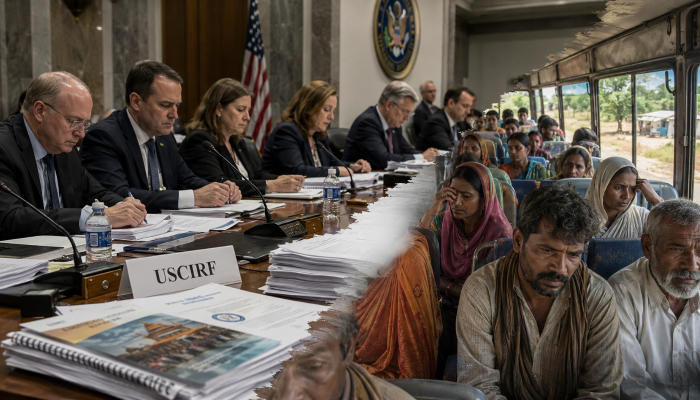
Case Summary
The United States Commission on International Religious Freedom (USCIRF), an independent bipartisan advisory body of the United States government, and a Western Christian publication citing its findings, portrayed the arrest of operators of a documented Christian conversion network in Uttar Pradesh as an instance of Christian persecution while omitting the circumstances that led to the arrests and the Hindu victims who were the targets of the conversion operation. The incident had earlier been documented by the Hinduphobia Tracker on 27 May 2026. In Kuthaund, Orai district of Uttar Pradesh, a Christian conversion network was intercepted by members of the Vishwa Hindu Parishad (VHP) and the police after more than twenty economically vulnerable Hindu villagers from multiple districts were found travelling on a bus bound for Lucknow. According to the investigation, the villagers had been lured through cash payments, financial inducements, and promises of material assistance as part of an organised conversion operation. Police subsequently arrested Pentecostal pastors Vivek Kumar and Mohit Chaudhary, along with another individual identified as Amit, under the Uttar Pradesh Prohibition of Unlawful Religious Conversion Act, 2021. Investigators further found that the accused had been travelling from village to village targeting poor Hindu families and persuading them to convert through financial inducements. Despite these documented facts, the USCIRF presented the arrests as evidence that allegations of forced religious conversion were being used in India to justify action against members of the Christian community. Its 2026 Annual Report argued that anti conversion laws were facilitating the arrest and harassment of religious minorities, specifically referring to arrests made under Uttar Pradesh's strengthened anti conversion framework. Neither the report nor the subsequent Western Christian publication acknowledged that the individuals arrested were accused of operating a conversion network targeting economically vulnerable Hindus or that the Hindu villagers intercepted on the bus were the intended targets of the alleged conversion operation. By omitting these facts, the documented Hindu victims disappeared from the narrative, while the accused operators of the conversion network were instead portrayed as victims of religious persecution. The USCIRF further recommended that the United States government designate India as a Country of Particular Concern (CPC) for the seventh consecutive year since 2020 over alleged violations of religious freedom. It also called for legislative measures requiring annual reporting on acts of transnational repression by the Indian government against religious minorities in the United States. The Western Christian publication amplified this narrative, citing the Kuthaund arrests as an example of worsening conditions for Christians in India without disclosing the findings of the police investigation or the allegations that the accused had been operating an organised conversion network targeting poor Hindu families through financial inducements.
Why it is Hate Crime ?
This incident has been added under Hate speech against Hindus, and within this, the subcategory selected is Anti Hindu subversion and prejudice. Hate speech is defined as any speech, gesture, conduct, writing, or display that is prejudicial against a specific individual and/or group of people, which is leading to or may lead to violence, prejudicial action or hate against that individual and/or group. Media plays a specific and overarching reach in perpetuating prejudicial attitudes towards a community owing to unfair, untrue coverage and/or misrepresentation/misinterpretation, selective coverage and/or omission of facts of/pertaining to issues affecting a specific religious group. This type of bias can dehumanise the victim group, making it easier for others to justify harmful actions against them, which aligns with the objectives of hate speech laws aimed at preventing such harm. It is often observed that the media takes a prejudicial stand against the Hindu community driven by their need to shield the aggressor community which happens to be a numeric minority, however, is the one perpetrating violence against Hindus. For example, the media is often quick to contextualise religiously motivated crimes against Hindus, omit or misrepresent facts that point towards religiously motivated hate crimes, justify and/or downplay religiously motivated hate crimes or simply present fake news to stereotype Hindus. Such media bias leads to the denial of persecution and is often used to dehumanise Hindus, leading to justification for violence against them. For example, the media covered several fake allegations of Hindus targeting Muslims and forcing them to chant Jai Shree Ram. Most of these cases were proved false and fabricated after police investigation. These fake news reports were subsequently never retracted or clarified. Such fake news led to the justification of violence and dehumanisation of Hindus based on the argument that since Hindus targeted Muslims and forced them to chant Jai Shree Ram, the dehumanisation of Hindus and violence against them was par for the course and merely a retaliation. Such media bias leads to prejudicial portrayal of Hindus and offers a justification for violence against them and therefore, is considered hate speech under this category. This incident has been categorised as a hate crime because it involved the inversion of a documented conversion operation in which Hindu victims disappeared from the narrative while the accused operators of the conversion network were portrayed as victims of religious persecution. Such reframing goes beyond a mere omission of facts. It fundamentally alters the nature of the incident by shifting public sympathy away from the targeted Hindu victims and towards those accused of attempting to convert them through unlawful means. According to the police investigation, the individuals arrested were accused of operating an organised conversion network that targeted economically vulnerable Hindu villagers through financial inducements and promises of material assistance. The Hindu villagers intercepted on the bus were the intended targets of the alleged conversion operation. However, the USCIRF and the Western Christian publication cited the arrests solely as examples of Christian persecution under India's anti-conversion laws, omitting the circumstances that led to the police action and the existence of the Hindu victims altogether. Such selective presentation is significant because it reframes a documented instance of alleged predatory proselytisation against Hindus into a narrative of victimhood for the accused. By excluding the experiences of the Hindu villagers and presenting only the perspective of the arrested individuals, the reports effectively erased the victimisation of Hindus from the public record. This not only obscures the alleged wrongdoing under investigation but also undermines the experiences of vulnerable Hindus who, according to the police investigation, had been specifically targeted for religious conversion through financial inducements. The incident also illustrates a broader pattern in which documented cases involving Hindu victims of conversion-related offences are recast in sections of international advocacy and media discourse as examples of persecution against Christian evangelists or missionaries. Such framing often overlooks the underlying allegations, the findings of police investigations, and the circumstances under which legal action was initiated. The result is that documented instances of Hindus being targeted for religious conversion are stripped of their context, while the focus shifts exclusively to the legal consequences faced by the accused. This selective inversion of victim and perpetrator has wider implications. It diminishes the visibility of predatory proselytisation targeting Hindus, weakens public recognition of the methods allegedly employed to induce religious conversion, and promotes a narrative in which the concerns and experiences of Hindu victims are rendered invisible. By erasing the Hindu victims from a documented conversion operation and recasting the accused as the sole victims of the incident, the reporting contributed to prejudice against Hindus and justified its classification in the Hinduphobia Tracker.


Case Status
Unknown


Perpetrators Details
Perpetrators
Others
Perpetrators Range
Unknown
Perpetrators Gender
unknown
 Sources




