Hindu villagers lured into conversion with promises of money, medical treatment, and financial assistance; rescued by Hindu activists
 Jalaun, Uttar Pradesh, India
  26 May, 2026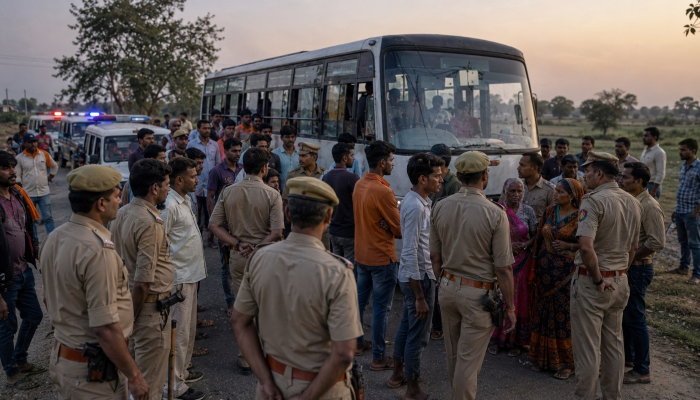
Case Summary
Hindu villagers from Orai district, Uttar Pradesh, were being transported to Lucknow on 27 May 2026 as part of an organised conversion operation that had been luring poor Hindu families from village to village with promises of money, medical treatment, and financial assistance as inducements to board the bus. The operation was intercepted by Vishwa Hindu Parishad [VHP] workers and local youth who stopped the bus, informed police, and secured the detention of 22 individuals including several women. The alleged conversion network had been operating from Udhgaon, Sirsa police station area, with organisers going door to door targeting economically vulnerable Hindu families. As per details, organisers of the conversion network had been visiting villages in the area and approaching poor Hindu families with financial inducements, including cash payments, promises of medical treatment, and other material assistance, to convince them to board the bus bound for Lucknow. Local youth Sachin Sharma and Deependra Shukla played a key role in exposing the network by gathering information and passing it to VHP and the police. VHP workers Aniket, Himanshu Dixit, Pankaj Shukla, Vinod, Vipul Dwivedi, and Vivek Singh reached the scene and intercepted the bus. The bus driver was caught and handed over to the police. Circle Officer Shailendra Bajpai, Sub-Divisional Magistrate [SDM] Jalaun, and a heavy police force arrived at the scene. Police took possession of the bus and began questioning all 22 individuals taken into custody. Among those detained were several named women from multiple villages in the area. Raja Singh, a resident of Manpura, was identified as the main coordinator of the network. Police stated that the network extended to Madhya Pradesh and that they were investigating the mobile numbers, call details, and contact networks of all individuals on the bus. The bus passenger list was handed over to the police. Tension prevailed in the area until late in the night following the incident. Police stated that a detailed investigation was underway and that further action would be taken after the investigation report.
Why it is Hate Crime ?
The primary category for this case is "Predatory Proselytisation" The sub-category for this case is "Conversion/attempts to convert by inducement". Predatory Proselytisation is not just limited to threat, harassment, force and violence, but it also has contours of stealth. In several cases, the Hindu victim is exploited to convert, with non-Hindus taking advantage of their poverty. In such cases, the Hindu victim who is suffering financially is offered monetary benefits, including lucrative offers for jobs, health treatment, education, etc, to induce the victim into changing his/her religion. In such cases, the religious identity of the victim and the aim to disenfranchise him from his faith form the heart of the crime. Also, taking advantage of and exploiting an individual’s economic vulnerabilities is widely acknowledged as exploitation, forms of which are often penalised by law. Such cases therefore are considered religiously motivated hate crimes since the victim’s religious identity forms the very heart of the crime itself. Another sub-category for this case is "Proselytisation by grooming, brainwashing, manipulation and subtle indoctrination". The tertiary category for this case is "Pattern of targeting Hindus". Religious brainwashing essentially means the often subtle and forcible indoctrination to induce someone to give up their religious beliefs to accept contrasting regimented ideas. Religious grooming or brainwashing also involves propaganda and manipulation. It involves the systematic effort, driven by religious malice and indoctrination, to persuade “non-believers’ to accept allegiance, command, or doctrine to and of a contrasting faith. Cases of such grooming or brainwashing are far more nuanced than direct threats, coercion, inducement and violence. In such cases, it is often seen that there is repeated, subtle and continual manipulation of the victim to induce disaffection towards their own faith and acceptance of the contrasting faith of the perpetrator. While subtle indoctrination is widely acknowledged as predatory, an element which is often understated in such conversions or the attempts of such conversion is the role of loyalty and trust which might develop between the perpetrator and the victim. Fiduciary relationships are often abused to affect such religious conversion. For example, an educator transmitting religious doctrine of a competing faith to a Hindu student. The Hindu student is likely to accept what the teacher is transmitting owing to existence of the fiduciary relationship. The exploitation of the fiduciary relationship to religiously indoctrinate victims would also be included in this category. Since the underlying animosity towards the victim’s faith forms the basis of predatory proselytization, such cases are considered religiously motivated hate crimes. The conversion operation intercepted in Orai district on 27 May 2026 was not an improvised or spontaneous gathering. It was a structured and resourced operation involving a bus, an organised network of recruiters, a receiving destination in Lucknow, and an established methodology of village-to-village targeting of economically vulnerable Hindu families through financial inducements. The scale and coordination of the operation, 22 individuals transported from multiple villages across the area with a named main coordinator and a network extending to Madhya Pradesh, reflects an institutional conversion programme rather than individual missionary activity. The targeting methodology reflects a deliberate exploitation of economic vulnerability as the primary instrument of conversion. The network's organisers approached the vulnerable Hindu villagers with money, medical treatment, and material assistance, choosing instruments of persuasion specifically calibrated to the economic condition of poor rural Hindu families for whom such offers represented genuine material relief. The selection of these specific inducements reflects a well-oiled strategy to target the economic desperation that could be exploited to produce the access required for conversion. The families boarding the bus were not making a free religious choice. They were responding to material offers made by a well-resourced organisation that had specifically designed its approach to circumvent their religious resistance by appealing to economic need. The use of inducements to convert individuals is indeed a common tactic in efforts to influence or manipulate vulnerable individuals into changing their faith. This approach often targets economically disadvantaged groups, offering material benefits such as food, money, or livestock in exchange for conversion. It creates a form of dependency that can alienate individuals from their original faith, as they may feel compelled to convert not out of genuine belief but due to immediate needs or financial pressures. Here too, the accused adopted a similar tactic of exploiting the vulnerability of the Hindus to convert them. The geographic reach of the network, from Udhgaon, Sirsa police station area, across multiple villages in Orai district, and extending into Madhya Pradesh, establishes that this was not a local or informal operation. It was a coordinated inter-district and potentially inter-state conversion network with established supply chains, recruitment methodologies, transportation infrastructure, and receiving facilities in Lucknow. The pattern dimension of this case is confirmed by the selection of rural Hindu communities in the Orai district as the target population. Poor Hindu families in rural Uttar Pradesh represent the same structurally vulnerable population targeted in the Odisha railway case, the Sindhudurg case, the Khatima case, and multiple other documented predatory proselytisation operations in the tracker's database. The recurrence of the same targeting methodology, financial inducement directed at economically vulnerable rural Hindu communities, across multiple states and multiple operations reflects a coordinated national strategy of conversion targeting rather than isolated local activity. Given that this case met the parameters of a religiously motivated hate crime, the network's conduct reflected more than the exercise of religious freedom or charitable activity. By organising a structured inter-district conversion operation targeting poor Hindu families through financial inducements, transporting them to a receiving destination under the cover of material assistance, and operating a network that extended across state boundaries with a named coordinator and established contact networks, the organisers demonstrated a deliberate and coordinated campaign to remove Hindu individuals from their faith through the systematic exploitation of their economic vulnerability. The Hindu villagers of Orai district were targeted specifically because they were Hindu and because their poverty made them accessible to a conversion methodology that treated their faith as an obstacle to be overcome through financial transaction. This reflects an underlying hostility toward Hindu religious identity that cannot be characterised as anything other than religiously motivated. Given that this case met the parameters of a religiously motivated hate crime, it was added to the hate crime database of the tracker.
Victim Details
Total Victim
22
Deceased
0
Gender
- Male 0
- Female 0
- Third Gender 0
- Unknown 22
Caste
- SC/ST 0
- OBC 0
- General 0
- Unknown 22
Age Group
- Minor 0
- Adult 0
- Senior Citizen 0
- Unknown 22


Case Status
Arrested


Perpetrators Details
Perpetrators
Christian Extremists
Perpetrators Range
From 10 to 100
Perpetrators Gender
both
 Sources




