Hindu woman abducted, forcibly converted and coerced to perform nikah by Muslim man in Pakistan
 Sindh, Pakistan
  12 May, 2026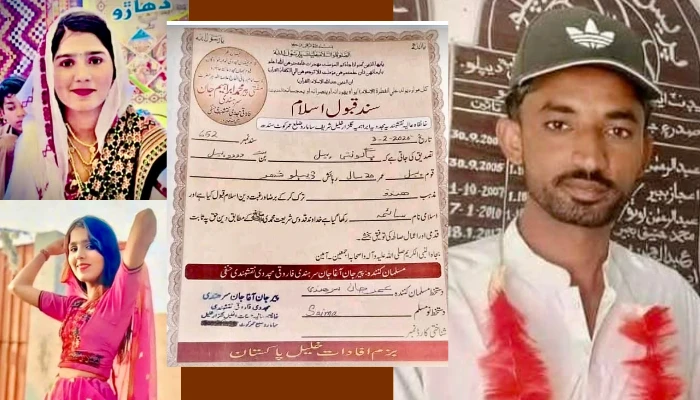
Case Summary
In Tharparkar district of Sindh, Pakistan, Hindu singer Bhagwanti Bheel, a married Hindu woman and mother of a child from Diplo, was abducted and forcibly converted to Islam by a Muslim man. The accused, Islamist journalist Saddam Bajir, abducted the victim and forcibly converted her to Islam at the shrine of Pir Ayoub Jan Sarhandi in Samaro. Following the conversion, her Hindu name was changed to Saima, and she was immediately married to Saddam Bajir through nikah. The victim, Bhagwanti Bheel, was taken away from her Hindu family and husband despite already being married and having a child. After her forced conversion at the Islamic shrine, she was made to appear in a statement claiming that she had converted and married “of her own free will”, a pattern frequently seen in forced conversion cases involving Hindu women and girls in Pakistan. The immediate nikah conducted after the conversion effectively severed Bhagwanti from her Hindu identity, family structure, and legal protections. Such rapid marriages following conversion are widely viewed as a tactic used to create legal and social barriers preventing Hindu victims from returning to their families or challenging the forced conversion. By quickly formalising the marriage under Islamic law, perpetrators often attempt to shield themselves from legal scrutiny and legitimise the abduction and conversion. The incident triggered outrage among minority rights activists and social media users, many of whom highlighted the growing pattern of abduction, forced conversion, and forced marriage of Hindu women and girls in Sindh. Concerns were raised regarding the vulnerability of Hindu minorities in Pakistan, particularly Hindu women, who are frequently targeted for religious conversion and marriage under coercive circumstances. At the time of reporting, Bhagwanti Bheel was stated to be in the custody of Saddam Bajir following the conversion and nikah. Calls were raised for immediate intervention, protection for the victim, and stronger safeguards for Hindu minorities facing forced religious conversions in Pakistan. This was not the first time that women and minor girls were abducted and forcibly converted in Pakistan. The Hinduphobia Tracker had previously documented numerous similar cases. For example, in Mirpur Khas, Sindh, a minor Hindu girl named Maria, daughter of Shamon Bheel of Village Usman Shah Hadi, Tando Allahyar, was abducted and forcibly converted to Islam. She was married to her abductor, Naeem Memon Rajput, aged twenty-nine, and her name was changed to Naila Sheikh. Her family stated that the conversion and marriage were carried out without consent and under coercion. In September 2025, in Umerkot, Sindh, a minor Hindu girl named Shardha Oad was abducted and subjected to forced religious conversion and marriage by a Muslim man named Riaz Ali and his accomplices. The case came to light after her widowed mother, Kamla Oad, approached the Women’s Police Station in Umerkot seeking justice. In September 2025, in Mirpur Khas, Sindh, a minor Hindu girl named Aneeta Thakur was abducted and subjected to forced religious conversion and marriage to a Muslim man named Abdul Rehman Mallah. In March 2026, in Dhilyar, Khipro, Sindh province, Pakistan, a Hindu woman and her minor daughter were abducted at gunpoint, sexually abused and forcibly converted to Islam by armed Muslim men. The victims were Pari, aged around 35 years, and her daughter Sapna, aged approximately 10 years. This current case highlights the persecution faced by the Hindu minorities in Pakistan, marked by systemic discrimination, violence, and forced conversions. Hindu women, particularly young girls, are often abducted, forcibly converted to Islam, and married off to Muslim men with little to no legal recourse. Temples are frequently vandalised or destroyed, and Hindu communities are subjected to social and economic marginalisation. Blasphemy laws are disproportionately used against Hindus, leading to false accusations and severe punishments. Many Hindu families are forced to flee their homes due to religious intolerance, living in constant fear of attacks. This sustained persecution highlights the dire conditions for Hindus in Pakistan, where their religious identity makes them targets of oppression.
Why it is Hate Crime ?
The primary category for this case is "Predatory Proselytisation". The sub-category here is "Harassment, threats, coercion for conversion". Harassment covers a wide range of behaviours of an offensive nature. It is commonly understood as behaviour that demeans, humiliates, and intimidates a person, including threats and coercion. Harassment and threats, in this case, find their root on discriminatory grounds, which has the effect of nullifying a person’s rights or infringing upon his freedom to exercise his right specifically owing to the victim’s religious identity. Verbal and physical threats and psychological or physical harassment are often used against Hindu victims because they choose to practice their professed religion. Religious harassment also includes forced and involuntary conversions by harassment, threats or coercion. Coercion includes intimidatory tactics like force-feeding a Hindu victim beef to convert to another religion, forceful circumcision, etc. In several cases documented, non-Hindu perpetrators or those who harbour specific animosity towards Hinduism, harass victims simply based on their religious identity. Such cases often also include harassment to ensure the Hindu victim abandons his/her professed religion and adopts the religion of the perpetrator. Such cases, where Hindu victims are harassed to convert to the perpetrator’s religion, are rooted in animosity towards the victim’s religious identity and are therefore documented as religiously motivated hate crimes. This case qualifies as a religiously motivated hate crime because a married Hindu woman and mother was abducted, forcibly converted to Islam, stripped of her Hindu identity, and immediately married through nikah to a Muslim man. The sequence of abduction, conversion, renaming, and marriage reflected a systematic process aimed at erasing the victim’s existing Hindu religious and familial identity and replacing it with an Islamic one through coercion and captivity. The first religious marker in this case was the deliberate targeting of a Hindu woman belonging to a vulnerable minority community in Sindh. Hindu women in Pakistan, particularly in Sindh, occupy a deeply vulnerable position due to their minority status and limited institutional protection. The perpetrator specifically targeted a Hindu woman despite her already being married and having a child. This demonstrated that the objective was not a consensual relationship but the removal of a Hindu woman from her existing religious and family structure to absorb her into an Islamic identity and household. The forced conversion itself was another clear religious marker. The victim was taken to an Islamic shrine where she was converted to Islam and assigned a new Muslim name. The replacement of her Hindu name with a Muslim one symbolised the deliberate erasure of her original religious identity. A name is not merely administrative; it is one of the most immediate markers of cultural, familial, and religious belonging. By removing her Hindu name and imposing a Muslim identity upon her, the perpetrators effectively severed her visible connection with her Hindu roots and community. The immediate nikah conducted after the conversion further exposed the coercive and organised nature of the process. Such rapid marriages following conversion are frequently used to create legal and social barriers preventing Hindu victims from returning to their families or reclaiming their religious identity. The conversion and nikah were therefore not isolated acts but interconnected steps in a process designed to make the religious transformation appear permanent and legally protected. The timing of the marriage indicated that the religious conversion was central to the perpetrators' objective. Another important aspect was the scripted statement claiming that the victim had converted and married “of her own free will.” Such statements are repeatedly observed in forced conversion cases involving Hindu women and girls in Pakistan and are often produced while the victim remains under the control of the perpetrators. The existence of such a statement, immediately after abduction and conversion, did not eliminate the surrounding indicators of coercion, captivity, and religious targeting. Instead, it reflected a recurring pattern through which forced religious conversions are publicly sanitised and legitimised. The incident also reflected a broader pattern of hostility and insecurity faced by Hindu minorities in Pakistan, particularly Hindu women. The repeated targeting of Hindu women for abduction, conversion, and marriage creates an atmosphere of fear within the community and reinforces the perception that Hindu identity itself has become a basis for religiously motivated victimisation. Such acts do not merely affect individual victims but strike at the continuity, dignity, and security of the minority Hindu community as a whole. Moreover, it stems from inherent hostility towards the victim's professed faith since Abrahamic faiths believe that any non-adherent to the faith is subject to being dehumanised till they convert. Since such predatory actions stem from doctrinal animosity towards the Hindu faith and its adherents, this case is being documented as a religiously motivated hate crime. Disclaimer: The Hinduphobia Tracker records incident dates based on when the crime occurred, not when it was reported or published. However, when the exact date the ordeal began is not specified in the available sources, the reporting date is used as the indicative incident date for documentation purposes only, as in this case.
Victim Details
Total Victim
1
Deceased
0
Gender
- Male 0
- Female 1
- Third Gender 0
- Unknown 0
Caste
- SC/ST 1
- OBC 0
- General 0
- Unknown 0
Age Group
- Minor 0
- Adult 1
- Senior Citizen 0
- Unknown 0


Case Status
Unknown


Perpetrators Details
Perpetrators
Muslim Extremists
Perpetrators Range
One Person
Perpetrators Gender
male
 Sources




