Hindu Brahmin community defamed through “Brahmanical Patriarchy” question in BHU exam
 Varanasi, Uttar Pradesh, India
  19 May, 2026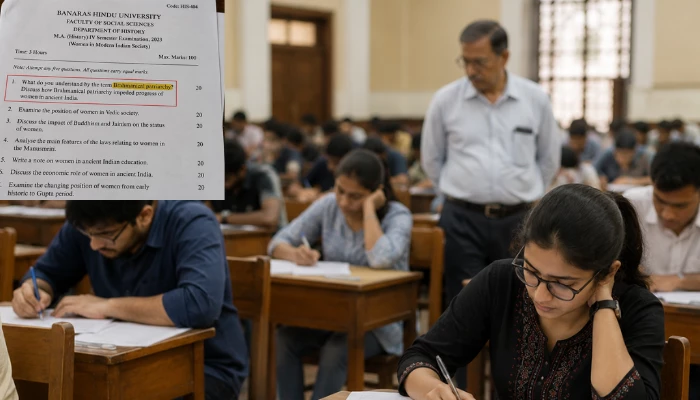
Case Summary
The Hindu Brahmin community was defamed and portrayed negatively in an MA History fourth-semester examination paper conducted by Banaras Hindu University. Students were asked to explain the term “Brahmanical patriarchy” and discuss how it impeded the progress of women in ancient India. The question appeared in an examination conducted by the History Department under the Faculty of Social Sciences. It formed part of the course titled “Women in Modern Indian Society.” Images of the question paper circulated widely on social media after the examination. The paper triggered reactions from students, members of the Brahmin community, and political figures. Objections were raised over the use of the term “Brahmanical patriarchy” in the examination paper. Congress city president Raghvendra Chaubey reacted to the controversy and described the matter as unfortunate and concerning. He stated that educational institutions should present factual history and should not promote ideological agendas through academic content. He also demanded withdrawal of the question from the examination paper. After the paper surfaced online, students and professors staged protests inside the university campus. Several individuals objected to the language used in the question paper, stating that it insulted and stereotyped Brahmins. The controversy intensified after a statement by Shankaracharya Avimukteshwaranand. He stated that attempts were being made to divide Hindu society along caste lines and that such incidents created distance within society. He said that Brahmins, Kshatriyas, Vaishyas, and Shudras were all integral parts of Hindu society and that efforts to create conflict among them were wrong. Following his statement, the issue became a subject of discussion among religious and social organisations as well. The Banaras Hindu University administration later issued a clarification regarding the controversy. The university claimed that the question had been framed in accordance with the prescribed syllabus and academic curriculum. The administration stated that the question formed part of approved course material taught under the programme. When Vice-Chancellor Professor Ajit Chaturvedi was questioned regarding the controversy, he avoided giving a direct response and stated that the matter would be discussed later. Reports stated that pressure from students and teachers regarding the issue continued to increase. The controversy subsequently expanded beyond the examination paper itself and became part of a broader debate concerning academic freedom, interpretation of history, and social sensitivity in educational institutions. Reports stated that the matter could become a larger subject of political and social discussion in the coming days. This incident did not stand in isolation. Similar controversies have repeatedly emerged across universities and educational institutions where Hinduism, Brahmin identity, or Hindu religious traditions were framed through hostile or derogatory ideological lenses in academic and activist spaces. At Azim Premji University, visuals from a campus event surfaced online showing a speaker standing near a podium bearing the university’s name while a display in the background carried the slogan “Annihilate Hinduism.” The display also depicted B. R. Ambedkar holding a copy of the Manusmriti shown in flames. At Ashoka University, slogans including “Brahmin–Baniyawaad Murdabad”, “Jai Bheem–Jai Meem”, and “Jai Savitri–Jai Fatima” were raised during campus protests. In 2023, the university also faced controversy regarding a research paper authored by Sabyasachi Das concerning electoral processes. At OP Jindal Global University, a campus event titled “Ram Mandir: A Farcical Project of Brahmanical Hindutva Fascism” was organised in February 2024 by the Revolutionary Students League. The organisers stated that the Ayodhya Ram Mandir Pran Pratishtha ceremony reflected what they described as the “inherent violence and anti-people nature of the Brahmanical Hindutva fascist state.” OP Jindal Global University also faced another controversy involving faculty member Sameena Dalwai, who was accused by some students of targeting students she considered “right-wing” and objecting to “Jai Shri Ram” slogans on campus. In 2021, the “Dismantling Global Hindutva” conference was organised virtually with the participation and co-sponsorship of multiple universities, including the University of Oxford. During the conference, speaker Kavita Krishnan linked the killing of a Muslim woman by her brothers to the Hindu festival of Raksha Bandhan. Journalist Neha Dixit attributed bodies found in rivers during the COVID-19 pandemic to the cost of Hindu cremation practices. Other speakers made remarks regarding Hindu deities and traditions. The organisers of the “Dismantling Global Hindutva” conference also stated that Hinduphobia rested on what they described as a “false notion” of systemic oppression against Hindus and asserted that anti-Hindu bias could not be linked to large-scale historical harm.
Why it is Hate Crime ?
This case has been documented under the selected primary category: Hate speech against Hindus, and, within this, the subcategory selected is- Anti-Hindu subversion and prejudice. Hate speech is defined as any speech, gesture, conduct, writing, or display that is prejudicial against a specific individual and/or group of people, which leads to or may lead to violence, prejudicial action or hate against that individual and/or group. Media plays a specific and overarching role in perpetuating prejudicial attitudes towards a community owing to unfair, untrue coverage and/or misrepresentation/misinterpretation, selective coverage and/or omission of facts of/about issues affecting a specific religious group. This type of bias can dehumanise the victim group, making it easier for others to justify harmful actions against them, which aligns with the objectives of hate speech laws aimed at preventing such harm. It is often observed that the media takes a prejudicial stand against the Hindu community, driven by their need to shield the aggressor community, which happens to be a numeric minority; however, that is the one perpetrating violence against Hindus. For example, the media is often quick to contextualise religiously motivated crimes against Hindus, omit or misrepresent facts that point towards religiously motivated hate crimes, justify and/or downplay religiously motivated hate crimes, or simply present fake news to stereotype Hindus. Such media bias leads to the denial of persecution and is often used to dehumanise Hindus, leading to justification for violence against them. For example, the media covered several fake allegations of Hindus targeting Muslims and forcing them to chant Jai Shree Ram. Most of these cases were proved false and fabricated after police investigation. These fake news reports were subsequently never retracted or clarified. Such fake news led to the justification of violence and dehumanisation of Hindus based on the argument that since Hindus targeted Muslims and forced them to chant Jai Shree Ram, the dehumanisation of Hindus and violence against them was par for the course and merely a retaliation. Such media bias leads to prejudicial portrayals of Hindus and offers a justification for violence against them and, therefore, is considered hate speech under this category. At the outset, the controversy stemmed from the manner in which Brahmin identity and Hindu traditions were framed in an official Banaras Hindu University examination paper. Students were asked to explain the term “Brahmanical patriarchy” and discuss how it obstructed the progress of women in ancient India. The framing directly associated a Hindu community and traditions rooted in the Hindu civilisational structure with oppression and social injustice, presenting Brahmin identity through a prejudicial lens in an institutional academic setting. The expression “Brahmanical patriarchy” is not ideologically neutral. It has frequently been used in activist and ideological discourse to portray Hindu traditions, scriptures, priesthood systems, and Brahmin communities as inherently oppressive and regressive. By including such terminology in an official university examination without balance or contextual nuance, the university gave academic legitimacy to a narrative many viewed as defamatory towards Brahmins and hostile towards Hindu traditions. The controversy also cannot be separated from Hindu identity itself. Brahmins are not an isolated social category detached from Hinduism. Brahmin traditions, priesthood roles, ritual systems, and scriptural interpretation are deeply embedded within Hindu religious and civilisational life. Therefore, repeatedly portraying “Brahmanical” traditions as synonymous with oppression indirectly delegitimises important components of the Hindu religious structure itself. This is why many students, professors, and Hindu religious figures viewed the question as more than a sociological critique and instead as an institutionalised negative portrayal of Hindu identity. Another important aspect was the role of institutional authority. This was not a slogan raised during a protest or an opinion shared online. The framing appeared in an official university examination conducted under an approved syllabus in one of India’s most prominent institutions associated with Hindu identity. Students were academically required to engage with and reproduce the framing within an examination environment, thereby normalising contested ideological language targeting Hindu traditions through formal educational structures. The BHU controversy also did not emerge in isolation. Similar rhetoric targeting Hindu identity and Brahmin traditions has repeatedly surfaced across academic and activist spaces through slogans and events such as “Annihilate Hinduism,” “Brahmanical Hindutva Fascism,” and “Dismantling Global Hindutva.” In many such cases, criticism extends beyond discussion of specific social issues and becomes directed towards the broader religious and cultural identity of Hindus themselves. Taken together, the use of ideologically charged terminology portraying Brahmin traditions as inherently oppressive, the institutional legitimacy granted to such framing through a university examination, and the broader pattern of hostile academic rhetoric directed towards Hindu identity established the religiously aggravating nature of the controversy. The incident reflected a growing trend where Hindu traditions and communities are increasingly framed negatively through academic and ideological discourse that normalises hostility towards Hindu civilisational identity. Disclaimer: The Hinduphobia Tracker records incident dates based on when the victim's ordeal began, rather than when the media reported it. In this case, the exact date of the examination was not specified in the report; therefore, the date when the controversy was first reported publicly has been recorded as the indicative incident date for documentation purposes.


Case Status
Unknown


Perpetrators Details
Perpetrators
Others
Perpetrators Range
Unknown
Perpetrators Gender
unknown
 Sources




