Hinduphobia in the name of academic freedom: Azim Premji University hosts event calling for "annihilating Hinduism"
 Bengaluru, Karnataka, India
  17 April, 2024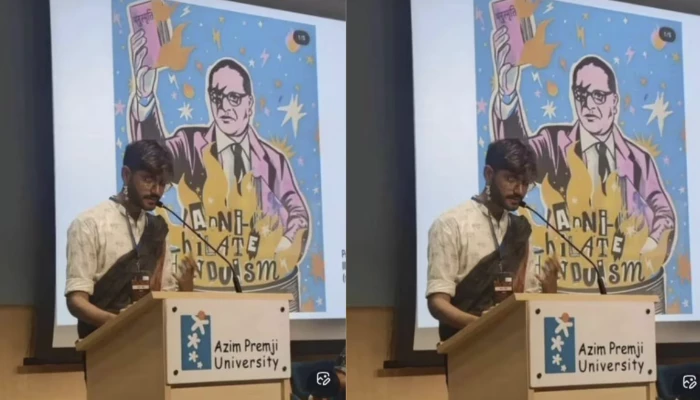
Case Summary
The Hindu religion was directly targeted at a college event held at Azim Premji University, where the central theme openly called for “Annihilating Hinduism.” This was not incidental but formed the core framing of the programme, placing a call for the destruction of a specific religion within an academic setting. Visuals from the event surfaced on social media, showing a student speaker standing beside a podium bearing the university’s name. In the background, a large display featured B. R. Ambedkar holding a copy of the Manusmriti depicted in flames, alongside the bold slogan “Annihilate Hinduism.” The setting appeared to be a formal academic lecture or discussion. The exact date of the event was not specified. However, the visuals were widely circulated online, bringing the incident into public attention. The phrase “Smash Brahmanical Patriarchy” was also referenced in the broader discourse surrounding such themes. In a similar instance in 2019, Jack Dorsey, during his visit to India, posed with a placard carrying the same slogan, which drew public attention and debate. This incident did not stand in isolation. Reports pointed to similar instances across educational institutions where Hinduism was subjected to derogatory or hostile framing. It was noted that segments within social sciences, humanities, and liberal arts departments in several universities have been associated with ideological positions that influence academic discourse. At IIT Bombay in November 2023, students filed a police complaint about an online lecture delivered by Sudhanva Deshpande that discussed Palestinian figures such as Zakaria Zubeidi and Ghassan Kanafani. At Ashoka University, slogans including “Brahmin–Baniyawaad Murdabad”, “Jai Bheem–Jai Meem”, and “Jai Savitri–Jai Fatima” were raised during campus protests. The institution also faced criticism in 2023 over a research paper by Sabyasachi Das concerning electoral processes. At OP Jindal Global University, an event titled “Ram Mandir: A Farcical Project of Brahmanical Hindutva Fascism” was organised on the campus of OP Jindal University in February 2024. The event was organised by a group called the Revolutionary Students League, which claimed that the Pran Prathishtha Ceremony at the Ayodhya Ram Temple on January 22nd, 2024, exposed ‘the inherent violence and anti-people nature of the Brahmanical Hindutva fascist state”. Likewise, OP Jindal got into another controversy when one os the university's faculty members, Prof. Sameena Dalwai, was called out for harassing students she deemed "right-wing" and for criticising "Jai Shri Ram" slogans on campus. Further, in 2021, the “Dismantling Global Hindutva” conference was held virtually, primarily organised and co-sponsored by multiple universities in the United States, including prominent institutions such as the University of Oxford. During this conference, speaker Kavita Krishnan, Communist Party of India (Marxist-Leninist), attempted to link the killing of a Muslim woman by her brothers to the Hindu festival of Raksha Bandhan. Neha Dixit attributed bodies found in rivers during the COVID-19 pandemic to the cost of Hindu cremation practices. Other speakers made derogatory and hyper-sexualised remarks about Lord Rama and advanced interpretations linking Lord Hanuman’s army to oppressed communities in a contentious manner. The organisers of the conference also stated that Hinduphobia rests on what they described as a “false notion” of systemic oppression against Hindus, asserting that anti-Hindu bias cannot be linked to large-scale historical harm.
Why it is Hate Crime ?
This case has been documented under the selected primary category: Hate speech against Hindus, and, within this, the subcategory selected is- Violent Threats. Violent threats, explicit, implicit or implied, are the most dangerous form of hate speech since it goes beyond discriminatory and prejudicial language to express the intent of causing harm to an individual or a group of people based on their religious identity and faith. There could be several different kinds of threats that are issued to Hindus based on religious animosity. An explicit threat would mean the direct threat of violence towards an individual Hindu, a group of Hindus or Hindus at large. Physical violence, death threats, threats of destruction of property belonging to Hindus and threats of genocide would mean explicit threats against Hindus for their religious identity. Implicit threats may not be a direct threat but implied through the use of symbols of actions – for example, in the Nupur Sharma case, other than explicit threats, there were also implicit threats when Islamists took to the streets to burn and beat her effigies. It implies that they want to do the same to Nupur Sharma, which is considered an implicit threat. Violent threats can be delivered in person, through letters, phone calls, graffiti, or increasingly through social media and other online platforms. It would be important to understand that a threat – explicit or implicit, online or offline – to an individual who happens to be a Hindu does not qualify as a religiously motivated threat. Such a threat, while vile and dangerous, could be owing to non-religious reasons and/or personal animosity. To qualify as a religiously motivated threat, it would need to exhibit an indication that the individual is being targeted for religious reasons and/or owing to his/her religious identity as a Hindu. The other subcategory selected is- Anti-Hindu subversion and prejudice. Hate speech is defined as any speech, gesture, conduct, writing, or display that is prejudicial against a specific individual and/or group of people, which leads to or may lead to violence, prejudicial action or hate against that individual and/or group. Media plays a specific and overarching role in perpetuating prejudicial attitudes towards a community owing to unfair, untrue coverage and/or misrepresentation/misinterpretation, selective coverage and/or omission of facts of/about issues affecting a specific religious group. This type of bias can dehumanise the victim group, making it easier for others to justify harmful actions against them, which aligns with the objectives of hate speech laws aimed at preventing such harm. It is often observed that the media takes a prejudicial stand against the Hindu community, driven by their need to shield the aggressor community, which happens to be a numeric minority; however, that is the one perpetrating violence against Hindus. For example, the media is often quick to contextualise religiously motivated crimes against Hindus, omit or misrepresent facts that point towards religiously motivated hate crimes, justify and/or downplay religiously motivated hate crimes, or simply present fake news to stereotype Hindus. Such media bias leads to the denial of persecution and is often used to dehumanise Hindus, leading to justification for violence against them. For example, the media covered several fake allegations of Hindus targeting Muslims and forcing them to chant Jai Shree Ram. Most of these cases were proved false and fabricated after police investigation. These fake news reports were subsequently never retracted or clarified. Such fake news led to the justification of violence and dehumanisation of Hindus based on the argument that since Hindus targeted Muslims and forced them to chant Jai Shree Ram, the dehumanisation of Hindus and violence against them was par for the course and merely a retaliation. Such media bias leads to prejudicial portrayals of Hindus and offers a justification for violence against them and, therefore, is considered hate speech under this category. At the outset, the event was built around a theme that openly called for the “annihilation” of Hinduism. The phrase formed part of the event’s framing, indicating that the discussion itself was centred on dismantling or destroying a specific religion, the Hindu religion, rather than presenting a neutral academic critique. Therefore, this was not reform or debate but a direct articulation of erasure, making the intent clear and inherently hostile towards Hindu identity. Moreover, the case squarely fell within the scope of violent threats. The call for “annihilation” signified elimination at a collective level and conveyed an implicit threat against Hindus as a community. In particular, when a religion was framed as something that must be destroyed, it signalled that its followers had no legitimate place. The imagery of sacred texts shown in flames reinforced this message, turning the expression into one of destruction rather than discourse. In addition, the incident also reflected a wider pattern within certain academic spaces. Bharatiya universities have increasingly become sites where such subversive narratives targeting Hindu Dharma and culture are presented under the guise of academic freedom. As a result, the fact that a university could host an event calling for the annihilation of a religion, followed by the majority of the population, did not emerge as an isolated shock but as part of a growing trend where such expressions have been normalised. Consequently, this normalisation points towards deeper prejudice and subversion. Such events, including calls for the destruction of Hindu Dharma or even extreme rhetoric against specific Hindu communities, have increasingly been treated as acceptable within certain circles. Thus, the framing of Hinduism in consistently negative terms contributes to a narrative that dehumanises the faith and those who follow it. Furthermore, the role of sections within academia further intensifies this pattern. Some faculty members, driven by rigid ideological positions, influence discourse in ways that promote one‑sided, politically charged narratives. In turn, within such environments, students are exposed to perspectives that frame Hindu identity as inherently problematic, shaping thought processes in a direction that normalises hostility rather than encouraging balanced critical engagement. Beyond this, the broader context reinforces the trajectory. References to global platforms such as the “Dismantling Global Hindutva” conference show how similar narratives have been used to blur the distinction between Hinduism and Hindutva, enabling sweeping attacks on Hindu identity. Indeed, statements made in such forums, including derogatory portrayals of Hindu beliefs and deities, reflected a continuing pattern of delegitimisation. Hindutva is often used as a euphemism to make the targeting of Hindus more palatable. Hindutva is essentially a unifying ideology for Hindus, which became imperative for Hindus to find and preserve their cultural identity, which was being eroded and attacked due to Islamic invasions, British colonisation, Christian theological impositions and conversions. Hindutva is not a destructive ideology, as some attempt to portray, but one that is used as a unifying edifice for Hindus. Hindutva is also often used as a euphemism to target Hindus on the whole and their religious identity and faith. It is essentially semantic jugglery to confuse Hindus into believing that their own persecution by supremacists is somehow 'justified' because the specific victims espoused an ideology (Hindutva) which deserves the onslaught. The fact that the use of 'Hindutva' is merely to mask animosity towards Hindus was evident from the "Dismantling Global Hindutva" conference held in the USA, where speakers unabashedly spoke about how Hindutva and Hinduism are indistinguishable and therefore, to "dismantle Hindutva" one would have to "dismantle Hinduism". The practices of targeting Hindus and their religious and cultural identity, and justifying that victimisation and dehumanisation by using euphemisms like "Hindutva", stem from inherent animosity and hostility towards Hindus. Taken together, the cumulative effect of these elements made the hostility unmistakable. The explicit call for annihilation, the visual symbolism of destruction, the academic platform used to legitimise such messaging, and the wider pattern of similar narratives all pointed towards a sustained and targeted expression of hate. Ultimately, this was not an isolated act of speech but part of a continuing pattern that fostered fear, exclusion, and hostility towards Hindus. Disclaimer: The Hinduphobia Tracker records incident dates based on when the victim's ordeal began, rather than when the media reported it. In this case, the report does not mention the exact date when the conference took place; therefore, the date when the report was published has been recorded as the indicative incident date for documentation purposes.


Case Status
Unknown


Perpetrators Details
Perpetrators
Others
Perpetrators Range
Unknown
Perpetrators Gender
unknown
 Sources




