Hindu sentiments mocked: police dismiss Shivling desecration act by Muslim man in Bihar's Nawada, calls the sacred idol "just a stone"
 Nawada, Bihar, India
  18 May, 2026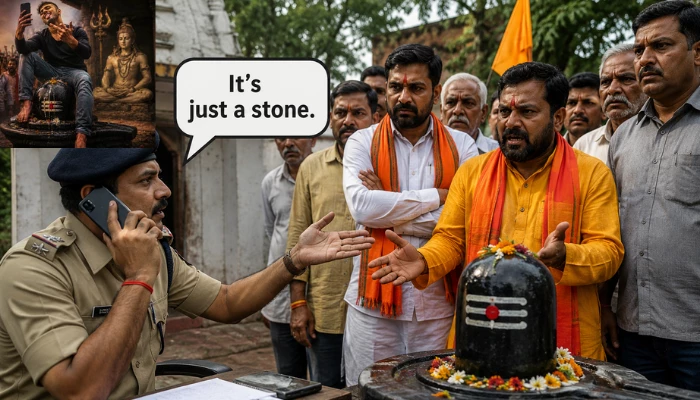
Case Summary
The Hinduphobia Tracker documented how, in Berauta village of Narhat block in Nawada district, Bihar, a sacred Hindu Shivling was desecrated by a Muslim man. The accused sat on the Shivling, mocked the Hindu religious symbol, and recorded the act on video. After the video of the incident went viral, the police resorted to downplaying the incident, with the Circle officer dismissing the act by calling the sacred Shivling a "stone". According to reports, the incident took place at a religious site in the village and later came to public attention after the video of the act went viral on social media. The visuals triggered anger among Hindu residents, and they approached the Police. The Police dismissed the whole act, calling it child's play. The Narhat Circle Officer issued a written statement describing the Shivling as “just a stone”. The remarks were widely criticised by Hindu organisations and residents, who stated that reducing a sacred Hindu religious symbol to an ordinary stone amounted to an insult to the Hindu faith and religious sentiments. The statement was viewed as an attempt to trivialise and downplay the desecration of a sacred object deeply revered by Hindus. Members of the Vishva Hindu Parishad and Bajrang Dal strongly objected to the remarks and demanded the Circle Officer's suspension. Hindu representatives stated that such comments from a government official in a matter concerning religious faith had deeply hurt the sentiments of the Hindu community and reflected insensitivity towards Hindu beliefs and traditions. After protests by local Hindus and growing public outrage, the administration initiated action. SP Abhinav Dheeman arrived at the spot with heavy police deployment and began an investigation. The accused, Mohammad Irfan, was subsequently taken into custody by the police.
Why it is Hate Crime ?
The primary category selected is "Hate Speech". Within it, the sub-category selected is "Anti-Hindu subversion and prejudice". And the tertiary category selected is "Anti-Hindu Fake News or Downplaying". Hate speech is defined as any speech, gesture, conduct, writing, or display that is prejudicial against a specific individual and/or group of people, which leads to or may lead to violence, prejudicial action or hate against that individual and/or group. Media plays a specific and overarching role in perpetuating prejudicial attitudes towards a community owing to unfair, untrue coverage and/or misrepresentation/misinterpretation, selective coverage and/or omission of facts of/about issues affecting a specific religious group. This type of bias can dehumanise the victim group, making it easier for others to justify harmful actions against them, which aligns with the objectives of hate speech laws aimed at preventing such harm. It is often observed that the media takes a prejudicial stand against the Hindu community, driven by their need to shield the aggressor community, which happens to be a numeric minority; however, that is the one perpetrating violence against Hindus. For example, the media is often quick to contextualise religiously motivated crimes against Hindus, omit or misrepresent facts that point towards religiously motivated hate crimes, justify and/or downplay religiously motivated hate crimes, or simply present fake news to stereotype Hindus. Such media bias leads to the denial of persecution and is often used to dehumanise Hindus, leading to justification for violence against them. For example, the media covered several fake allegations of Hindus targeting Muslims and forcing them to chant Jai Shree Ram. Most of these cases were proved false and fabricated after police investigation. These fake news reports were subsequently never retracted or clarified. Such fake news led to the justification of violence and dehumanisation of Hindus based on the argument that since Hindus targeted Muslims and forced them to chant Jai Shree Ram, the dehumanisation of Hindus and violence against them was par for the course and merely a retaliation. Such media bias leads to prejudicial portrayals of Hindus and offers a justification for violence against them and, therefore, is considered hate speech under this category. This case was added to the tracker because a sacred Shivling worshipped by Hindus was deliberately desecrated and mocked, after which the seriousness of the act was publicly downplayed by sections of the administration. The remarks describing the Shivling as “just a stone” and dismissing the incident as a child “playing” amounted to a trivialisation of the deep religious injury caused to Hindus. Such statements ignored the sacred significance the Shivling holds within Hinduism and reduced a targeted act of humiliation against a revered Hindu religious symbol to casual behaviour. Further, the attempt to portray the desecration as harmless conduct downplayed the evident religious targeting involved in the act. If the incident had merely been innocent behaviour or random misconduct, there would have been no reason to specifically target a sacred Shivling located at a Hindu religious site. The selective humiliation of one of the holiest symbols in Hinduism reflected clear hostility towards Hindu religious beliefs and sensitivities. By reducing the act to childish behaviour and denying its religious dimension, the seriousness of the offence and the emotional injury caused to Hindus were minimised in public discourse. Moreover, the downplaying of crimes targeting Hindu religious symbols is not an isolated phenomenon. In several such cases, despite the religious nature of the targeting being apparent from the facts, authorities or sections of the media often deny the presence of any communal angle or attempt to portray the incident as ordinary misconduct. Such responses frequently contribute to the erasure of Hindu grievances by dismissing or diluting the hostility directed towards Hindu faith and traditions. For example, in the case of Rinku Sharma, the Bajrang Dal activist who was stabbed to death inside his home in Delhi’s Mangolpuri area in 2021, repeated attempts were made by sections of the media and political ecosystem to deny any communal motive behind the killing. Even though the victim’s family and individuals present on the ground pointed towards religious hostility linked to his support for the Ram Mandir movement, the incident was publicly projected as having no communal angle. The surrounding circumstances and testimonies, however, suggested otherwise. Cases such as these demonstrate how repeated denial or minimisation of anti-Hindu hostility can shape public perception and obscure the religious targeting involved in such incidents. Similarly, in the present case, the remarks made by the Circle Officer contributed to the trivialisation of the desecration despite the clear and selective targeting of a sacred Hindu religious symbol. Referring to the Shivling as “just a stone” disregarded the spiritual and religious significance attached to it by millions of Hindus and reduced a deeply offensive act into something casual and insignificant. Such statements not only intensified the hurt experienced by the Hindu community but also contributed to the broader pattern of minimising or dismissing hostility directed towards Hindu religious symbols and practices. The reaction of the Hindu community reflected the profound emotional and spiritual injury caused by both the desecration and its subsequent downplaying. Local Hindus gathered in large numbers, expressed outrage, and conducted purification rituals with Gangajal to restore the sanctity of the desecrated Shivling. In Hinduism, purification rituals are performed when a sacred object or religious space is believed to have been spiritually defiled. The need felt by devotees to ritually purify the Shivling demonstrated the depth of pain, humiliation, and violation experienced by the community. The incident was therefore not viewed as an isolated act of misconduct but as a targeted insult against the Hindu faith, traditions, and sacred symbols. Since this case met the parameters of a hate crime, it was added to the hate crime database of the Hinduphobia Tracker. Disclaimer: The Hinduphobia Tracker records incident dates based on when the victim's ordeal began, rather than when the media reported it. In this case, none of the media reports mentioned when the victim's ordeal began; therefore, the date when the report was published, 19 May 2026, has been recorded as the indicative incident date for documentation purposes.


Case Status
Unknown


Perpetrators Details
Perpetrators
State and Establishment
Perpetrators Range
One Person
Perpetrators Gender
male
 Sources




