Sacred Hindu Shivling desecrated and mocked by Muslim man in Nawada, Bihar
 Nawada, Bihar, India
  18 May, 2026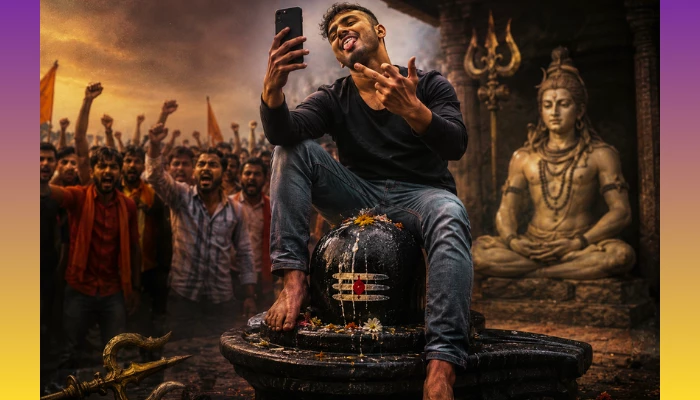
Case Summary
In Berauta village of Narhat block in Nawada district, Bihar, a sacred Shivling worshipped by local Hindus was desecrated by a Muslim man identified as Mohammad Irfan. The accused sat on the Shivling, mocked the Hindu religious symbol, and recorded the act on video, causing outrage and distress among the local Hindu community. According to reports, the incident took place at a religious site in the village and later came to public attention after the video of the act went viral on social media. The visuals triggered anger among Hindu residents, who viewed the act as a deliberate insult to their religious beliefs and sacred symbols. The matter further escalated after the Narhat Circle Officer described the Shivling as “just a stone” in a written statement while initially downplaying the incident by stating that “a child was playing”. The statement caused widespread resentment among Hindus, who considered it deeply insensitive towards their religious sentiments. Members of the Vishva Hindu Parishad and Bajrang Dal strongly objected to the remark and demanded the suspension of the officer. Hindu representatives stated that such comments in matters connected to religious faith had hurt the sentiments of the Hindu community. Following the incident, Hindu organisations and local devotees gathered at the site. Madhav Lal Kashyap, the provincial head of the Hindu Swabhiman Organisation, reached the village along with Sanatan Dharma followers. The Shivling was ceremonially purified with Gangajal, and prayers and rituals were performed to restore the sanctity of the desecrated religious symbol. After protests by local Hindus and growing public outrage, the administration initiated action. SP Abhinav Dheeman arrived at the spot with heavy police deployment and began an investigation. The accused, Mohammad Irfan, was subsequently taken into custody by the police.
Why it is Hate Crime ?
The primary category selected in this case is- "Attack on Hindu religious representations". The subcategory selected is- "Desecration of Hindu religious symbol". Icons and symbols, or a religious representation of a spiritual ideal, are widely revered in Hinduism. Iconography is of vital significance in the Hindu milieu. It helps connect people’s spiritual beliefs with the real world. Iconography within the Hindu faith takes several shapes and forms. Murtis are of most significance to Hindus, to which daily rituals, prayers and offerings are done. Besides the murtis, there are several other symbols which have deep significance in the Hindu faith – the Om and Swastika, for example. Since these Hindu religious symbols hold paramount importance in Hinduism, any desecration of symbols, icons, murtis, religious representations and manifestations, is driven by animosity towards the faith itself, which manifests itself through these murtis, icons and symbols. Therefore, any desecration of these Hindu religious symbols and representations is considered a religiously motivated hate crime under this category. Another sub-category selected is "Breaking rules of place of worship" Sanatan Dharma is not a religion of one book, which is to say that while it has religious scriptures that form the central tenets of the faith, there are several traditions followed through thousands of years, mostly passed from generation to generation orally. One of these oral traditions or written traditions is the rules of specific temples. Certain temples have rules that are traditional, dependent on the worship of the presiding deities. These rules and traditions have been followed for thousands of years, whether they find scriptural mention or not. Such traditions are based on the nature and rules of worship of the presiding deity of that temple. Any non-compliance of these traditions owing to animosity towards the faith or for the sake of activism stems not only from the lack of faith in the presiding deity but also disregard for the faith of the devotees of that deity/temple and implicit bias against the faith, the tradition and the deity itself. Since these specific traditions are central to the faith of the devotees of that specific temple and presiding deity, any non-compliance with these traditional rules would be considered a religiously motivated hate crime. Another sub-category selected is "Defiling religious customs" Sanatan Dharma is not a religion of one book, which is to say that while it has religious scriptures that form the central tenets of the faith, there are several traditions followed through thousands of years, mostly passed from generation to generation orally. Several such customs and traditions are followed by various Hindus and Hindu sects. Defiling of these traditions and customs is a breach of an individual or group’s religious practices. Such practices can range from dietary restrictions like not eating non-vegetarian food for a certain period of the year, not eating non-vegetarian food at all, not eating beef since the cow is considered holy in Hinduism, the sanctity of religious customs followed in the house (like many ISCKON devotees), etc. Any malicious action leading to the breach of such traditions or defilement of these traditions owing to animosity towards the faith or for the sake of activism stems not only from the lack of faith in the religion itself but also from disregard for the faith of the devotees who follow the customs/traditions and implicit bias against the faith, the tradition itself. Since these specific traditions are central to the faith of the devotees of that specific sect of Hindus, any non-compliance with these traditional rules would be considered a religiously motivated hate crime. In this case, the accused specifically chose a sacred Shivling for the act of humiliation and mockery. The act was deliberate and targeted in nature because the perpetrator did not choose an ordinary public structure, nor did he target symbols or places associated with his own faith or any other religion. Instead, a sacred Hindu religious symbol, instantly recognisable as an object of immense reverence among Hindus, was specifically selected for insult and public ridicule. Such selective targeting demonstrated conscious hostility towards Hindu beliefs and practices. The deliberate recording and circulation of the act further showed that the objective extended beyond private misconduct and was intended to publicly humiliate and provoke Hindu devotees by insulting one of the holiest symbols of their faith. Further, the act constituted a direct violation of the sanctity and customs associated with Hindu worship and temple conduct. Hindu traditions prescribe strict norms of purity, reverence, and ritual discipline around consecrated Shivlings and temple spaces. Devotees approach such sacred objects barefoot, offer prayers with devotion, and treat them as living embodiments of divine presence. Mockingly sitting on a Shivling directly violated these established customs and breached the accepted norms governing conduct inside Hindu religious spaces. Such behaviour reflected contempt not only towards the sacred object itself but also towards the religious traditions and devotional practices followed by Hindu worshippers for generations. Moreover, the desecration caused a serious defilement of Hindu religious customs and spiritual sanctity. In Hinduism, a Shivling is not regarded as a mere stone or symbolic object but as a sacred manifestation of Lord Shiva himself. Any act considered impure, insulting, or degrading towards it is viewed by devotees as a direct spiritual violation. The fact that local Hindus felt compelled to conduct purification rituals using Gangajal to restore the sanctity of the Shivling demonstrated the depth of the religious injury caused by the act. Such purification rituals hold immense significance in Hindu traditions and are performed when a sacred object or space is believed to have been defiled. The need for such rituals reflected the extent to which the act wounded the religious sentiments of the Hindu community. The subsequent remarks made by the Circle Officer further aggravated the distress caused to Hindus. Such remarks ignored the deep spiritual significance attached to the Shivling in Hinduism. The outrage expressed by Hindu organisations and devotees reflected the broader sense of humiliation and hurt experienced by the community following both the desecration and the official response to it. Taken together, the deliberate targeting of a sacred Shivling, the mockery and public recording of the act, the violation of accepted religious customs, the resulting need for purification rituals, and the subsequent trivialisation of the incident demonstrated clear hostility towards Hindu faith, traditions, and religious identity. Since the act specifically targeted a sacred Hindu religious representation and defiled the customs associated with its worship, this case was documented as a religiously motivated hate crime in the Hinduphobia Tracker. Disclaimer: The Hinduphobia Tracker records incident dates based on when the victim's ordeal began, rather than when the media reported it. In this case, none of the media reports mentioned when the victim's ordeal began; therefore, the date when the report was published, 19 May 2026, has been recorded as the indicative incident date for documentation purposes.


Case Status
Arrested


Perpetrators Details
Perpetrators
Muslim Extremists
Perpetrators Range
One Person
Perpetrators Gender
male
 Sources




