Tribal Hindus targeted for illegal religious conversion through missionary encroachment on Tribal welfare land in Kodagu, Karnataka
 Kodagu, Karnataka, India
  16 May, 2026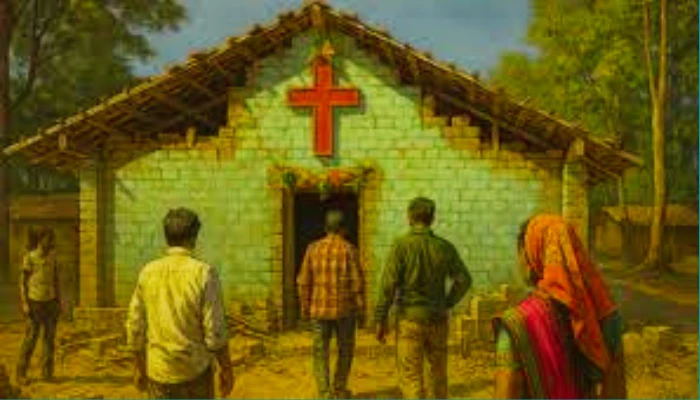
Case Summary
In Kodagu district, Karnataka, Christian missionaries were carrying out illegal religious conversions of tribal communities under the guise of religious expansion. The missionaries had arrived from Tamil Nadu specifically to participate in the inauguration of the church structure, which they had constructed illegally on government land belonging to the Tribal Welfare Department in a tribal region. The incident triggered protests and strong opposition from local tribal communities. Local residents and tribal groups stated that the construction and inauguration were part of a broader agenda aimed at influencing and converting vulnerable tribal Hindus in the area. The church had been built on land reserved for tribal welfare purposes without legal authorisation or permission from the authorities. As news of the church inauguration spread, local tribal residents and Hindu organisations gathered in protest, demanding immediate action from the administration. Protesters objected to the use of government tribal welfare land for religious purposes and raised concerns that outside missionaries were interfering with the religious and cultural traditions of indigenous tribal communities in Kodagu. Local tribal groups stated that such activities threatened tribal identity, customs, and ancestral belief systems. Protesters urged the government to protect tribal lands from encroachment and prevent outside religious groups from exploiting vulnerable communities for conversion activities. They also demanded stronger monitoring of missionary activities in sensitive tribal regions to safeguard local culture and religious traditions. Police and district authorities intervened following the protests and detained the missionaries involved in the inauguration event.
Why it is Hate Crime ?
This case has been added to the tracker under the prime category of Predatory proselytisation and within this, the sub-category selected is "Proselytisation by grooming, brainwashing, manipulation or subtle indoctrination". The tertiary category here for this case is "Pattern of targeting Hindus". Religious brainwashing essentially means the often subtle and forcible indoctrination to induce someone to give up their religious beliefs to accept contrasting, regimented ideas. Religious grooming or brainwashing also involves propaganda and manipulation. It involves the systematic effort, driven by religious malice and indoctrination, to persuade “non-believers’ to accept allegiance, command, or doctrine to and of a contrasting faith. Cases of such grooming or brainwashing are far more nuanced than direct threats, coercion, inducement and violence. In such cases, it is often seen that there is repeated, subtle and continual manipulation of the victim to induce disaffection towards their own faith and acceptance of the contrasting faith of the perpetrator. While subtle indoctrination is widely acknowledged as predatory, an element which is often understated in such conversions or the attempts of such conversion is the role of loyalty and trust which might develop between the perpetrator and the victim. Fiduciary relationships are often abused to affect such religious conversion. For example, an educator transmitting religious doctrine of a competing faith to a Hindu student. The Hindu student is likely to accept what the teacher is transmitting owing to the existence of the fiduciary relationship. The exploitation of the fiduciary relationship to religiously indoctrinate victims would also be included in this category. Since the underlying animosity towards the victim’s faith forms the basis of predatory proselytisation, such cases are considered religiously motivated hate crimes. This case qualified as a religiously motivated hate crime because Christian missionaries specifically targeted a vulnerable tribal Hindu region. The act was not merely an issue of illegal construction but part of a broader pattern of organised missionary activity aimed at altering the religious identity and cultural fabric of tribal Hindu communities, though there is no denying that the arrival of missionaries from Tamil Nadu specifically for the church inauguration further demonstrated that the effort was coordinated and intentional rather than incidental. Tribal communities in regions such as Kodagu maintain deep ancestral ties to their indigenous Hindu traditions, customs, sacred spaces, and community practices. Attempts to impose religion through unauthorised means directly threaten the continuity of tribal religious identity and social cohesion. This was precisely why local tribal residents strongly opposed the construction of the church and viewed it as an intrusion into their cultural and spiritual lives. Their protests reflected fear that outside missionary groups were attempting to gradually influence and detach tribal Hindus from their ancestral belief systems. Importantly, this was not an isolated incident. The Hinduphobia Tracker has documented several recent cases where Christian missionaries targeted vulnerable Hindu tribal populations for conversion activities across India. In Mangipali village under Kalimela Block in Malkangiri district, Odisha, tribal Hindu villagers were targeted through organised Christian prayer meetings and missionary activities aimed at influencing them towards religious conversion, on 17 May 2026. Similarly, in Retavand village in the Bastar district of Chhattisgarh, on 26 April 2026, Hindu tribal families were converted to Christianity by a Christian pastor who had been operating in the region for over 1.5 years. In another case on 12 May 2026, economically weaker Hindu families from the Tharu tribal community in Khatima, Uttarakhand, were targeted through inducements, anti-Hindu propaganda, and sustained pressure by Christian evangelists seeking conversions. These repeated incidents reveal a larger and systematic pattern in which economically and socially vulnerable tribal Hindu communities are repeatedly singled out for conversion-focused activities. Missionary groups often concentrate their efforts in remote tribal regions where communities may lack institutional protection and are more susceptible to external influence. Such actions are not neutral acts of religious expression. They involve deliberate attempts to undermine existing Hindu faith structures, weaken indigenous traditions, and replace ancestral practices with a different religious identity. The strong reaction from tribal residents in Kodagu further demonstrated that the community perceived these activities as an attack on their culture, religion, and tribal heritage. Their demand for strict action to protect tribal lands and traditions highlighted the broader social harm caused by such missionary operations. Since the actions in this case involved organised attempts to expand Christian religious influence within a vulnerable Hindu tribal region, it met the parameters of a religiously motivated hate crime targeting Hindu tribal identity and belief systems. Disclaimer: The Hinduphobia Tracker records incident dates based on when the victim's ordeal began, rather than when the media reported it. In this case, the report does not mention when the missionaries targeted; therefore, the date when the report was published, 17 May, 2026, has been recorded as the indicative incident date for documentation purposes.


Case Status
Unknown


Perpetrators Details
Perpetrators
Christian Extremists
Perpetrators Range
Unknown
Perpetrators Gender
unknown
 Sources




