Tribal Hindu villagers targeted for forced conversion through organised Christian missionary activities and prayer meetings
 Malakanagiri, Odisha, India
  17 May, 2026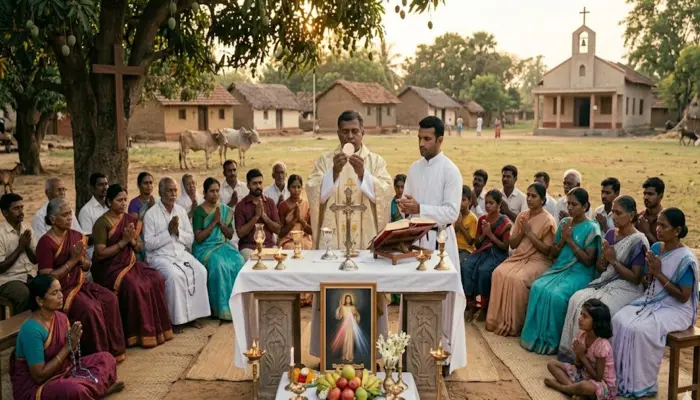
Case Summary
In Mangipali village under Kalimela Block in Malkangiri district, Odisha, tribal Hindu villagers were targeted through organised Christian missionary activities and prayer meetings aimed at influencing them towards religious conversion. The issue surfaced after tribal Hindu villagers submitted a memorandum to the local administration seeking intervention to protect their ancestral traditions and maintain social harmony in the region. The memorandum was submitted to Sub-Collector Pallavi Khara in the presence of former MLA Mukunda Sodi, former sarpanch Deba Madkami, and other local representatives. According to the memorandum submitted by the villagers, Mangipali village consisted of around 250 families with an estimated population of nearly 1,000 people, the majority belonging to tribal Hindu communities. Villagers stated that while a small number of families had previously converted to Christianity, organised efforts had intensified to influence more tribal residents towards religious conversion. They stated that individuals from outside the village and from different linguistic backgrounds had been visiting the area to conduct prayer meetings and religious gatherings linked to Christian missionary activities. The villagers further stated that during these gatherings, remarks were made against traditional tribal beliefs, customs, rituals, and ancestral practices, creating resentment and tension within the community. Residents expressed concern that these activities were disrupting long-standing tribal traditions and weakening the cultural identity of indigenous communities in the region. In their memorandum, the villagers urged the administration to conduct an official verification of the number of residents who had converted to Christianity and to ensure that traditional tribal customs and community practices remained protected. They also sought preventive measures to stop external interference in local cultural and social affairs. The memorandum highlighted that Malkangiri is a Scheduled Area where tribal customs, cultural practices, and community rights are protected under constitutional provisions and existing laws, and requested administrative action to safeguard tribal identity and communal harmony. Sudhanshu Patnaik, National Secretary of the Vishva Hindu Parishad, stated that Christian missionary groups had been attempting to distance tribal communities from their ancestral culture through unlawful conversion-related activities. He stated that such actions posed a threat not only to tribal traditions and cultural identity but also to broader social stability. He further stated that although laws existed in Odisha to prevent illegal religious conversions, the provisions were not being implemented strictly, compelling villagers to approach the administration with their grievances and demand government intervention.
Why it is Hate Crime ?
This case has been added to the tracker under the primary category Predatory Proselytisation. Within this, the subcategory selected is - Proselytisation by grooming, brainwashing, manipulation or subtle indoctrination, with the tertiary category being - Pattern of targeting Hindus. Religious brainwashing essentially means the often subtle and forcible indoctrination to induce someone to give up their religious beliefs to accept contrasting regimented ideas. Religious grooming or brainwashing also involves propaganda and manipulation. It involves the systematic effort, driven by religious malice and indoctrination, to persuade “non-believers’ to accept allegiance, command, or doctrine to and of a contrasting faith. Cases of such grooming or brainwashing are far more nuanced than direct threats, coercion, inducement and violence. In such cases, it is often seen that there is repeated, subtle and continual manipulation of the victim to induce disaffection towards their own faith and acceptance of the contrasting faith of the perpetrator. While subtle indoctrination is widely acknowledged as predatory, an element which is often understated in such conversions or the attempts of such conversion is the role of loyalty and trust which might develop between the perpetrator and the victim. Fiduciary relationships are often abused to affect such religious conversion. For example, an educator transmitting religious doctrine of a competing faith to a Hindu student. The Hindu student is likely to accept what the teacher is transmitting owing to existence of the fiduciary relationship. The exploitation of the fiduciary relationship to religiously indoctrinate victims would also be included in this category. Since the underlying animosity towards the victim’s faith forms the basis of predatory proselytization, such cases are considered religiously motivated hate crimes. The other sub-category selected is - Attempting to convert/converting by denigrating Hinduism. In several cases, Hindus are converted or an attempt is made to convert Hindus by denigrating their faith, Hinduism. In such cases, the Hindus associate with the non-Hindu perpetrators often by choice and then, the attempt to convert them by insulting their faith, showing the faith down etc begins. An example of this would be a non-Hindu gathering where the Hindus are attending the gathering of their own free will. However, once they attend the gathering, there is an explicit attempt to convert them by abusing their faith and hailing the faith of the perpetrator. The denigration of the Hindu faith is often based on misrepresentation of the Hindu faith, its doctrine and scriptures and insult to espoused traditions if not blatant lies about Hindu beliefs and ways. Such conversions or attempts at conversions are driven by animosity towards the Hindu faith and are therefore documented as religiously motivated hate crimes. This case has been added to the tracker because tribal Hindu communities in Mangipali village in Odisha’s Malkangiri district were specifically targeted through organised Christian missionary activities aimed at influencing them towards religious conversion. The incident demonstrated sustained attempts to interfere with the indigenous religious identity, cultural traditions, and ancestral customs of vulnerable tribal Hindus through missionary-linked gatherings and conversion-oriented outreach activities. Firstly, the villagers stated that outsiders had been entering the village to organise prayer meetings and religious gatherings intended to influence local tribal Hindus towards Christianity. What is often presented as a simple prayer gathering is in reality a covert attempt at religious conversion. These are not genuine community prayers but calculated efforts to exploit the trust of Hindus and manipulate them into abandoning their faith. By conducting such gatherings, the Christian missionaries sought to manipulate vulnerable Hindus, taking advantage of their emotional and social circumstances to push them towards conversion. The fact that these activities specifically targeted a tribal region with constitutionally protected indigenous customs further highlighted the intrusive nature of the conversion efforts. Secondly, villagers stated that derogatory remarks were made against traditional tribal beliefs, customs, rituals, and ancestral practices during these gatherings. Such conduct was not merely theological disagreement but an act of hostility directed at the faith, traditions, and cultural identity of tribal Hindus. By portraying indigenous religious practices in a negative or inferior manner, the organisers attempted to weaken the community’s attachment to its ancestral faith and create resentment towards long-standing tribal customs. Insulting and undermining the religious traditions of a community in the course of conversion activities demonstrated clear prejudice and disrespect towards the beliefs of tribal Hindus. Thirdly, the case revealed concerns regarding organised and sustained conversion-related activities in the region. Villagers stated that individuals from outside areas and different linguistic backgrounds had repeatedly visited the village to conduct missionary-linked gatherings. This indicated a broader and coordinated pattern of outreach directed at tribal communities rather than an isolated incident. The repeated targeting of tribal Hindus through external religious influence raised fears regarding the erosion of indigenous traditions, social cohesion, and community identity in a Scheduled Area where tribal customs and practices receive constitutional protection. The Christian faith, by its very theological foundations, places a strong emphasis on proselytisation. In pursuit of conversion objectives, Christian evangelists often employ unethical means, ranging from psychological pressure and misinformation to inducements such as money or jobs. These tactics are designed not as acts of charity but as tools to engineer religious change under the guise of social upliftment, particularly among vulnerable and underprivileged communities. This systematic attempt to erode the religious foundation of individuals and replace it with allegiance to another faith reflects deep religious malice and animus against the Hindu identity. Since the activities specifically targeted a vulnerable Hindu tribal community and involved hostility towards indigenous religious traditions, this case was added to the tracker under religiously motivated targeting and organised proselytisation of Hindus. Disclaimer: The Hinduphobia Tracker records incidents based on when an event occurred or when the victim's ordeal began. It is important to clarify that none of the media sources covering this case has specified the exact date when the conversion activities were going on. Therefore, for documentation purposes, we have recorded the date based on when the incident was reported in the media, 17 May 2026.


Case Status
Complaint filed


Perpetrators Details
Perpetrators
Christian Extremists
Perpetrators Range
Unknown
Perpetrators Gender
unknown
 Sources




