Revered Hindu historical saints and leaders denigrated, Hindu devotional tradition potrayed as “regressive” and "bigoted" by Indian politician in Pune, Maharashtra
 Pune, Maharashtra, India
  9 May, 2026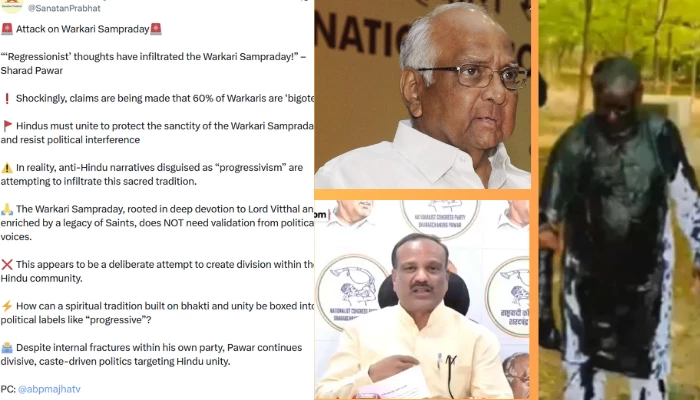
Case Summary
In Pune, Maharashtra, Hindu saints, Warkari spiritual leaders, and the Warkari Sampraday were insulted and politically targeted by Sharad Pawar, leader of the Nationalist Congress Party and Vikas Lawande, spokesperson of the Sharad Pawar faction. They deliberately passed remarks portraying the Hindu devotional tradition as “regressive”, "bigoted", and separate from Sanatan Dharma. While addressing a public meeting in Pune concerning the Warkari Sampraday, Sharad Pawar stated that “regressionist thoughts” had infiltrated the Warkari tradition. He also claimed that nearly 60 per cent of Warkaris were “bigoted”. The remarks triggered outrage among Hindu devotees and Warkari followers, who viewed the statements as direct insults against a centuries-old Hindu bhakti tradition devoted to Lord Vitthal and shaped by revered Hindu saints such as Sant Dnyaneshwar Maharaj, Sant Tukaram Maharaj, Sant Eknath Maharaj, and Sant Namdev Maharaj. The controversy escalated further after Vikas Lawande, Nationalist Congress Party leader and spokesperson of the Sharad Pawar faction, declared that the Warkari sect was separate from Sanatan Dharma. He also publicly announced the names of 20 maharajs from the Warkari tradition, terming them as “regressive". Hindu groups strongly condemned this branding of Hindu saints and kirtankars, stating that these saints were respected not only by Warkaris but by Hindus across India for their contribution to the Hindu bhakti movement and spiritual traditions. Hindu organisations and devotees pointed out that the Bhagavad Gita is a foundational scripture of Sanatan Dharma and that Sant Dnyaneshwar Maharaj’s Dnyaneshwari is itself based upon the Gita. They further highlighted that Sant Eknath Maharaj’s Eknathi Bhagwat and the abhangas of Sant Tukaram Maharaj and Sant Namdev Maharaj are deeply rooted in Hindu Dharma and form an inseparable part of the Hindu devotional tradition. The statements generated widespread anger among Warkari followers and Hindu devotees. Devotees objected to attempts to impose political and ideological labels such as “progressive” and “regressive” upon a sacred Hindu sampraday built upon devotion, pilgrimage, bhakti, and spiritual equality. On May 10, angry Hindus threw ink on Vikas Lawande in the Loni Kalbhor area in protest against his derogatory remarks about the saints and spiritual figures of the Warkari sect. Lawande was on his way to attend a morning sermon when Sangram Bhandare and his associates stopped him and threw ink at him in protest over his controversial statements. Following the incident, Lawande filed a complaint at the Loni Kalbhor police station. Notably, this was not the first time leaders associated with the Nationalist Congress Party faction led by Sharad Pawar made remarks perceived as hostile towards Hindu traditions, symbols, saints, or Sanatan Dharma. Hinduphobia tracker has recorded various cases where multiple leaders from the Sharad Pawar faction have made controversial statements targeting Hindu beliefs, practices, and revered historical figures. For example, former Maharashtra minister and NCP-Sharadchandra Pawar faction MLA Jitendra Awhad, in August 2025, stated that Sanatan Dharma had “ruined Bharat” and described it as “perverted”. He further claimed that there was no religion called Sanatan Dharma and asserted that people of Bharat followed Hindu Dharma instead. His remarks came while supporting comments linked to the 2008 Malegaon blast discourse, where terms such as “Sanatani terrorism” and “Hindutvavadi terrorism” from Shushil Kumar Shinde were defended in place of “saffron terrorism”. Awhad also blamed Sanatan Dharma for the humiliation of major Hindu and national icons. He claimed that Sanatan traditions denied Chhatrapati Shivaji Maharaj his rightful coronation, defamed Chhatrapati Sambhaji Maharaj, and oppressed social reformers such as Jyotirao Phule, Savitribai Phule, Shahu Maharaj, and Dr B.R. Ambedkar. He further praised Ambedkar’s rejection of Manusmriti and caste traditions as an act of liberation from Sanatan Dharma. Similarly, in March 2026, Jitendra Awhad sparked outrage in the Maharashtra Legislative Assembly after making controversial remarks regarding the coronation of Chhatrapati Shivaji Maharaj during discussions on the Maharashtra Freedom of Religion Bill. According to reports, Awhad stated that “he had applied a tilak with the foot”, claiming the statement was based on a book. The remarks were widely condemned as disrespectful towards one of the most revered Hindu kings and cultural icons in Indian history. The remarks made by Sharad Pawar, Vikas Lawande, and other leaders of the Sharad Pawar faction regarding the Warkari Sampraday therefore formed part of a broader and continuing pattern of statements targeting Hindu traditions, saints, symbols, and religious identity.
Why it is Hate Crime ?
This case has been added to the tracker under the primary category of - Hate speech against Hindus. The sub-category selected here is- Mocking/Denigrating Hindu leaders. Hate speech is defined as any speech, gesture, conduct, writing, or display that is prejudicial against a specific individual and/or group of people, which leads to or may lead to violence, prejudicial action or hate against that individual and/or group. Religious leaders are often seen as representatives of the community, especially the community’s religious faith and beliefs. Mocking or denigrating a religious leader specifically owing to his religious identity and/or the religious rituals he observes can be considered hate speech because the motivating factor of the speech is animosity and/or dislike for what he represents – the religious beliefs and faith of the community. It is important to note that mere insulting words against an individual do not constitute hate speech. Insulting words may be used for an individual; however, the specific speech is not the result of religious hate and/or animosity towards the professed faith of the religious leader, but the individual himself. For the speech to be considered hate speech, the speech itself or the motivating factor behind the speech has to be religious in nature. Such speech, which denigrates Hindu religious leaders specifically owing to animosity towards the faith they profess and the community faith they represent, will be treated as hate speech under this category. The other sub-category selected is: Anti-Hindu subversion and prejudice. The tertiary category selected under it is: Anti-Hindu Fake news or Downplaying. Hate speech is defined as any speech, gesture, conduct, writing, or display that is prejudicial against a specific individual and/or group of people, which leads to or may lead to violence, prejudicial action or hate against that individual and/or group. Media plays a specific and overarching role in perpetuating prejudicial attitudes towards a community owing to unfair, untrue coverage and/or misrepresentation/misinterpretation, selective coverage and/or omission of facts of/about issues affecting a specific religious group. This type of bias can dehumanise the victim group, making it easier for others to justify harmful actions against them, which aligns with the objectives of hate speech laws aimed at preventing such harm. It is often observed that the media takes a prejudicial stand against the Hindu community, driven by their need to shield the aggressor community, which happens to be a numeric minority; however, that is the one perpetrating violence against Hindus. For example, the media is often quick to contextualise religiously motivated crimes against Hindus, omit or misrepresent facts that point towards religiously motivated hate crimes, justify and/or downplay religiously motivated hate crimes, or simply present fake news to stereotype Hindus. Such media bias leads to the denial of persecution and is often used to dehumanise Hindus, leading to justification for violence against them. For example, the media covered several fake allegations of Hindus targeting Muslims and forcing them to chant Jai Shree Ram. Most of these cases were proved false and fabricated after police investigation. These fake news reports were subsequently never retracted or clarified. Such fake news led to the justification of violence and dehumanisation of Hindus based on the argument that since Hindus targeted Muslims and forced them to chant Jai Shree Ram, the dehumanisation of Hindus and violence against them was par for the course and merely a retaliation. Such media bias leads to prejudicial portrayals of Hindus and offers a justification for violence against them and, therefore, is considered hate speech under this category. The other selected sub-category here is - Anti-Hindu slurs, mocking faith. Anti-Hindu slurs and the deliberate mocking of the Hindu faith owing to religious animosity involve the usage of derogatory terms, stereotypes, or offensive references to religious practices, symbols, or figures. One of the common anti-Hindu slurs used against Hindus is “cow-worshipper” and “cow piss drinker”. The intention of using this term is to demean and mock Hindus as a group and their religious beliefs since Hindus consider the cow holy. Additionally, some symbols and the slurs attached to them have a historical context that exacerbates the insult, hate, stereotyping, dehumanisation and oppression against Hindus. Cow worship has been used for centuries to denigrate Hindus, insult their faith and oppress Hindus specifically as a religious group. There has been overwhelming documentation about how cow slaughter has been used to persecute Hindus, with cow meat being thrown in temples and places of worship. There has also been overwhelming documentation where cow meat (beef) has been force-fed to Hindus to either forcefully convert them to Islam or denigrate their faith. Apart from cow worship, the Swastika – which holds deep religious significance for the Hindus – has also been misinterpreted and distorted to use as a slur against Hindus. Similarly, the worship of the Shivling has been used by supremacist ideologies and religions to denigrate Hindus owing to religious animosity. Such slurs and denigration stem from inherent animosity and hate towards Hindus and their faith; therefore, it is categorised as hate speech targeted at Hindus specifically owing to their religious identity. This case has been added to the tracker because leaders associated with the Nationalist Congress Party faction led by Sharad Pawar made deliberate and targeted remarks against the Warkari Sampraday, Hindu saints, and Sanatan Dharma with the intent to politically and ideologically undermine a revered Hindu spiritual tradition. Statements describing the Warkari tradition as “regressive”, branding Warkaris as “bigoted”, and declaring that the Warkari sect was separate from Sanatan Dharma amounted to a direct attack on the religious identity, traditions, and spiritual foundations of millions of Hindu devotees associated with the sampraday. The Warkari Sampraday is one of the most important bhakti traditions within Hindu Dharma, centred on devotion to Lord Vitthal of Pandharpur and rooted in the teachings of revered Hindu saints such as Sant Dnyaneshwar Maharaj, Sant Tukaram Maharaj, Sant Eknath Maharaj, and Sant Namdev Maharaj. The tradition emphasises bhakti, spiritual equality, moral living, collective devotion, kirtan, pilgrimage, and remembrance of God through abhangas and devotional practices. For centuries, the Warkari movement has played a major role in preserving Hindu spiritual traditions, strengthening social unity among Hindus, and protecting Hindu civilisational values in Maharashtra. The teachings of Warkari saints are deeply interwoven with Sanatan Dharma, particularly through works such as Dnyaneshwari and Eknathi Bhagwat, which are themselves rooted in core Hindu scriptures like the Bhagavad Gita and Bhagwat Purana. Against this backdrop, the remarks made by Sharad Pawar and leaders of his faction were not ordinary political criticism but targeted denigration of a Hindu religious tradition and the saints associated with it. Calling the Warkari Sampraday “regressive” and publicly identifying Hindu maharajs as “regressive” amounted to mocking and insulting Hindu spiritual leaders because of the faith and traditions they represented. Hindu saints are not merely individuals but civilisational figures who embody Hindu religious identity, spiritual discipline, and collective cultural memory. Insulting them, therefore, directly impacted the larger Hindu community that reveres them. Similarly, the statement made by Vikas Lawande that the Warkari sect was separate from Sanatan Dharma reflected a deliberate attempt to ideologically fragment Hindu identity and distort the historical and theological foundations of the Warkari tradition. The Warkari movement emerged entirely from within the Hindu bhakti tradition and has always remained inseparably linked to Hindu scriptures, Hindu pilgrimage traditions, and devotion to Hindu deities. Presenting it as disconnected from Hindu Dharma amounted to the dissemination of misleading and divisive narratives aimed at weakening Hindu unity and creating artificial separations within Hindu society. The remarks also carried elements of anti-Hindu prejudice because they framed a sacred Hindu devotional tradition through politically loaded labels such as “progressive” and “regressive”, thereby reducing a centuries-old spiritual movement into a target of ideological ridicule. Such framing delegitimised Hindu traditions and portrayed practising Hindu devotees and saints as socially backward or extremist. This form of rhetoric contributed to broader prejudicial narratives that increasingly attempt to stigmatise visible expressions of Hindu faith and devotion in public life. Notably, this incident did not occur in isolation but formed part of a wider pattern of controversial remarks made by leaders associated with the Sharad Pawar faction targeting Hindu traditions, Sanatan Dharma, Hindu kings, and revered Hindu figures. Leaders such as Jitendra Awhad had previously described Sanatan Dharma as “perverted”, blamed it for historical oppression, and made controversial remarks regarding Chhatrapati Shivaji Maharaj. This continuity of conduct removed any scope for treating the statements regarding the Warkari Sampraday as isolated lapses or accidental remarks. Furthermore, portraying Hindu saints and devotees as “regressive” while simultaneously attempting to politically redefine or separate a major Hindu sampraday from Sanatan Dharma reflected a calculated attempt to weaken Hindu religious cohesion for ideological and political purposes. Such conduct fostered hostility and contempt towards visible Hindu traditions while encouraging divisions within the Hindu community itself. Taken together, the mocking of Hindu saints, the denigration of the Warkari Sampraday, the dissemination of divisive narratives regarding Sanatan Dharma, the repeated pattern of anti-Hindu remarks by leaders of the Sharad Pawar faction, and the attempt to politically stigmatise Hindu devotional traditions clearly established this as a case of hate speech directed at Hindus and their religious identity. Such conduct targeted the Hindu faith, traditions, saints, and symbols through ridicule, distortion, and ideological hostility. Therefore, this case has been added to the Hinduphobia Tracker’s hate crime database. Disclaimer: The Hinduphobia Tracker records incident dates based on when the victim’s ordeal began rather than when the media reported it. In this case, the report did not specify when the controversial statements were made, but states when the ink was thrown in opposition to the statements. Therefore, for documentation purposes, we have recorded the said date as the date of the incident, 10 May 2026.


Case Status
Unknown


Perpetrators Details
Perpetrators
State and Establishment
Perpetrators Range
From 2 To 5
Perpetrators Gender
male
 Sources




