Hindu student groomed via fake identity, lured by Muslim woman for conversion racket in Kolkata
 Didwana, Rajasthan, India
  16 April, 2026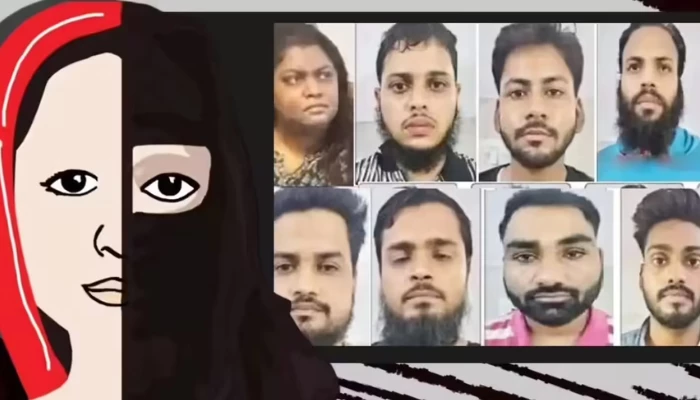
Case Summary
In Didwana, Rajasthan, a Hindu Chartered Accountancy student was targeted and brainwashed through social media by a Muslim woman identified as Ayesha, who operated under the alias “SB Krishna.” She presented herself as a sister figure and established sustained contact with the student, gradually influencing her beliefs and decisions. The Hindu student was lured through repeated money transfers, which created financial dependence and trust. A plan was then set in motion to relocate her from Rajasthan via Jaipur and Delhi to Kolkata, where she was to be forcibly converted to Islam. The plot was exposed by Hindu activists, following which the movement of the students was halted, and the matter came under scrutiny. The Agra conversion case involved an organised network engaged in targeting Hindu women through deception, emotional manipulation, and inducements. Investigations revealed that members of the gang used fake identities, social media platforms, and coordinated roles to approach victims, build relationships, and subsequently pressure them into religious conversion. The network had interstate links, with victims being moved across cities to isolate them from their families and facilitate conversion. Police action in the case led to arrests and the uncovering of a structured racket operating across multiple regions. Mastermind Abdul Rehman was arrested in Delhi, and a missing Hindu girl from Haryana was rescued from his residence during the course of the investigation. In the present case, the CA student remained in contact with Ayesha over a period of time and did not file a complaint earlier as she believed the accused to be a well-wisher who was offering guidance and support. As the plan to relocate her progressed, arrangements were made for her movement through Jaipur and Delhi. The objective was to eventually take her to Kolkata, which had already emerged in earlier cases as a destination where victims were kept after being separated from their families. The student’s continued compliance stemmed from sustained psychological conditioning and the trust that had been built over time. The matter came to light when Hindu activists intervened and exposed the planned movement. Their intervention led to immediate attention on the case and prompted further examination of the individuals involved. Following this, authorities initiated action and began investigating the broader network connected to the Agra conversion racket, including the role played by Ayesha and other associates in targeting and influencing Hindu women. The victim's family stated that their daughter was also planned to be taken to Kolkata similarly, but after the case was exposed, she escaped this trap. However, due to fear and social pressure, they had not yet come forward. After counselling, the young woman gathered courage and recorded her statement with the police. According to ADCP Aditya Kumar, statements from seven victims have been recorded in this case so far. Police investigations revealed that the gang used social networks, dark web platforms, and dating applications to lure Hindu women. Members initially befriended the women, ensnared them romantically, and then brainwashed them into converting to Islam. The group maintained links with banned terror organisations such as PFI, SIMI, and Lashkar-e-Taiba, and they also received foreign funding to facilitate conversions. Uttar Pradesh DGP Rajeev Krishna explained that the gang had managed to convert hundreds of Hindu women across different states. In response to the illegal conversion activities by the Muslim gang, the Yogi Adityanath administration initiated a special drive named “Mission Asmita” against forced conversions. As part of this, seven special teams from Agra police conducted raids in Kolkata, Jammu & Kashmir, Goa, Rajasthan, Delhi, and Uttarakhand, arresting ten accused, including a woman. The case was registered under several sections of the Bharatiya Nyaya Sanhita and the Uttar Pradesh Prohibition of Unlawful Religious Conversion Act, 2021. It is also pertinent to note that the Muslim gang was part of a larger religious conversion racket orchestrated by a Muslim Peer known as Chhangur Baba. The Uttar Pradesh ATS (Anti-Terrorism Squad) had recently dismantled this organised network, uncovering its systematic operation aimed at targeting and converting Hindu individuals, particularly women and minors, to Islam. According to the investigation, Chhangur Baba provided financial incentives to Muslim men to lure Hindu women, often under false identities by posing as Hindus, and then pressured them into conversion. Once converted, these women were married off through Nikah ceremonies arranged by Chhangur Baba himself. Authorities also discovered that Chhangur Baba had published a book titled Shijra-e-Tayyaba, intended as a manual to propagate Islam. The ATS investigation revealed that his network operated on a structured incentive model: Rs15–16 lakh was paid for converting Brahmin, Sikh, or Kshatriya women; Rs10–12 lakh for OBC women; and Rs8–10 lakh for those from other castes. He, along with his wife, was arrested on 5th July 2025. The ATS confirmed that the gang had received nearly Rs100 crore in foreign funds to facilitate these illegal conversions across India. Members of his own family were reportedly involved in the operation. The Hinduphobia Tracker had previously documented several such cases where Chhangur Baba was involved. He used coercion to convert Hindu individuals to Islam. In the first case, Chhangur encouraged a Muslim man named Meraj to lure a Hindu woman named Aarti by posing as a Hindu. Afterwards, Chhangur, along with Meraj, forcibly converted her to Islam and conducted her Nikah according to Islamic customs. Another case involved a Hindu man named Harjeet, who was forcibly converted to Islam by Chhangur. The accused had offered Harjeet incentives and subjected him to harassment and had filed false cases against him in an attempt to persuade him to convert to Islam. Similarly, in another case, in Balrampur, Uttar Pradesh, a Hindu man named Sanchit and his wife were lured to convert to Islam with incentives by the Muslim Peer Chhangur. Both victims were also subjected to death threats and were harassed with false cases for refusing to convert. Another such instance was reported in Faridabad, Haryana, where a minor Hindu girl was brainwashed and forcibly converted to Islam by her Muslim neighbours who were part of a Muslim gang run by the Muslim peer Chhangur. After her conversion, her Hindu identity was erased; she was given a Muslim name, compelled to wear a burqa, forced to perform Islamic rituals, and fed meat against her beliefs. She was horrifically exploited sexually, blackmailed using obscene videos, and pushed into prostitution. In another such case, a Hindu woman from Ghaziabad, Uttar Pradesh, was lured into a relationship by a Muslim man. The accused pretended to be Hindu and had manipulated and brainwashed her into converting to Islam. The victim had been missing since 2019. The accused was also linked to the Islamic cleric Peer Chhangur. In another such case, a Hindu woman named Rashmi (name changed) from Karnataka was trafficked to Saudi Arabia and subjected to years of physical, sexual, and psychological abuse as part of a systematic religious conversion racket operated under the influence of Islamic Peer Jalaluddin alias Chhangur Baba. Under false pretences of marriage and employment, the woman was entrapped, manipulated, and eventually transported across international borders. Further, in Noida, Uttar Pradesh, a Hindu woman was lured into a romantic relationship and subsequently married by a Muslim man named Tabish Asgar. The accused had posed as a Hindu youth while deceiving the woman into a relationship and married her as per Hindu rituals. After marriage, the accused exerted pressure on the victim to renounce Hinduism and adopt Islam, but was not successful. He then took her to Muslim Peer Chhangur alias Jalaluddin, who is known for converting several Hindus to Islam by use of force, deception, and coercion. There, she was also coerced and enticed with incentives to adopt Islam. In another case, in Ranipokhari, Uttarakhand, a young Hindu woman became the target of an organised Muslim conversion gang who attempted to forcibly convert her to Islam through online grooming, emotional pressure, and inducements. This conversion gang was connected to Chhangur Peer. In yet another case in Agra's Sadar Bazar, two Hindu sisters were targeted and brainwashed by a Muslim conversion gang. The older Hindu sister fell victim to brainwashing by the Muslim gang around the year 2021. Following this, in March 2025, two Hindu sisters, aged 33 and 18, went missing from the Sadar Bazar area of Agra. After this, a photograph of one of the sisters holding an AK-47 was circulated on social media, prompting an investigation. The sisters had been brainwashed by the Muslim gang and converted to Islam. Subsequently, they were persuaded to elope from their house and were then kept in a Muslim-majority area of Kolkata.
Why it is Hate Crime ?
The primary category for this case is "Predatory Proselytisation". Another sub-category for this case is "Conversion/attempts to convert by inducement". Predatory Proselytisation is not just limited to threat, harassment, force and violence, but it also has contours of stealth. In several cases, the Hindu victim is exploited to convert, with non-Hindus taking advantage of their poverty. In such cases, the Hindu victim who is suffering financially is offered monetary benefits, including lucrative offers for jobs, health treatment, education, etc, to induce the victim into changing his/her religion. In such cases, the religious identity of the victim and the aim to disenfranchise him from his faith form the heart of the crime. Also, taking advantage of and exploiting an individual’s economic vulnerabilities is widely acknowledged as exploitation, forms of which are often penalised by law. Such cases, therefore, are considered religiously motivated hate crimes since the victim’s religious identity forms the very heart of the crime itself. Another sub-category for the case is "Proselytisation by grooming, brainwashing, manipulation or subtle indoctrination". The tertiary category here is "Victim says was brainwashed/groomed". Religious brainwashing essentially means the often subtle and forcible indoctrination to induce someone to give up their religious beliefs to accept contrasting, regimented ideas. Religious grooming or brainwashing also involves propaganda and manipulation. It involves the systematic effort, driven by religious malice and indoctrination, to persuade “non-believers’ to accept allegiance, command, or doctrine to and of a contrasting faith. Cases of such grooming or brainwashing are far more nuanced than direct threats, coercion, inducement and violence. In such cases, it is often seen that there is repeated, subtle and continual manipulation of the victim to induce disaffection towards their own faith and acceptance of the contrasting faith of the perpetrator. While subtle indoctrination is widely acknowledged as predatory, an element which is often understated in such conversions or the attempts of such conversion is the role of loyalty and trust which might develop between the perpetrator and the victim. Fiduciary relationships are often abused to affect such religious conversion. For example, an educator transmitting religious doctrine of a competing faith to a Hindu student. The Hindu student is likely to accept what the teacher is transmitting owing to the existence of the fiduciary relationship. The exploitation of the fiduciary relationship to religiously indoctrinate victims would also be included in this category. Since the underlying animosity towards the victim’s faith forms the basis of predatory proselytisation, such cases are considered religiously motivated hate crimes. This case demonstrated a targeted hate crime against Hindus. A Hindu student was systematically groomed and influenced through social media by a Muslim woman through concealing her identity and posing as a trusted sister figure. The engagement was not incidental; it unfolded through sustained interaction, financial inducements, and psychological conditioning. The intent was to detach the victim from her religious identity and family atmosphere. The intent was to move her across states for forced conversion. As the interaction progressed, inducements and emotional engagement were used to shape the victim’s decisions. Monetary transfers created a sense of obligation and dependency, while continuous communication ensured psychological influence. This was not a spontaneous interaction but a gradual process where contact evolved into influence and then into direction. The planned relocation of the victim across states, from Rajasthan through Jaipur and Delhi to Kolkata, showed that the objective extended beyond interaction and moved towards isolation and conversion. The methods used in this case aligned with a broader pattern identified in the Agra conversion racket. Police investigations revealed that networks operated through social media, dark web platforms, and dating applications to identify and approach Hindu women. Individuals within the network played specific roles, beginning with contact and trust-building, followed by emotional or romantic involvement, and eventually leading to ideological pressure for conversion. The existence of links with banned organisations and the flow of foreign funding indicated that these activities were structured and organised. The scale of the network reinforced this pattern. Investigations revealed that multiple victims across different states were targeted using similar methods. Coordinated police action across several regions, including arrests and recovery of victims from distant locations, demonstrated that the network functioned across state lines and relied on relocation to isolate individuals from their families and support systems. This case also formed part of a wider ecosystem linked to a larger conversion network led by Chhangur Baba. Investigations uncovered a structured mechanism where inducements were offered, identities were concealed, and victims were gradually influenced before being pressured to convert. The existence of a fixed incentive structure and significant financial backing reflected a deliberate and sustained effort to target Hindu individuals, particularly women. Other documented cases connected to this network showed the same recurring pattern of deception, coercion, and control. Victims were drawn into relationships under false pretences, subjected to pressure to abandon their faith, and in several instances faced threats, blackmail, or trafficking. The inclusion of minors and vulnerable individuals further demonstrated that the targeting was deliberate and calculated. The impact extended beyond the individual victim. The repeated use of deception, inducement, and concealment of identity created an atmosphere of fear and vulnerability within the Hindu community. Victims were distanced from their families, their autonomy weakened, and their religious identity steadily eroded through sustained pressure. Taken together, the sequence of false identity, inducement, psychological conditioning, and planned relocation demonstrated a deliberate and coordinated effort. The pattern, scale, and networked nature of these actions showed that this was not an isolated instance but part of a continuing strategy of targeting Hindu individuals for conversion through manipulation and coercion.
Victim Details
Total Victim
1
Deceased
0
Gender
- Male 0
- Female 1
- Third Gender 0
- Unknown 0
Caste
- SC/ST 0
- OBC 0
- General 0
- Unknown 1
Age Group
- Minor 0
- Adult 0
- Senior Citizen 0
- Unknown 1


Case Status
Complaint filed


Perpetrators Details
Perpetrators
Muslim Extremists
Perpetrators Range
One Person
Perpetrators Gender
female
 Sources




