Hindu sentiments outraged; Tamil Nadu politician mocks revered Hindu deity and concept of Ram Rajya, portraying it as oppressive
 Tamil Nadu, India
  27 April, 2026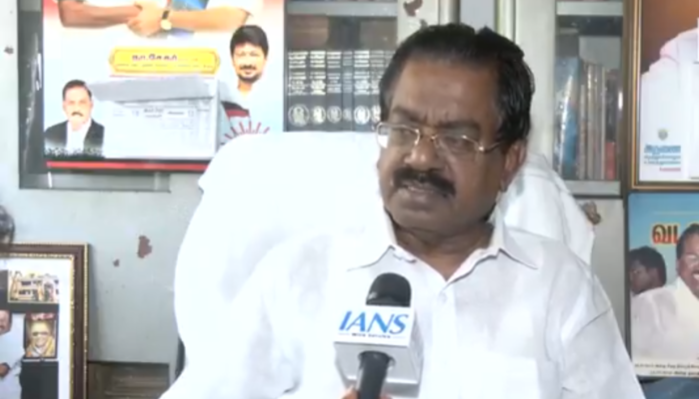
Case Summary
An anti-Hindu remark was made by DMK [Dravida Munnetra Kazhagam] spokesperson TKS Elangovan, who publicly mocked and derided Lord Ram and the concept of Ram Rajya [the ideal kingdom of Lord Ram, revered in the Hindu tradition as the epitome of righteous and just governance]. He stated he did not know what Ram Rajya was because he was not there when Ram was ruling. The remarks were made by the accused to the media and added to a pattern of public statements by Elangovan denigrating Lord Ram and Hindu religious concepts. Speaking to the media, Elangovan stated that he did not know what Ram Rajya was because he was not present when Lord Ram was ruling, and that what existed at that time was not present in Tamil Nadu. In the same breath, he framed the Dravidian movement's objective as the establishment of human equality, implicitly positioning Ram Rajya as a concept incompatible with equality and therefore unworthy of aspiration. This was not the first time Elangovan had made such public remarks dismissing Lord Ram and Hindu religious concepts. As previously recorded by the Hinduphobia Tracker, in 2023, in response to the invitation extended to Prime Minister Narendra Modi for the inauguration of the Ram Temple in Ayodhya, Elangovan stated that history had been demolished and replaced with mythology, that Ram's birth was a myth and a story from the Ramayana, and that the Ramayana was a mere literary work rather than a sacred Hindu text. He characterised the Ram Temple consecration as a politically motivated exercise by the BJP and dismissed any genuine religious significance to the sacred site or the event.
Why it is Hate Crime ?
The primary category for this case is "Hate speech against Hindus". The sub-category for this case is "Anti-Hindu slurs, mocking faith". Anti-Hindu slurs and the deliberate mocking of the Hindu faith owing to religious animosity involve the usage of derogatory terms, stereotypes, or offensive references to religious practices, symbols, or figures. One of the common anti-Hindu slurs used against Hindus is “cow-worshipper” and “cow piss drinker”. The intention of using this term is to demean and mock Hindus as a group and their religious beliefs since Hindus consider the cow holy. Additionally, some symbols and the slurs attached to them have a historical context that exacerbates the insult, hate, stereotyping, dehumanisation and oppression against Hindus. Cow worship has been used for centuries to denigrate Hindus, insult their faith and oppress Hindus specifically as a religious group. There has been overwhelming documentation about how cow slaughter has been used to persecute Hindus with cow meat being thrown in temples and places of worship. There has also been overwhelming documentation where cow meat (beef) has been force-fed to Hindus to either forcefully convert them to Islam or denigrate their faith. Apart from cow worship, the Swastika – which holds deep religious significance for the Hindus – has also been misinterpreted and distorted to use as a slur against Hindus. Similarly, the worship of the Shivling has been used by supremacist ideologies and religions to denigrate Hindus owing to religious animosity. Such slurs and denigration stem out of inherent animosity and hate towards Hindus and their faith, therefore, it is categorised as hate speech targeted at Hindus specifically owing to their religious identity. In this case, DMK spokesperson TKS Elangovan used a national news platform to publicly dismiss Ram Rajya, one of the most cherished and sacred concepts in the Hindu tradition, by questioning whether it ever existed, and compounded this with his previously documented pattern of publicly denying Lord Ram's existence and dismissing the Ramayana as mere literature. Taken together, these statements constitute a sustained and deliberate campaign of public denigration directed at the most foundational figures and concepts of Hindu religious identity. Ram Rajya [the kingdom of Lord Ram] is one of the most sacred and enduring concepts in the Hindu tradition. It refers to the ideal reign of Lord Ram, the seventh avatar of Lord Vishnu, as described in the Valmiki Ramayana, one of Hinduism's two foundational sacred epics. As per Hindu belief, in Ram Rajya, every citizen lived in prosperity, justice, and righteousness; no one suffered from poverty or illness, dharma [righteous conduct] governed every dimension of public and private life, and the ruler placed the welfare of his subjects above all personal considerations. Ram Rajya is not merely a political concept within the Hindu tradition. It is a devotional aspiration, the vision of a society so perfectly aligned with divine order that it represents the closest approximation of heaven on earth that human governance can achieve. For hundreds of millions of Hindu devotees, Ram Rajya is the standard against which all governance is measured and the ideal toward which Hindu civilisational aspiration has been directed for millennia. = Therefore, the dismissal of Ram Rajya through implied denial of Lord Ram's existence is the primary religious marker of this case. When Elangovan stated that he did not know what Ram Rajya was because he was not there when Ram was ruling, he was not making a neutral historical observation. He was publicly and deliberately questioning whether Lord Ram ever existed at all, communicating to a national audience that the concept most sacred to hundreds of millions of Hindu devotees was built on a foundation he personally refused to acknowledge. The phrasing was calculated. By saying he was not there when Ram was ruling, he implied that Ram's rule was either unprovable or fictional, embedding the denial of Hindu religious belief within the language of sceptical rationalism to give it a veneer of intellectual legitimacy. For a Hindu devotee, this is not a political disagreement. It is a public declaration that the most revered ideal in their tradition never existed and therefore deserves neither aspiration nor respect. The framing of the Dravidian movement's objectives as a corrective to what Ram Rajya represents is the second religious marker. Elangovan did not merely question Ram Rajya's historical existence. He positioned the Dravidian movement's ideal of human equality as the alternative to what Ram Rajya stood for, implying that Ram Rajya was a system incompatible with equality and therefore something to be rejected rather than aspired to. This framing transforms a denial of Hindu religious history into an active ideological attack on Hindu values, communicating that the most revered ideal in Hindu political and spiritual thought was not merely mythological but was antithetical to justice and human dignity. For a Hindu devotee, this is not a political disagreement. It is a public declaration that their faith's highest ideal was a system of oppression unworthy of the reverence the Hindu community extends to it. The pattern of sustained public denigration across multiple statements is the third and most significant religious marker. Elangovan's dismissal of Ram Rajya did not occur in isolation. It was part of a documented pattern of public statements in which he had previously dismissed Lord Ram as a myth, described the Ramayana as literature rather than a sacred text, and characterised the Ram Temple consecration as the replacement of history with mythology. A political leader who repeatedly returns to the same target, Lord Ram, the Ramayana, Ram Rajya, across multiple public statements, is not making casual political observations. He is conducting a sustained and deliberate campaign of denigration directed at the most sacred figures and concepts of Hindu religious identity, using the platform of national media to communicate his contempt for Hindu faith to the widest possible audience on each occasion. The consistency of the target across multiple statements confirms that the hostility is not incidental to his political positions but is itself the objective. The recurrence of the same pattern of denigration in 2023 confirms that the intent behind these statements was neither accidental nor contextual. In 2023, in response to the invitation extended to Prime Minister Modi for the Ram Temple inauguration in Ayodhya, Elangovan stated publicly that history had been demolished and replaced with mythology, that Ram's birth was a myth, that the Ramayana was literature, and that the entire consecration was a BJP political exercise rather than a genuine act of Hindu religious restoration. The 2023 statements and the Ram Rajya remarks are not two isolated incidents separated by time and context. They are two instances of the same deliberate and sustained campaign, directed at the same target, Lord Ram and the Hindu religious tradition he embodies, delivered through the same instrument of national media, and designed to produce the same outcome, the public delegitimisation of Hindu religious belief in the most prominent forum available. A political leader who makes the same category of statement about the same religious figure across multiple years and multiple platforms is not reacting to political circumstances. He is expressing a settled ideological hostility toward Hindu religious identity that he has chosen to articulate publicly and repeatedly, and the repetition itself is the clearest possible evidence of deliberate and sustained intent. Given that this case met the parameters of a religiously motivated hate speech, it was added to the hate crime database of the Hinduphobia Tracker. Disclaimer: The Hinduphobia Tracker records incident dates based on when the crime occurs, not when it is reported by the media. However, in this case, media reports do not specify the exact date of the accused's derogatory remarks. Therefore, the first media publication date, 28 April 2026, has been selected as the indicative incident date. This date is recorded for documentation purposes only.


Case Status
Unknown


Perpetrators Details
Perpetrators
Others
Perpetrators Range
One Person
Perpetrators Gender
male
 Sources




