Hindu faith denigrated; Tamil Nadu politician mocks Lord Ram and Ram Janmabhoomi temple in Ayodhya
 Tamil Nadu, India
  25 October, 2023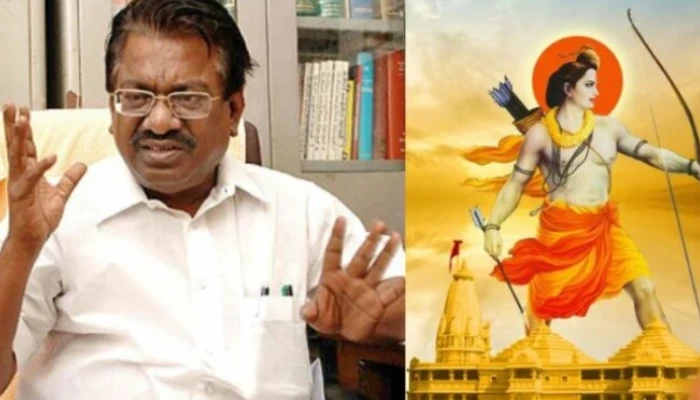
Case Summary
Amidst the Ram Janmabhoomi temple's inaugration in Ayodhya, DMK [Dravida Munnetra Kazhagam] leader and former Rajya Sabha Member of Parliament TKS Elangovan publicly dismissed Lord Ram as a 'mythological figure', mockingly described the Ramayana as mere literature rather than a sacred religious text, characterised the consecration of the Ram Janmabhoomi [birthplace of Lord Ram] Temple in Ayodhya as the replacement of history with mythology, and described the entry of Hinduism into Tamil Nadu as having spoilt the land. As per media reports, these remarks were made in 2023 in response to the invitation extended to Prime Minister Narendra Modi for the Ram Temple inauguration in Ayodhya and were widely circulated. On the Ram Temple consecration, Elangovan mocked Hindu faith by stating that history had been demolished and replaced with mythology, that Ram's birth was mythology and a story from the Ramayana, and that the Ramayana was mere literature. He framed the Babri Masjid as the history that had been demolished and the Ram Temple as the mythology that had replaced it. He further stated that the BJP's (Bharatiya Janata Party) interest was not in Ram but in political gain and that Ram was being leveraged as a political tool. On the question of Hinduism itself, Elangovan defended controversial remarks made by DMK Member of Parliament A. Raja in September 2022, which had included offensive references to Shudras. Elangovan linked those remarks to what he described as the impact of Hinduism in Tamil Nadu. He stated that the entry of Sanskrit and Hinduism into Tamil Nadu had "spoiled" the land and framed the Dravidian movement's opposition to Hinduism as a fight against Manu Dharma. He characterised Hinduism as a system that denied rights to lower-caste Hindus and used this framing to justify A. Raja's offensive remarks. Notably, the Ayodhya Ram Janmabhoomi is a site in Uttar Pradesh deeply revered by Hindus as the birthplace of Lord Rama, considered an incarnation of Vishnu and a central figure in the Hindu faith. The temple held immense religious and cultural significance, existing on this sacred land for centuries before being desecrated in 1528. At that time, the Mughal emperor Babur ordered the destruction of the original temple and the construction of Babri Masjid on its ruins, causing generations of dispute and pain within the Hindu community. Hindus endured decades of legal and social hardships, fighting relentlessly in courts for the right to reclaim and restore their holy site. Their struggle ended with the Supreme Court of India’s verdict in 2019, legally restoring the site to the Hindu community and permitting the temple’s consecration.
Why it is Hate Crime ?
The primary category for this case is "Hate speech against Hindus". The sub-category for this case is "Anti-Hindu slurs, mocking faith". Anti-Hindu slurs and the deliberate mocking of the Hindu faith owing to religious animosity involve the usage of derogatory terms, stereotypes, or offensive references to religious practices, symbols, or figures. One of the common anti-Hindu slurs used against Hindus is “cow-worshipper” and “cow piss drinker”. The intention of using this term is to demean and mock Hindus as a group and their religious beliefs since Hindus consider the cow holy. Additionally, some symbols and the slurs attached to them have a historical context that exacerbates the insult, hate, stereotyping, dehumanisation and oppression against Hindus. Cow worship has been used for centuries to denigrate Hindus, insult their faith and oppress Hindus specifically as a religious group. There has been overwhelming documentation about how cow slaughter has been used to persecute Hindus with cow meat being thrown in temples and places of worship. There has also been overwhelming documentation where cow meat (beef) has been force-fed to Hindus to either forcefully convert them to Islam or denigrate their faith. Apart from cow worship, the Swastika – which holds deep religious significance for the Hindus – has also been misinterpreted and distorted to use as a slur against Hindus. Similarly, the worship of the Shivling has been used by supremacist ideologies and religions to denigrate Hindus owing to religious animosity. Such slurs and denigration stem out of inherent animosity and hate towards Hindus and their faith, therefore, it is categorised as hate speech targeted at Hindus specifically owing to their religious identity. The other subcategory selected is- Anti-Hindu subversion and prejudice. Hate speech is defined as any speech, gesture, conduct, writing, or display that is prejudicial against a specific individual and/or group of people, which is leading to or may lead to violence, prejudicial action or hate against that individual and/or group. Media plays a specific and overarching reach in perpetuating prejudicial attitudes towards a community owing to unfair, untrue coverage and/or misrepresentation/misinterpretation, selective coverage and/or omission of facts of/pertaining to issues affecting a specific religious group. This type of bias can dehumanise the victim group, making it easier for others to justify harmful actions against them, which aligns with the objectives of hate speech laws aimed at preventing such harm. It is often observed that the media takes a prejudicial stand against the Hindu community driven by their need to shield the aggressor community which happens to be a numeric minority, however, is the one perpetrating violence against Hindus. For example, the media is often quick to contextualise religiously motivated crimes against Hindus, omit or misrepresent facts that point towards religiously motivated hate crimes, justify and/or downplay religiously motivated hate crimes or simply present fake news to stereotype Hindus. Such media bias leads to the denial of persecution and is often used to dehumanise Hindus, leading to justification for violence against them. For example, the media covered several fake allegations of Hindus targeting Muslims and forcing them to chant Jai Shree Ram. Most of these cases were proved false and fabricated after police investigation. These fake news reports were subsequently never retracted or clarified. Such fake news led to the justification of violence and dehumanisation of Hindus based on the argument that since Hindus targeted Muslims and forced them to chant Jai Shree Ram, the dehumanisation of Hindus and violence against them was par for the course and merely a retaliation. Such media bias leads to prejudicial portrayal of Hindus and offers a justification for violence against them and therefore, is considered hate speech under this category. In this case, DMK leader and former Rajya Sabha Member of Parliament TKS Elangovan made public statements to mock and denigrate Lord Ram, the Ramayana, the Ram Janmabhoomi Temple, and Hinduism itself as a faith. He framed Hindu religious belief as mythology, Hindu scripture as mere literature, and the entry of Hinduism into Tamil Nadu as a historical contamination that had "spoilt" the land. The statements were not made in private. They were made to the national media and in public political contexts, ensuring that the denigration of Hindu religious identity reached the widest possible audience. The dismissal of Lord Ram as mythology and the Ramayana as literature is the most direct religious marker of this case. Lord Ram is not merely a political symbol or a historical claim. He is one of the most profoundly revered figures in the Hindu tradition, the seventh avatar of Lord Vishnu and the embodiment of dharmic virtue whose life and teachings form the spiritual foundation of hundreds of millions of Hindu people across the subcontinent and the diaspora. The Ramayana is not merely literature. It is one of the two foundational sacred texts of the Hindu tradition, a text through which Hindu values, ethics, and devotional identity have been transmitted across generations for millennia. To publicly characterise Lord Ram as a myth and the Ramayana as literature is to publicly deny the religious validity of the faith of every Hindu who reveres them, communicating that their deepest religious convictions are historically unfounded and intellectually unworthy of respect. Elangovan chose to make this characterisation in response to the consecration of the Ram Temple, ensuring that the denial of Lord Ram's religious significance was delivered at the precise moment when its impact on Hindu religious sentiments would be greatest. The framing of the Ram Temple consecration as the replacement of history with mythology is the second religious marker. The Ram Janmabhoomi in Ayodhya is not merely a political site. It is the most sacred location in the Hindu tradition associated with the birth of Lord Ram, a site of Hindu devotional significance so profound that its restoration has been the aspiration of the Hindu community for centuries. By describing the consecration of the Ram Temple as the demolition of history and its replacement with mythology, Elangovan was not making any neutral historical observation. He was publicly delegitimising the most significant act of Hindu religious restoration in living memory, framing it as a politically motivated fraud rather than the fulfilment of a sacred Hindu aspiration. By doing this attempted to promote anti-Hindu prejudice and frame the Hindu community and its religious sites in a negative light. The choice to make such derogatory remarks at this specific moment, when the Hindu community was experiencing the consecration of Ram Janmabhoomi as a moment of profound religious joy, reflects a deliberate decision to inflict maximum religious hurt at a moment of maximum Hindu emotional and devotional investment. The description of Hinduism's entry into Tamil Nadu as having spoiled the land is the third and most sweeping religious marker. This statement does not target a specific political position or a specific BJP policy. It targets Hinduism itself as a faith, characterising its very presence in Tamil Nadu as a historical contamination that damaged the region. A political leader who describes a religion's entry into a territory as having spoiled that territory is a political leader who is communicating to his audience that the Hindu religion itself is a malign force whose presence is harmful. Applied to Hinduism, this characterisation delegitimises the religious identity of every Hindu, communicating that their faith is not a source of spiritual meaning and cultural richness but a historical poison introduced from outside that corrupted an otherwise healthy society. The defence of A. Raja's offensive remarks about Shudras and their linkage to Hinduism are the fourth religious marker. Rather than distancing himself from remarks that had caused widespread offence to Hindu communities, Elangovan defended them and used them as the platform for a broader attack on Hinduism as a system of oppression. While caste discrimination within Indian society is a genuine and serious issue, Elangovan's framing weaponised it specifically to delegitimise Hinduism as a faith rather than to address the specific injustice of caste. By linking A. Raja's offensive remarks to the broader claim that Hinduism had spoiled Tamil Nadu, he transformed a critique of caste into a comprehensive attack on Hindu religious identity, using the real suffering of caste discrimination as the rhetorical instrument for a wholesale denigration of the faith. Overall, TKS Elangovan's statements reflected more than political disagreement with the BJP or ideological opposition to Hindu nationalism. By publicly dismissing Lord Ram as mythology, the Ramayana as literature, the Ram Temple consecration as political fraud, and Hinduism's presence in Tamil Nadu as a historical contamination, his statements demonstrated a clear and sustained hostility toward Hindu religious identity that used the platforms of national media and political discourse to communicate to the broadest possible audience that Hindu faith, Hindu scripture, and Hindu sacred sites were unworthy of the reverence the Hindu community extends to them. This reflects an underlying hostility toward Hindu religious identity that cannot be characterised as anything other than religiously motivated hate speech. Given that this case met the parameters of a religiously motivated hate speech, it was added to the hate crime database of the tracker. Disclaimer: The Hinduphobia Tracker records incident dates based on when the crime occurs, not when it is reported by the media. However, in this case, media reports do not specify the exact date of the accused's derogatory remarks. Therefore, the first media publication date, October 26, 2023, has been selected as the indicative incident date. This date is recorded for documentation purposes only.


Case Status
Unknown


Perpetrators Details
Perpetrators
Others
Perpetrators Range
One Person
Perpetrators Gender
male
 Sources




