Hindu guards brutal attack at Mira Bhayandar road downplayed and claimed "unverified" by news media outlet
 Mumbai, Maharashtra, India
  26 April, 2026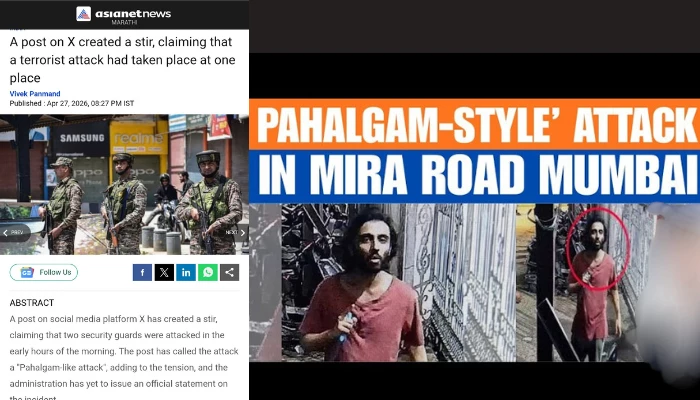
Case Summary
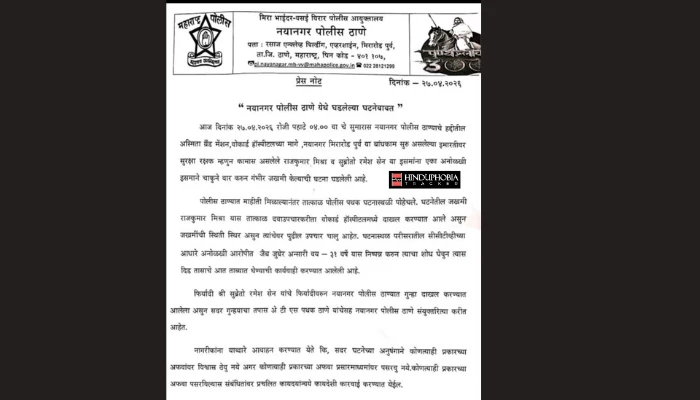
In Mumbai, Maharashtra, two guards were brutally attacked by a Muslim man for being Hindu. Both the victims, who survived a stabbing attack in Mira Bhayandar, provided statements detailing that the attacker, identified as Zaib Zubair Ansari, asked about their religion and demanded the recitation of the Kalma (an Islamic declaration of faith) before attacking. Despite this, Asianet, a Malayalam TV channel, went on to downplay the anti-Hindu violence, terming the incident as ‘unverified’. The Mira Bhayandar incident drew public attention after reports emerged that two Hindu security guards, Subroto Sen and Rajkumar Mishra were brutally attacked in the early hours of the morning by a Muslim assailant who had initially approached them with seemingly routine questions. According to the victim’s statement, the accused first asked for directions to a mosque and then proceeded to question the guards about their religion. He asked if they were Hindu and whether they could read the Kalma. Upon confirming that they were Hindus, the situation escalated abruptly, and he launched a violent assault using a sharp weapon, leaving the guards seriously injured. The sequence reflected a targeted act where religious identity became the trigger for violence. The team at Hinduphobia Tracker secured a copy of the FIR of the Mira Bhayandar case. One of the victims, Subroto Sen, told police that the attacker asked for a nearby mosque, then asked "Hindu ho kya?" (Are you Hindu?). When Sen returned to his post later, the attacker grabbed him, said "Hindu ho na" (You are Hindu, right?), and stabbed him in the back. The attacker then targeted supervisor Rajkumar Mishra, saying, "Tu bhi Hindu hai na? Agar nahi hai toh kalma padh" (You are also Hindu, right? If not, recite the Kalma). However, despite details of the incident circulating widely in the public domain, Asianet News (Marathi edition) referred to a post by an X handle, “Treeni,” which had described the attack as “Pahalgam-like,” and used this characterisation to frame the incident as an “unverified” claim circulating on social media. The report noted that the incident had not been independently confirmed and pointed to a lack of reliable information to support the claims online, thereby presenting it as uncertain rather than an established fact in its coverage of the incident. At the centre of this framing was the outlet’s assertion that no official police press release could be located at the time of reporting. This absence was presented as the primary basis for treating the case as unverified. However, this position stood in contrast with developments on the ground, as a police press note detailing the attack and subsequent arrest had already been released hours earlier, outlining the sequence of events and confirming the nature of the assault. The article was authored by Vivek Panmad, a journalist associated with Asianet Marathi. His report relied on the claimed lack of immediate verification while omitting emerging official disclosures that had begun to clarify the facts.
Case Images
Why it is Hate Crime ?
This case has been added to the tracker under the primary category of - Hate speech against Hindus. The sub-category selected here is- Anti-Hindu subversion and prejudice. The tertiary category selected under it is: Anti-Hindu Fake news or Downplaying. Hate speech is defined as any speech, gesture, conduct, writing, or display that is prejudicial against a specific individual and/or group of people, which leads to or may lead to violence, prejudicial action or hate against that individual and/or group. Media plays a specific and overarching role in perpetuating prejudicial attitudes towards a community owing to unfair, untrue coverage and/or misrepresentation/misinterpretation, selective coverage and/or omission of facts of/about issues affecting a specific religious group. This type of bias can dehumanise the victim group, making it easier for others to justify harmful actions against them, which aligns with the objectives of hate speech laws aimed at preventing such harm. It is often observed that the media takes a prejudicial stand against the Hindu community, driven by their need to shield the aggressor community, which happens to be a numeric minority; however, that is the one perpetrating violence against Hindus. For example, the media is often quick to contextualise religiously motivated crimes against Hindus, omit or misrepresent facts that point towards religiously motivated hate crimes, justify and/or downplay religiously motivated hate crimes, or present fake news to stereotype Hindus. Such media bias leads to the denial of persecution and is often used to dehumanise Hindus, leading to justification for violence against them. For example, the media covered several fake allegations of Hindus targeting Muslims and forcing them to chant Jai Shree Ram. Most of these cases were proved false and fabricated after police investigation. These fake news reports were subsequently never retracted or clarified. Such fake news led to the justification of violence and dehumanisation of Hindus based on the argument that since Hindus targeted Muslims and forced them to chant Jai Shree Ram, the dehumanisation of Hindus and violence against them was par for the course and merely a retaliation. Such media bias leads to prejudicial portrayals of Hindus and offers a justification for violence against them and, therefore, is considered hate speech under this category. This case has been added to the tracker because the response by a section of the media was not a neutral attempt at verification, but a selective casting of doubt presented as caution. By the time the report appeared, the incident in Mira Bhayandar was already in the public domain. Victim statements were available and an FIR had been registered. Despite this, the incident was described as “unverified”, even though key facts had already been established. Instead of engaging with what had actually happened, the report chose to question whether the incident could be verified at all. This shifted the focus away from the attack itself, particularly the fact that the victims were asked about their religion and then assaulted, and turned it into a question of uncertainty. This was not due to a lack of information. Details were already emerging, and primary documentation existed. Ignoring that had the effect of diluting the seriousness of the attack. The justification offered was the absence of a police press release at the time. However, this reasoning does not hold up, since official communication confirming the incident and the arrest had already been issued shortly after. When primary information is available, continuing to label the incident as unverified reflects a choice in framing rather than a genuine gap in facts. This becomes even more questionable given that the report came from a journalist based in the same city where the incident occurred. Another important aspect is how the report chose to focus on the wording used in a social media post that described the attack as “Pahalgam-like.” Instead of examining whether the core facts were accurate, attention was shifted to the comparison itself, almost as a way to suggest exaggeration. This moved the conversation away from what happened on the ground to how it was described online. At the same time, the comparison was not entirely baseless. In both cases, the sequence is similar. The victims’ religious identity was established first, and violence followed. In Mira Bhayandar, the victims were asked if they were Hindu and were told to recite the Kalma before being attacked. In Pahalgam, survivors also spoke about identity being checked before the attack. The scale and context are very different, but the pattern of identity leading to violence is common to both. By dismissing the comparison outright, the report avoided engaging with this similarity. The nature of the attack itself also points to a clear trigger. The assailant did not act randomly. He asked about religion, confirmed identity, and then attacked. That sequence matters. It shows that religion was not incidental but central to what happened. Ignoring this aspect weakens the understanding of the incident. Overall, the way the report was framed suggests an attempt to minimise the implications rather than examine them fully. By focusing on verification despite available evidence, and by centring the discussion on how the incident was described instead of what actually occurred, the narrative shifted away from the victims and the nature of the attack. This kind of framing contributes to a broader pattern where such incidents are met with disproportionate scepticism. When victim accounts and documented facts are set aside in favour of doubt, it does not just affect reporting. It shapes how the incident is understood. In this case, the effect was to move attention away from a documented act of targeted violence and towards an uncertainty that did not reflect the available evidence. Such biased reporting, as seen in the handling of the Mira Bhayandar stabbing case, fosters animosity against the Hindu community and perpetuates harmful stereotypes. By casting doubt on a documented incident where Hindu victims were attacked after their religious identity was established, and by downplaying the seriousness of the violence, this type of media bias contributes to creating a hostile environment. When media outlets shift focus away from verified facts and instead introduce scepticism or dismiss comparisons that highlight identity-based targeting, it begins to shape perception in a way that undermines the victims’ experiences. When such framing fuels division or weakens recognition of targeted violence, it can contribute to real-world consequences such as discrimination, indifference to victimisation, or social exclusion of Hindus. This kind of one-sided narrative, where documented incidents are treated with hesitation despite available evidence, risks maligning the community’s identity, culture, and faith. In doing so, it aligns with a broader pattern where consistent downplaying or dismissal of such cases contributes to the marginalisation of a specific religious community.


Case Status
Unknown


Perpetrators Details
Perpetrators
Others
Perpetrators Range
One Person
Perpetrators Gender
male
 Sources




