Hindu students’ sacred religious symbol Kalava forcibly cut at exam centres as a condition for entry, Gurugram
 Gurgaon, Haryana, India
  25 April, 2026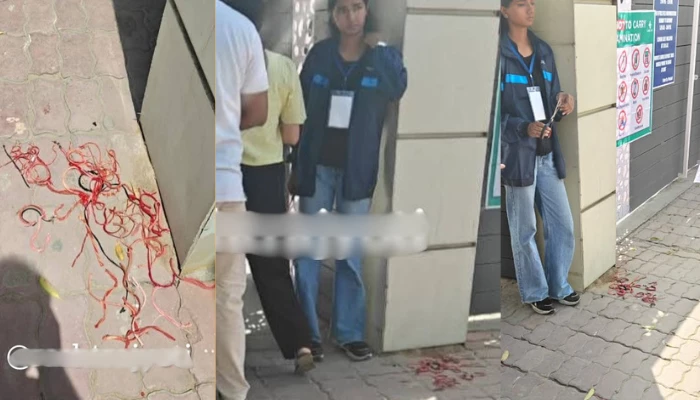
Case Summary
At examination centres in Gurugram, Haryana, Hindu students were forced to remove or had their sacred wrist threads cut before being allowed to proceed with the examination. This examination was conducted by the Haryana Public Service Commission. According to reports, the incident occurred during an examination held on Sunday, 26 April, 2026, when candidates arrived at their designated centres to appear for the test. During the entry and checking process, invigilation staff objected to the sacred threads tied on the wrists of Hindu students. These threads were treated as prohibited items, and students were either instructed to remove them or had them cut on the spot as a precondition for entry into the examination hall. The video of the incident circulating showed a female staff member holding scissors, with a visible pile of cut sacred threads placed near her feet. It was indicated that her role at the centre involved cutting these threads from students’ wrists during the entry procedure. The basis or authority for such action was not specified in the reports, and questions were raised about the origin of these instructions. Students were required to comply with these directions to be permitted to sit for the examination. The removal or cutting of the sacred thread took place immediately before entry, leaving students with no practical alternative if they wished to appear for the test. The act occurred in the presence of examination staff and was part of the centre's standardised checking procedure. The incident drew attention on social media platforms, where users questioned the rule's legitimacy and sought clarification on examination guidelines. Concerns were raised about whether such actions were authorised under official protocols or constituted an arbitrary imposition at the centre level. Public reactions further referenced similar instances in educational and examination settings where Hindu students were asked to remove religious markers such as forehead markings, sacred threads, or other symbols as a condition for entry. These concerns were framed in the context of recurring practices linked to security checks or anti-cheating measures. Following the circulation of the incident, demands were made for an inquiry into the conduct of the examination centre staff and for clarification from the authorities responsible for organising the examination. Appeals were also directed to local administrative and law enforcement authorities to take appropriate action and determine accountability. A similar incident had been reported earlier in Bengaluru on 23 April 2026, where Hindu students were forced by invigilators to remove their sacred thread (Janivara) before being allowed to enter the examination hall during the Common Entrance Test (CET), despite clear instructions issued by the government stating otherwise. This prior occurrence, documented by the Hinduphobia Tracker, reflected a pattern of Hindu religious symbols being targeted in examination settings under similar circumstances.
Why it is Hate Crime ?
This case has been added to the tracker under the primary category - Restriction/ban on Hindu practices. Within this, the subcategory selected is - Restriction on expression of Hindu identity. An example of the state-affected prejudicial and targeted orders against the Hindu community would be a government denying the right of a Hindu or a group of Hindus to hold a religious procession owing to the animosity of non-Hindu groups. Denial of the religious right of the Hindus to assuage the non-Hindu group, which harbours animosity to a point where it could lead to violence against Hindus, is not only a failure of law and order but is a prejudicial order against Hindus, denying them their fundamental rights to express their religious identity. An example of a hate crime against Hindus by a non-Hindu would be a non-Hindu institution forcing its Hindu employees to abandon religious symbols that a Hindu would wear as an expression of faith owing to inherent prejudice against the faith professed by the victim or a non-Hindu group of people restricting a Hindu group from constructing a place of worship simply because the demography of the area in which the temple is being built is dominated by non-Hindus. Such actions are driven by religious animosity and/or prejudice against Hindus and their faith and would therefore be categorised as a hate crime. Another primary category selected for this case is - Attack on religious representations. Under this, the subcategory selected is - Desecration of a Hindu religious symbol. Icons and symbols, or a religious representation of a spiritual ideal, are widely revered in Hinduism. Iconography is of vital significance in the Hindu milieu. It helps connect people’s spiritual beliefs with the real world. Iconography within the Hindu faith takes several shapes and forms. Murtis are of most significance to Hindus, to which daily rituals, prayers and offerings are done. Besides the murtis, there are several other symbols which have deep significance in the Hindu faith – the Om and Swastika, for example. Since these Hindu religious symbols hold paramount importance in Hinduism, any desecration of symbols, icons, murtis, religious representations and manifestations, is driven by animosity towards the faith itself, which manifests itself through these murtis, icons and symbols. Therefore, any desecration of these Hindu religious symbols and representations is considered a religiously motivated hate crime under this category. This case qualified as a religiously motivated hate incident because Hindu students were compelled to remove or had their sacred wrist threads cut as a condition for accessing an essential academic opportunity. The restriction was imposed specifically on a Hindu religious practice and was enforced at a moment when students had no real choice but to comply if they wished to sit for the examination. The act directly targeted their religious identity and placed it in conflict with their educational rights, demonstrating that religion was central to the harm inflicted. The sacred wrist thread, commonly tied during rituals and prayers, carries deep spiritual meaning within Hindu tradition. It symbolised divine protection, a bond with sacred vows, and the blessings invoked during religious ceremonies. It was not a decorative accessory but a consecrated thread worn with faith and intent. Therefore, cutting it arbitrarily, outside any religious context, stripped it of its sanctity and amounted to a symbolic act of desecration. For a practising Hindu, its removal was not a casual or administrative matter but an intrusion into personal faith and spiritual continuity. Moreover, the manner in which the threads were cut, in a routine and mechanical process at the examination centre, further reduced a sacred object to something disposable. This was not a voluntary act, but one carried out under clear institutional pressure. The students were placed in a position of complete helplessness, with no real option but to comply if they wished to sit for the examination. Furthermore, the students were given no opportunity to question the directive, seek clarification from any higher authority, or approach the management for redressal. No written rule was shown to them mandating the removal of such religious symbols, nor was any such restriction publicly notified on the official examination platform. In these circumstances, students were forced to prioritise their academic future over their religious observance, creating a coercive environment where compliance was extracted rather than freely given. Such compulsion reflected a disregard for the sacred nature of the symbol and the beliefs attached to it. Additionally, the incident reflected a broader and recurring pattern where expressions of Hindu identity were curtailed in institutional spaces under the guise of uniformity or discipline. When such actions occurred repeatedly, they ceased to be isolated administrative decisions and instead indicated a systemic disregard for Hindu religious practices. Beyond the immediate act, there was a more subtle layer of psychological conditioning at play, wherein students were made to internalise that their religious symbols were dispensable, inferior, or out of place in formal spaces, while conformity was implicitly rewarded. The message conveyed was quiet but forceful: to be accepted, to participate, to belong, one must shed visible markers of Hindu identity and blend into a standard defined without them. Consequently, the psychological impact was immediate; students were made to feel that their faith was incompatible with participation in public spaces, leading to distress, alienation, and a diminished sense of belonging. It is also significant to mention that the restriction was discriminatory and was applied selectively. While Hindu symbols such as the sacred thread were removed, no other comparable restriction was enforced on visibly identifiable attire associated with other religions, such as the burqa or hijab. This differential treatment raised concerns of unequal application of rules, where Hindu practices were subjected to scrutiny and removal, while others were accommodated. Such selective enforcement undermined the claim of neutrality and pointed towards discriminatory treatment based on religious identity. Finally, even within examination protocols, restrictions were typically limited to items that posed a risk of unfair means or security concerns, such as electronic devices or metallic objects. A simple sacred thread did not fall within these categories and did not interfere with the conduct of the examination. Its targeting, therefore, lacked reasonable justification and appeared arbitrary. When a rule disproportionately impacted one religious group without a clear procedural necessity, it reflected bias rather than regulation. Here, it is important to mention that in 2022, a massive controversy had erupted in Karnataka, which took a national form, after Muslim women had insisted that they should be allowed to wear Burqas and Hijabs in their schools and classrooms. At that time, the argument put forward by several politicians, social commentators, Hindu activists, and even the judiciary was that schools have the right to enforce uniform rules, since wearing uniforms brings harmony and equality in the classroom. Therefore, not allowing girls to wear hijab in classrooms was framed not as religious discrimination, but as the enforcement of widely accepted uniform norms. The pseudo-secular and leftist groups may argue that a similar line of reasoning should apply in this case. However, it is important to note that the kalava, a sacred thread traditionally worn as a marker of faith, does not violate the examination dress code nor does it pose any security risk. Examination authorities may regulate outer clothing for uniformity and security, but what a candidate wears as part of their religious identity, especially something minimal and non-intrusive like the kalava, should not be subject to arbitrary control. Forcing its removal without any valid or written justification amounts to a violation of religious freedom and sends a deeply exclusionary message by singling out Hindu customs for unnecessary scrutiny. More broadly, this reflects a concerning pattern where expressions of Hindu identity are marginalised even in supposedly neutral, secular spaces like examination centres. In this instance, the enforcement of rules appears selective and rooted in disregard for Hindu sentiments rather than any genuine procedural necessity. In conclusion, the forced removal of a sacred symbol, the coercive circumstances under which it was carried out, and the apparent selective application of rules collectively demonstrated that the act was not a neutral enforcement of guidelines but a targeted interference with Hindu religious expression. This was why the incident had been classified as a hate incident in the tracker.


Case Status
Unknown


Perpetrators Details
Perpetrators
Others
Perpetrators Range
Unknown
Perpetrators Gender
unknown
 Sources




