Hindu students compelled to remove Janeu during CET exam in Bengaluru despite prior government directives
 Bengaluru, Karnataka, India
  22 April, 2026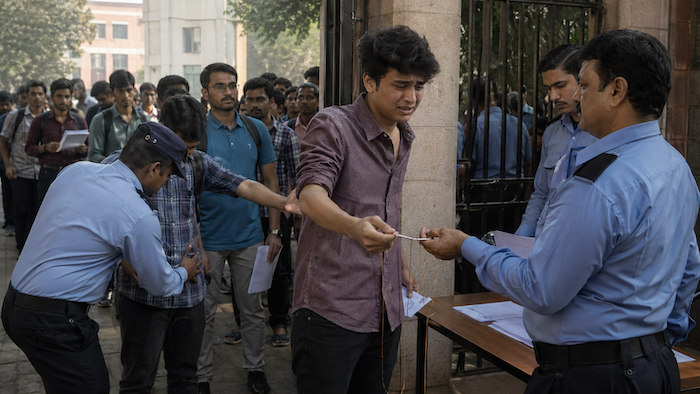
Case Summary
At Krupanidhi College, Madiwala in Bengaluru, Karnataka, several Hindu students were forced by invigilators to remove their sacred thread (Janeu/Janivara) before being allowed to enter the examination hall, despite clear instructions by the government stating otherwise. During the Common Entrance Test (CET) held on 23 April 2026 at an examination centre, a Hindu student named Anand Sudheer Rao stated that when he reached the examination centre at approximately 09:40 AM, he proceeded with the entry process after depositing his belongings. During the security check, invigilators noticed that Anand was wearing a janivara, a sacred thread worn after the upanayana ritual and regarded as an essential marker of religious identity. He, along with at least five to seven other students who faced the same condition, was stopped and instructed to remove the sacred thread before being allowed to enter the examination hall. The sacred thread was treated as a prohibited item despite existing guidelines only restricting objects such as chains and bracelets. The Hindu student initially refused to remove it, citing his religious beliefs. He was then informed that he would not be permitted to take the examination if he did not comply with the instructions. The restriction placed him in a position where he had to decide between adhering to his religious practice and being allowed to sit for the examination. Under pressure and fearing the loss of an important academic opportunity, he removed the sacred thread. Multiple other Hindu students at the same centre were also instructed to remove their janivara under similar conditions. The Hindu student later stated that he felt distressed and was unable to perform properly in the examination due to the emotional impact of the incident. The issue spread among other students and parents, leading to objections being raised regarding the treatment of a religious symbol as a prohibited item. Concerns were expressed over the impact on Hindu students who were required to compromise on their religious identity in order to participate in the examination. Following the incident, parents lodged formal complaints, leading to the registration of a First Information Report under provisions related to disturbing communal harmony. Authorities initiated an inquiry, and three staff members involved in examination duties were suspended. Officials from the local administration, including education authorities and police personnel, visited the centre to assess the situation, while the college management issued an apology and permitted students to appear in subsequent examinations without removing the sacred thread. The controversy gained wider attention as it emerged that similar incidents had taken place in Karnataka in 2025, after which the government had issued clear instructions that students should not be asked to remove the sacred thread, especially as it is worn beneath clothing and does not pose any security concern. Karnataka Higher Education Minister M. C. Sudhakar acknowledged that students had been made to remove their sacred threads despite explicit prior guidelines prohibiting such actions. He described the act as a violation of human rights and privacy, stating that no student should be forced to choose between faith and education, and directed that action be taken against the examination centre management.
Why it is Hate Crime ?
This case has been added to the tracker under the primary category - Restriction/ban on Hindu practices. Within this, the subcategory selected is - Restriction on expression of Hindu identity. An example of the state-affected prejudicial and targeted orders against the Hindu community would be a government denying the right of a Hindu or a group of Hindus to hold a religious procession owing to the animosity of non-Hindu groups. Denial of the religious right of the Hindus to assuage the non-Hindu group which harbours animosity to a point where it could lead to violence against Hindus is not only a failure of law and order but is a prejudicial order against Hindus, denying them their fundamental rights to express their religious identity. An example of a hate crime against Hindus by a non-Hindu would be a non-Hindu institution forcing its Hindu employees to abandon religious symbols that a Hindu would wear as an expression of faith owing to inherent prejudice against the faith professed by the victim or a non-Hindu group of people restricting a Hindu group from constructing a place of worship simply because the demography of the area in which the temple is being built is dominated by non-Hindus. Such actions are driven by religious animosity and/or prejudice against Hindus and their faith and would therefore be categorized as a hate crime. Another primary category selected for this case is - Attack on religious representations. Under this, the subcategory selected is - Desecration of Hindu religious symbol. Icons and symbols or a religious representation of a spiritual ideal are widely revered in Hinduism. Iconography is of vital significance in the Hindu milieu. It helps connect people’s spiritual beliefs with the real world. Iconography within the Hindu faith takes several shapes and forms. Murtis are of most significance to Hindus, to which daily rituals, prayers and offerings are done. Besides the murtis, there are several other symbols which have deep significance in the Hindu faith – the Om and Swastika for example. Since these Hindu religious symbols hold paramount importance in Hinduism, any desecration of symbols, icons, murtis, religious representations and manifestations, is driven by animosity towards the faith itself which manifests itself through these murtis, icons and symbols. Therefore, any desecration of these Hindu religious symbols and representations is considered religiously motivated hate crimes under this category. This case qualified as a religiously motivated hate crime because Hindu students were compelled to remove their sacred religious symbols by the invigilators as a condition for accessing an essential academic opportunity. The invigilators imposed a restriction directly tied to a Hindu religious practice and enforced compliance under threat of exclusion. The act targeted the student’s religious identity at a moment of vulnerability and had a direct impact on his ability to participate in the examination. The nature of the compulsion and its consequences demonstrated that religion was central to the harm inflicted. The Janivara (sacred thread) is not merely a piece of clothing or an accessory but a deeply spiritual and identity-affirming marker within the Hindu tradition, particularly among Brahmin communities. Its removal is tantamount to religious humiliation. Moreover, the act of removing the Janivara is symbolically violent. It communicates not only a rejection of the sacred but a deliberate attempt to degrade and desacralise Hindu identity in a space that is ostensibly secular. Therefore, for a Hindu student, wearing the sacred thread is not optional but an integral part of his religious observance and identity. The invigilators chose to impose a condition that directly interfered with this practice, despite government orders permitting them, at a critical moment when the student had no real alternative. This revealed that the perpetrators deliberately targeted a Hindu religious practice and enforced its removal in a setting where refusal would result in exclusion, demonstrating intent to suppress the Hindu religious expression in a secular space. This act amounted to an attack on a Hindu religious symbol through its forceful removal under duress, constituting symbolic desecration of the Janivara. The Hindu students, under pressure and fear of missing the examination, removed the sacred thread despite their initial refusal, making the act coercive rather than voluntary. In Hindu tradition, the Janivara is not a mere ornament but a consecrated thread symbolising devotion. Its removal is governed by specific ritual contexts and personal observance, not external compulsion. Forcing its removal in a non-ritualistic, institutional setting stripped the act of its sanctity and reduced a sacred object to something disposable, thereby severing its religious meaning. The perpetrators enforced this removal in a setting devoid of religious consideration, compelling the student to act against his beliefs and demonstrating a disregard for the sacred nature of the symbol. This coercion not only caused emotional and spiritual distress but also imposed a condition where the student’s faith was subordinated to administrative authority, reinforcing the perception that Hindu religious symbols could be overridden without consequence. Here, it is important to mention that in 2022, a massive controversy had erupted in Karnataka, which took a national form, after Muslim women had insisted that they should be allowed to wear Burqas and Hijabs in their schools and classrooms. That time, the argument that was given by several politicians, social commentators, Hindu activists and even the Judiciary was that schools have the right to enforce uniform rules, since wearing uniforms brings harmony and equality in the classroom, and therefore, schools not allowing girls to wear hijab in the classroom is not religious discrimination, but merely an enforcement of widely accepted uniform norms. The pseudo-seculars and leftist groups may argue that a similar line of reasoning should be applied in this case. However, it becomes important to mention here that, firstly, while the Common Entrance Test (CET) exam mandates simple attire to prevent malpractices, it also accommodates religious customs. Candidates wearing articles of faith, such as turbans or Kalava, are permitted, and only metal items such as earrings or nose rings are restricted. Moreover, the Janeu, a sacred thread traditionally worn underneath one’s clothes, neither violates the CET exam dress code nor poses any security risk. Examination authorities may regulate outer clothing for uniformity and security, but what a student wears beneath their attire, especially something as personal and concealed as the Janeu, should not be subject to such control. Forcing its removal without any valid or written justification is a clear violation of religious freedom. It sends a deeply exclusionary message, singling out Hindu customs for unnecessary scrutiny. More broadly, this reflects a disturbing pattern where expressions of Hindu identity are marginalised, even in supposedly neutral, secular spaces like exam centres. In this case, the enforcement of rules appears selective and rooted in disregard for Hindu sentiments rather than any genuine procedural necessity. This is why the incident has been classified as a hate crime in the tracker. Disclaimer: Media reports stated that, along with Anand, seven other Hindu students faced a similar issue. Therefore, for documentation purposes, the victim count has been recorded as eight.
Victim Details
Total Victim
8
Deceased
0
Gender
- Male 8
- Female 0
- Third Gender 0
- Unknown 0
Caste
- SC/ST 0
- OBC 0
- General 8
- Unknown 0
Age Group
- Minor 0
- Adult 0
- Senior Citizen 0
- Unknown 8


Case Status
Complaint registered


Perpetrators Details
Perpetrators
Unknown
Perpetrators Range
From 2 To 5
Perpetrators Gender
unknown
 Sources




