Hindu woman receives death threats and abuse online after opposing derogatory Vishu poster by Muslim-owned restaurant in Kerala
 Kerala, India
  17 April, 2026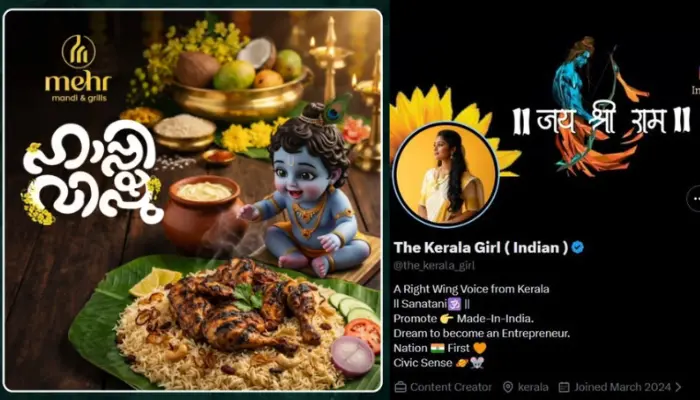
Case Summary
A Hindu woman from Kerala was issued death threats and abusive messages online after she objected to a Vishu advertisement by the Cherthala-based Mehr Mandi & Grills, a Muslim-owned restaurant in Kerala. The Muslim-owned restaurant, Mehr Mandi & Grills, had published a derogatory Vishu greeting poster in which Lord Krishna was shown eating meat. This triggered outrage on social media. After the Hindu woman posted about this and objected to it, she received a barrage of hateful comments online, mostly violent death threats and abuse. She posted screenshots of the threats and abusive messages on her X handle, "@the_kerala_girl", on 18 April 2026. One of the accused threatening her was a Malayali living in Saudi Arabia, following which she tagged the Saudi and Kerala authorities and urged action against him. In an interview with Janam TV, a media outlet, the Hindu victim said that she found the situation distressing and feared for her personal safety. She said she was particularly alarmed by the tone of the messages and expressed concern that something similar to the T. J. Joseph hand-chopping case could happen to her. Notably, in 2010, T. J. Joseph, a Christian professor in Kerala, was attacked by Muslim individuals linked to the now-banned Popular Front of India (PFI), an Islamic terror group. This incident occurred after a mere allegation that Joseph had insulted Prophet Muhammad in an examination paper. During the assault, his right hand was chopped off, and he suffered serious injuries. The Hindu woman recounted that the episode began after she reacted to social media posts related to the Vishu advertisement. She said that she had only recently become aware of the issue and that, as a Hindu believer and a devotee of Krishna, she felt deeply hurt. She said that when she saw posts showing Krishna eating beef, chicken and mandi, she felt upset as a believer. After she posted her objections on Twitter, the comments under her post frightened her. She said that if she had been in Kerala, she might have faced something similar to what happened to T.J Joseph and that she felt fortunate to have been outside Kerala. As per the victim's narration, the replies under her post were vile, and people had used her Vishu photograph along with her own photo while writing threatening remarks such as, “I will come to your house, and when I come there, I will give you the answer for this.” She said that her family was insulted, that she was abused in filthy language, and received repeated threats from an account based in Saudi Arabia, run by a Malayali there. When asked whether she had approached the police, she said that the abusive replies had continued under her older posts as well. She said that she had tagged the Saudi account and the Kerala Police and had also posted about the matter. However, the victim had not taken any separate legal step beyond that. The victim also stated that many of her old posts had also attracted insults, abuse and vulgar comments that could not even be spoken aloud. She said she did not understand why this was happening or what the intention was. She added that if it had been only one person from Kerala, it might have been explainable, but the pattern appeared coordinated, including the use of slipper images, which suggested an organised group behind it. The TV host concluded by encouraging the Hindu woman to remain strong and thanked her for speaking about the issue. Following this, many Hindu users on social media shared her ordeal and showed her their support. They also requested authorities to look into the matter.
Why it is Hate Crime ?
This case is being added to the tracker under the primary category- Attack not resulting in death. The subcategory selected is- Attacked for opposing radicals or trying to save victim. In several cases, Hindus are attacked for opposing religiously motivated crimes being committed against a fellow Hindu or simply for voicing an opinion opposing radical elements, who either have in the past or continue to persecute Hindus. In such cases, the initial attack against the victim, against which the Hindu was trying to defend the victim, would also need to be classified as a religiously motivated hate crime. Since the initial crime itself was religiously motivated and the subsequent crime of attempting to save the victim or speaking against the radical elements ends up inviting a violent attack, it would also be classified as a religiously motivated hate crime under this category. Another primary category selected is- Hate Speech against Hindus. The subcategory selected is- Violent Threats. Violent threats, explicit, implicit or implied, is the most dangerous form of hate speech since it goes beyond discriminatory and prejudicial language to express the intent of causing harm to an individual or a group of people based on their religious identity and faith. There could be several different kinds of threats that are issued to Hindus based on religious animosity. An explicit threat would mean the direct threat of violence towards an individual Hindu, a group of Hindus or Hindus at large. Physical violence, death threats, threats of destruction of property belonging to Hindus and threats of genocide would mean explicit threats against Hindus for their religious identity. Implicit threats may not be a direct threat but implied through the use of symbols of actions – for example – in the Nupur Sharma case, other than explicit threats, there were also implicit threats when Islamists took to the streets to burn and beat her effigies. It implies that they want to do the same to Nupur Sharma – thereby is considered an implicit threat. Violent threats can be delivered in person, through letters, phone calls, graffiti, or increasingly through social media and other online platforms. It would be important to understand that a threat – explicit or implicit, online or offline – to an individual who happens to be a Hindu does not qualify as a religiously motivated threat. Such a threat, while vile and dangerous, could be owing to non-religious reasons and/or personal animosity. To qualify as a religiously motivated threat, it would need to exhibit an indication that the individual is being targeted for religious reasons and/or owing to his/her religious identity as a Hindu. In this case, a Hindu woman was subjected to severe death threats and online abuses simply for opposing the denigration of her revered deity, Lord Krishna, in a derogatory Vishu poster published by a Muslim-owned restaurant in Cherthala, Kerala. Her objection was not an act of aggression but a defence of her faith, yet it drew a vicious wave of intimidation and abuses that made the case deeply alarming, making it a religiously motivated crime. The act of the Muslim-owned restaurant itself was derogatory from the outset, as it depicted Lord Krishna eating meat in a Vishu greeting poster. This was done to offend Hindu sentiments, desecrate a sacred religious symbol of a Hindu deity, and wound the religious beliefs of Hindus during a holy festival, making it a clear case of a religiously motivated offence in itself. When the Hindu woman, who was a devotee of Lord Krishna, opposed this insult, she became the target of death threats and abuses online. That amounted to an attack on a Hindu individual for merely defending her faith identity and resisting those who denigrated Hindu beliefs and Hindu deities, making it a clear case of a religiously motivated hate crime. The death threats and abuses were so severe that she linked her fear to the T. J. Joseph hand-chopping incident in Kerala, where a Christian professor had been attacked by Muslim extremists linked to the banned outfit, Popular Front of India (PFI), over a mere allegation of blasphemy against Prophet Muhammad. Her reference to that case showed the intensity of the threats she received and the genuine fear they created. It was not a casual exchange of insults but a frightening campaign of intimidation directed at her for standing up for her faith and objecting to a derogatory religious image. Issuing death threats and abuses in this case served to intimidate and silence Hindu devotees from speaking up when their faith was violated or mocked in this manner. Such behaviour is meant to punish dissent, spread fear, and discourage others from defending their religious identity in public. Taken together, the insult to a sacred Hindu festival and the subsequent online threats against a Hindu woman who objected to it showed a clear pattern of targeted hostility against the Hindu faith and community. In this case, even though the identity of the perpetrators has not been specified in media reports, the act itself amounts to a crime motivated by anti-Hindu animosity. Therefore, this case is being added to the hate crime database of the Hinduphobia Tracker. Disclaimer: In this case, since only one perpetrator was specified as threatening the victim, the perpetrator count has been recorded as one. This has been noted for documentation purposes only.
Victim Details
Total Victim
1
Deceased
0
Gender
- Male 0
- Female 1
- Third Gender 0
- Unknown 0
Caste
- SC/ST 0
- OBC 0
- General 0
- Unknown 1
Age Group
- Minor 0
- Adult 1
- Senior Citizen 0
- Unknown 0


Case Status
Unknown


Perpetrators Details
Perpetrators
Unknown
Perpetrators Range
One Person
Perpetrators Gender
male
 Sources




