Hindu employees penalised for wearing religious symbols, denied festival holidays at their workplace; whereas non-Hindus get leave and no restrictions
 Hyderabad, Telangana, India
  17 April, 2025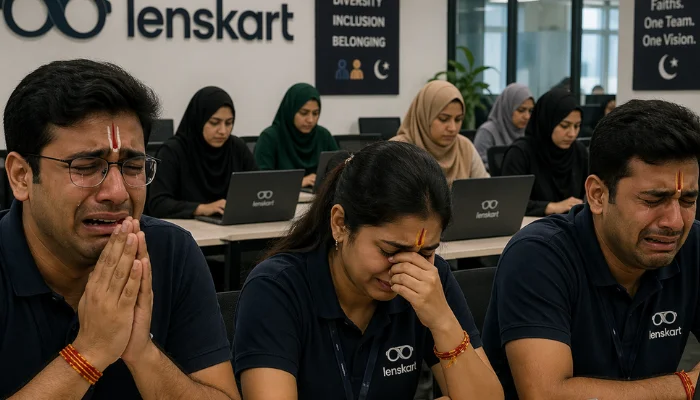
Case Summary
In Hyderabad, Telangana, Hindu employees working for Lenskart, a multinational company, faced religious targeting and discrimination at their workplace. They faced restrictions on their religious symbols and received penalties for wearing them. In some cases, their sacred religious symbols suffered desecration. At the same time, Hindus received no holidays during Hindu festivals. However, non-Hindus enjoyed holidays on their festivals and faced no restrictions on faith expressions. This incident occurred against the backdrop of workplace discrimination in Lenskart stores, where Hindu employees were barred from visibly wearing religious symbols such as bindi, kalava, and sindoor, while Muslim employees were allowed to wear the hijab. As earlier documented by the Hinduphobia Tracker, the issue emerged when a customer shared a video in which a store employee confirmed that wearing a bindi and kalava was not permitted, yet the hijab was allowed, sparking public criticism over unequal treatment. It later came to light that these instructions formed part of an official training document, which prohibited Hindu religious markers while permitting the hijab (worn by Muslims) and turban (worn by Sikhs) under certain conditions. Following backlash, Lenskart initially dismissed the document as outdated, but later the founder apologised and claimed that such policies had existed in the past and had since been amended. According to media reports, this came to light when a Hindu employee's video testimony went viral on X on 18 April 2026. In it, the victim, a Hindu woman who worked as an employee for three and a half years at Lenskart, delivered a detailed and specific testimony. She stated that for roughly the past year (2025), the company applied different standards for its employees based on religion. Hindu employees received instructions not to arrive wearing a tilak, not to wear kumkum, and to remove religious threads (taayattu/kalava) from their wrists. During monthly video audits conducted by external auditors, Hindu employees wearing a bindi faced penalties, either forced to remove it before entering the store or having it forcibly removed by the auditors themselves. On non-audit days, managers directly confronted Hindu employees: “Hindus must not wear bindi. Why do you come with it?” However, Muslim employees, by contrast, escaped these restrictions. When Muslim employees chose not to wear nail polish (a mandatory part of the uniform) for religious reasons before marriage, the company exempted them, even absorbing audit point deductions rather than enforcing the rule. Even in matters of leave policy, only Muslims received a week off for Ramadan and Christians received leave for Christmas. Whereas, during Hindu festivals, including Ugadi, Hindu employees were not given any holidays. The company’s stated position to employees, delivered face-to-face: “Hindus have too many festivals, so we shall not provide for you.”This policy, the victim confirmed, applied pan-India across all Lenskart stores, verified by staff across locations. As the incident surfaced, Hindu users on X questioned Lenskart's policy of religious discrimination that selectively targeted Hindu symbols.
Why it is Hate Crime ?
The first primary category selected in this case is- Restriction/ban on Hindu practices. The subcategory selected is- Restriction on expression of Hindu identity. An example of the state-affected prejudicial and targeted orders against the Hindu community would be a government denying the right of a Hindu or a group of Hindus to hold a religious procession owing to the animosity of non-Hindu groups. Denial of the religious right of the Hindus to assuage the non-Hindu group which harbours animosity to a point where it could lead to violence against Hindus is not only a failure of law and order but is a prejudicial order against Hindus, denying them their fundamental rights to express their religious identity. An example of a hate crime against Hindus by a non-Hindu would be a non-Hindu institution forcing its Hindu employees to abandon religious symbols that a Hindu would wear as an expression of faith owing to inherent prejudice against the faith professed by the victim or a non-Hindu group of people restricting a Hindu group from constructing a place of worship simply because the demography of the area in which the temple is being built is dominated by non-Hindus. Such actions are driven by religious animosity and/or prejudice against Hindus and their faith and would therefore be categorized as a hate crime. The second primary category selected is- Attack not resulting in death. The subcategory selected is- Attacked for Hindu identity. In several cases, Hindus are attacked merely for their Hindu identity without any perceived provocation. A classic example of this category of religiously motivated hate crime is a murder in 2016. 7 ISIS terrorists were convicted for shooting a school principal in Kanpur because they got ‘triggered’ seeing the Kalava on his wrist and tilak that he had put. In this, the Hindu victim had offered no provocation except for his Hindu religious identity. The motivation for the murder was purely religious, driven by religious supremacy. Such cases where Hindus are targeted merely for their religious identity would be documented as a hate crime under this category. The third primary category selected is- Attack on Hindu religious representations. The subcategory selected is- Desecration of Hindu religious symbol. Icons and symbols or a religious representation of a spiritual ideal are widely revered in Hinduism. Iconography is of vital significance in the Hindu milieu. It helps connect people’s spiritual beliefs with the real world. Iconography within the Hindu faith takes several shapes and forms. Murtis are of most significance to Hindus, to which daily rituals, prayers and offerings are done. Besides the murtis, there are several other symbols which have deep significance in the Hindu faith – the Om and Swastika for example. Since these Hindu religious symbols hold paramount importance in Hinduism, any desecration of symbols, icons, murtis, religious representations and manifestations, is driven by animosity towards the faith itself which manifests itself through these murtis, icons and symbols. Therefore, any desecration of these Hindu religious symbols and representations is considered religiously motivated hate crimes under this category. This case qualifies as a religiously motivated hate crime as Hindu employees working at a Lenskart store in Hyderabad, Telangana, experienced discrimination based on their religious identity. The company restricted their use of religious symbols, including bindi, tilak, and kalava. These symbols hold immense religious significance in Hinduism. Bindi marks the third eye and marital status. Tilak is applied to the forehead for blessings and spiritual protection. Kalava is a sacred thread worn on the wrist to ward off negativity. The company policy banned these items. Hindu employees faced penalties for wearing them. This restriction limited Hindu religious expression at work. It forced Hindu employees to conceal their identity to retain employment; all of this showcases a clear example of institutionalised Hinduphobia. The act of forbidding Hindu employees from wearing Hindu religious symbols such as the bindi, tilak and kalava amounts to a clear case of anti-Hindu prejudice. These symbols are small, visible markers of Hindu identity and faith, not disruptive or dangerous. By banning them specifically while permitting equivalent expressions of other faiths in the workplace, the company reveals a deliberate religious bias against Hinduism. The policy sends the message that Hindu religious expression is unacceptable, while other religions are tolerated, which showcases intolerance toward Hindu symbols and faith practices. This restriction forces Hindu employees to conceal their religious identity to retain their employment, effectively making religious concealment a condition of professional survival. Such coercion violates the victims’ religious autonomy and fundamental right to freely express their religious identity in everyday life, including at work. The fact that the company treated these minute religious symbols as incompatible with workplace norms, whereas similar visible markers of other faiths were allowed, demonstrates a deep‑seated religious animosity towards Hinduism and Hindu religious expression. When Hindu employees wore their religious symbols, they were penalised through formal performance mechanisms, which directly affected their work and livelihood. Their religious identity, worn on their bodies through bindis, tilaks and similar markers, became a ground for professional attack rather than a neutral aspect of personal belief. The company targeted Hindu employees specifically for these symbols, hampering their work and introducing arbitrary, faith‑based penalties where no safety, operational or professional misconduct existed. This targeted penalisation transformed routine Hindu religious expression into a punishable offence, rooted not in job performance but in religious identity. By converting the wearing of Hindu religious symbols into a formal reason for deducting scores or imposing discipline, the company institutionalised discrimination and showed that its animosity was directed at Hindu employees as a group. Such systematic penalisation, solely because of religious markers, meets the core criteria of a religiously motivated hate crime, as it singles out members of a religious community for harm on account of their faith. In some instances, Hindu employees who wore bindis had those bindis forcibly removed by auditors or were ordered to remove them before entering the store. Bindi is not a mere cosmetic item; it is a sacred Hindu symbol associated with marital status, devotion and the spiritual centre of the forehead. Forcibly removing it, or compelling its removal under threat of professional consequences, constitutes desecration of a sacred religious symbol. Such actions disrespect the religious significance attached to the symbol and wound the emotional and spiritual sentiments of Hindu employees and the wider Hindu community. The act of physically targeting and stripping away a clearly religious marker sends a harsh message that Hindu symbols are not only unwelcome but are to be treated as objects of contempt. This intentional violation of a sacred marker, carried out in a professional setting, reflects profound religious animosity from the Lenskart company towards Hinduism and its visible expressions. The forced removal of bindis, therefore, represents a clear case of religiously motivated desecration and hate‑driven harm, reinforcing the classification of the incident as a hate crime. Alongside the symbol ban, Hindu employees were denied holidays on Hindu festivals while other religious groups continued to enjoy leave on their religious occasions. This differential treatment in holiday policy reveals an additional layer of religious animosity in the workplace. By granting leave for certain religious festivals but not for Hindu festivals, the company signalled that Hindu religious life was less important or worthy of recognition. The disparity communicates a hierarchy of religions, placing Hindu practices and days of significance below the status of others. This systematic exclusion from religious benefits, combined with the earlier restrictions on symbols, shows that the company’s hostility was not incidental but structural. Such unequal arrangements reinforce the idea that Hindu employees must diminish their religious identity to conform to workplace norms, which further entrenches religious discrimination. The cumulative effect, no holidays, no visible symbols, and distinct allowances for others, demonstrates a hate‑filled bias against Hindu religious identity and worship, making it a religiously motivated act of discrimination. When viewed against the broader backdrop of Lenskart’s policies, the discriminatory nature of this act becomes even clearer. The company’s official grooming policy and training documents showed that Lenskart allowed religious symbols of Islam and Sikhism, such as the hijab for Muslim employees and the turban or pagdi for Sikh employees, while selectively restricting and barring Hindu employees from visibly wearing any religious symbols of Hinduism. Tilak, bindi, kalava, and sindoor were all treated as inadmissible religious markers, whereas similar visible expressions of other faiths were permitted under certain conditions. This selective treatment placed a disproportionate burden on Hindu religious expression and turned workplace rules into a mechanism of religious bias. By allowing employees of other faiths to retain their visible religious identities while systematically excluding Hindu religious symbols, Lenskart demonstrated deep‑seated institutionalised discrimination and prejudice against Hindus. This pattern of unequal treatment of religious symbols confirms that the targeting of Hindu employees, even in this current case from Hyderabad, was not isolated but part of a broader framework of religious discrimination motivated by anti-Hindu bigotry and bias. Given that this case fulfils the key parameters of a religiously motivated hate crime, it is added to the Hate Crime database of the Hinduphobia Tracker. Disclaimer: The Hinduphobia Tracker recorded dates of incidents based on when the victims' ordeal began, rather than when it was reported by the media. In this case, media reports did not state the exact date when the victims' ordeal occurred. They only indicated that the Hindu employees were targeted since 2025. The only other specific date mentioned was when a video containing the victim woman's testimony went viral on social media, which is 18 April 2026. Based on this information, 18 April 2025 has been selected as the indicative incident date. This has been recorded for documentation purposes only. In this case, although multiple Hindu employees were targeted in the audit, only one Hindu woman has been specifically named in the available information. The total number of victims has not been clearly specified; therefore, the conservative victim count has been recorded as one.
Victim Details
Total Victim
1
Deceased
0
Gender
- Male 0
- Female 1
- Third Gender 0
- Unknown 0
Caste
- SC/ST 0
- OBC 0
- General 0
- Unknown 1
Age Group
- Minor 0
- Adult 1
- Senior Citizen 0
- Unknown 0


Case Status
Unknown


Perpetrators Details
Perpetrators
Others
Perpetrators Range
Unknown
Perpetrators Gender
unknown
 Sources




