Hindus face discrimination at an Indian multinational company; wearing religious symbols like 'bindi', 'kalava' banned while Hijab permitted
 India
India  14 April, 2026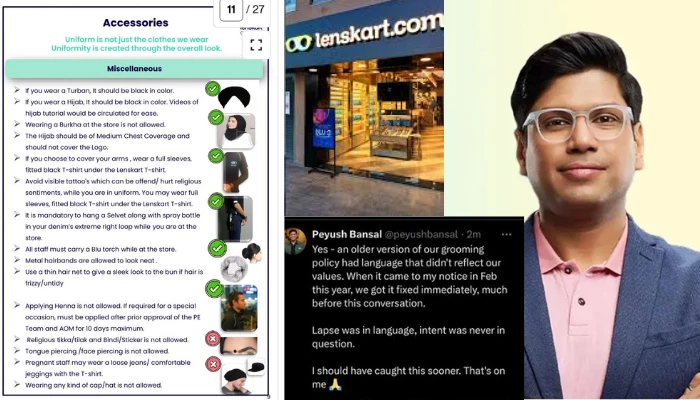
Case Summary
In Lenskart stores, Hindus were discriminated, restricted and barred from wearing their Hindu religious symbols like Bindi, Kalava, and sindoor, while Muslims were allowed Hijab. The issue first came to light when a customer who had visited a Lenskart outlet shared a video online, questioning staff about their dress code. In the viral video, a store employee stated that wearing items such as a kalava and a bindi was not allowed in the workplace. At the same time, the employee said that the hijab was permitted. The video was posted on social media with captions questioning this distinction. One user wrote, “No to kalava and bindi, but yes to hijab? What kind of policy is this?” Another post stated, “Why are Hindu symbols being restricted while other religious attire is allowed in the same store?” These posts were widely shared and brought the matter into public attention. During the same interaction, the customer asked the employee what would happen if a staff member came to work wearing a kalava or any other item not permitted under the rules. The employee responded that in such a situation, the concerned employee would be asked to leave for the day. The employee added that the individual could continue working only if they complied with the prescribed rules. When asked specifically about kalava, which holds religious significance for many Hindus and is not easily removed or cut, the employee stated that those who wished to wear it could do so only if it was concealed under their sleeves. This meant that the kalava should not be visible to any other person or customer within the store. Subsequently, it emerged that this diktat was mentioned in the introductory training document provided to Lenskart employees. This 23-page document outlined grooming and uniform-related rules for all staff. It stated that it contained all grooming standards, including cleanliness and presentability, that employees were required to adhere to. Pages from this document were circulated widely on social media. On page 7, it was stated that employees were not allowed to wear a kalava and a bindi, while wearing a hijab and a turban was permitted under certain conditions. Religious threads or wristbands must be removed, the document read. The document also included detailed instructions regarding footwear, clothing, watches, and other aspects of employee appearance, specifying what was permitted and what was not. Another section of the same document, on page 10, addressed the application of sindoor. It stated that if sindoor was worn, it should be minimal and should not spread across the forehead. Further documents associated with the company also surfaced online, containing similar instructions. Shefali Vaidya shared an image on X (formerly Twitter) of what was described as a “Lenskart style guide”, which included directions discouraging the wearing of a bindi while allowing the use of a hijab. In her post, she wrote, “Peyush Bansal (Lenskart’s founder) tells his employees that hijab is fine, but bindi/tilak/kalava is not. What would you say about a company like Lenskart, which operates in a Hindu-majority India where most employees and customers are Hindus?” The post further intensified the online debate, with several users questioning the company’s policies and how they were implemented. As the documents and posts continued to circulate, social media users raised concerns regarding the differential treatment of religious symbols within the workplace and sought clarification from the company. Following the backlash, Lenskart founder and CEO Peyush Bansal initially dismissed the document as “outdated” or “inaccurate” He justified this, however, after he was schooled, he apologised and stated that they had had those policies earlier but had since amended them.
Why it is Hate Crime ?
This case has been documented under the selected primary category: Restriction/ban on Hindu practices. Under this, the selected secondary category is: Restriction on expression of Hindu identity. An example of the state-affected prejudicial and targeted orders against the Hindu community would be a government denying the right of a Hindu or a group of Hindus to hold a religious procession owing to the animosity of non-Hindu groups. Denial of the religious right of the Hindus to assuage the non-Hindu group, which harbours animosity to a point where it could lead to violence against Hindus, is not only a failure of law and order but is a prejudicial order against Hindus, denying them their fundamental rights to express their religious identity. An example of a hate crime against Hindus by a non-Hindu would be a non-Hindu institution forcing its Hindu employees to abandon religious symbols that a Hindu would wear as an expression of faith owing to inherent prejudice against the faith professed by the victim or a non-Hindu group of people restricting a Hindu group from constructing a place of worship simply because the demography of the area in which the temple is being built is dominated by non-Hindus. Such actions are driven by religious animosity and/or prejudice against Hindus and their faith and would therefore be categorised as a hate crime. This incident qualifies as a religiously motivated hate crime because workplace rules were enforced in a manner that directly interfered with the visible expression of Hindu identity while imposing a disproportionate burden on Hindu employees. The issue was not merely about dress code or uniformity but about restricting specific religious markers that form part of everyday Hindu practice. The first marker is the suppression of visible Hindu religious symbols. The restriction on wearing kalava, bindi, and sindoor is significant because these are not ornamental accessories but expressions of faith worn in daily life. The kalava, in particular, is associated with religious rituals, protection, and spiritual commitment, while the bindi and sindoor carry cultural and religious meaning, especially for Hindu women. Forcing employees to remove or conceal these symbols is not a neutral act; it directly interferes with how individuals practise and express their religion in public spaces. The second marker is the compulsion to conceal religious identity as a condition of participation in the workplace. When employees are told to remove such symbols or leave, the choice presented is not about adhering to a general standard but about suppressing one’s religious identity in order to continue working. This transforms a workplace rule into a form of coercion, where continued participation becomes conditional upon dilution of faith. The third marker is the differential treatment of religious expression. While Hindu symbols such as kalava and bindi were restricted, other forms of religious attire, such as the hijab, were permitted. This distinction is important because it shows that the rule was not uniformly applied across all religious identities. When one group is required to alter or conceal its religious markers while another is allowed to retain them, the policy ceases to be neutral and instead imposes an unequal burden on a specific community. In this case, Hindu employees were placed at a disadvantage. The fourth marker is the institutional enforcement of these restrictions. The fact that employees were instructed to comply or leave indicates that the limitation was not incidental but actively enforced within the workplace. This gave the restriction a formal character, turning it into a systemic condition rather than an isolated instance. Such enforcement amplifies the impact, as it normalises the expectation that Hindu identity must be adjusted or concealed in professional spaces. Taken together, these elements show that the rules did not operate as a neutral standard of discipline but resulted in the selective restriction of Hindu religious expression. The cumulative effect was to render visible Hindu identity incompatible with workplace participation, thereby creating pressure on employees to internalise that their faith must be confined or made invisible. The intent behind such enforcement becomes evident from the pattern itself. When specific religious symbols associated with Hindu practices are restricted, while comparable expressions of other faiths are permitted, it indicates that the impact on Hindu employees was not incidental but knowingly imposed. Such selective restriction reflects a disregard for Hindu religious practices and the importance they hold in everyday life. By treating these expressions as expendable or inappropriate within the workplace, the rules effectively devalue the legitimacy of Hindu identity in a professional setting. The impact of such measures extends beyond appearance. It affects dignity, personal belief, and the ability to practise religion in everyday life. When individuals are required to suppress visible markers of their faith to remain employed, it creates an environment where their identity is marginalised and treated as less acceptable. For these reasons, the case has been included in the tracker as a religiously motivated hate crime. It involves the suppression of Hindu religious expression, coercive concealment of identity, differential treatment across communities, and institutional enforcement, all of which demonstrate discrimination rooted in religious identity. Disclaimer: The Hinduphobia Tracker records incident dates based on when the victim's ordeal began, rather than when the media reported it. In this case, the report does not specify when the victim's ordeal began; therefore, the publication date has been recorded as the indicative incident date for documentation purposes.


Case Status
Unknown


Perpetrators Details
Perpetrators
Others
Perpetrators Range
Unknown
Perpetrators Gender
unknown
 Sources




