Hindu employees targeted at Indian multinational company; penalised for wearing sacred kalavas in Pune
 Pune, Maharashtra, India
  15 October, 2024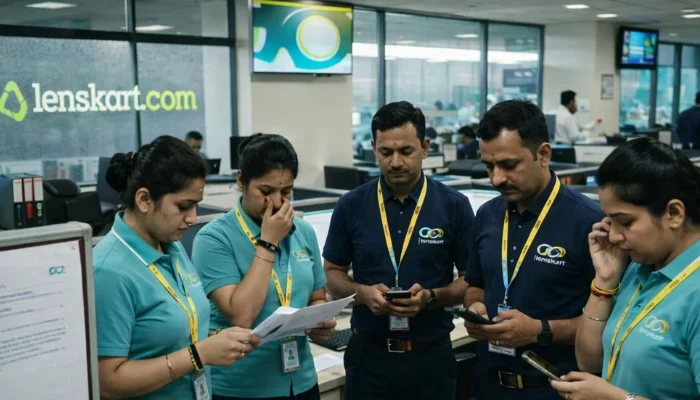
Case Summary
Hindu employees, namely Harsh Hatekar and his team of Hindu members working at a Lenskart store in Pune, were penalised by the Lenskart company for merely wearing kalavas, sacred Hindu threads worn by devotees on their wrists. This incident occurred against the backdrop of workplace discrimination in Lenskart stores, where Hindu employees were barred from visibly wearing religious symbols such as bindi, kalava, and sindoor, while Muslim employees were allowed to wear the hijab. As earlier documented by the Hinduphobia Tracker, the issue emerged when a customer shared a video in which a store employee confirmed that wearing a bindi and kalava was not permitted, yet the hijab was allowed, sparking public criticism over unequal treatment. It later came to light that these instructions formed part of an official training document, which prohibited Hindu religious markers while permitting the hijab (worn by Muslims) and turban (worn by Sikhs) under certain conditions. Following backlash, Lenskart initially dismissed the document as outdated, but later the founder apologised and claimed that such policies had existed in the past and had since been amended. According to reports, this incident came to light when a tweet from the Hindu victim, Harsh Hatekar, went viral on X (formerly Twitter). In the X post, Harsh said he was the former flagship store manager in Pune. He described a specific audit incident linked to Kalavas. “I was the manager of a flagship store in Pune. At Lenskart, third-party audits were conducted to check grooming standards. In October 2024, my store lost points specifically because we wore kalavas (sacred threads); the audit was conducted by a person named Ayush Verma,” Hatekar wrote on X. After this tweet by Harsh, Hindu users on X expressed even more outrage at Lenskart and its owner, Peyush Bansal. Some Hindu users swore never to shop at Lenskart because the company discriminated against its Hindu employees.
Why it is Hate Crime ?
This case has been documented under the primary category: Restriction/ban on Hindu practices. Within this, the subcategory selected is: Restriction on expression of Hindu identity. An example of the state-affected prejudicial and targeted orders against the Hindu community would be a government denying the right of a Hindu or a group of Hindus to hold a religious procession owing to the animosity of non-Hindu groups. Denial of the religious right of the Hindus to assuage the non-Hindu group, which harbours animosity to a point where it could lead to violence against Hindus, is not only a failure of law and order but is a prejudicial order against Hindus, denying them their fundamental rights to express their religious identity. An example of a hate crime against Hindus by a non-Hindu would be a non-Hindu institution forcing its Hindu employees to abandon religious symbols that a Hindu would wear as an expression of faith owing to inherent prejudice against the faith professed by the victim or a non-Hindu group of people restricting a Hindu group from constructing a place of worship simply because the demography of the area in which the temple is being built is dominated by non-Hindus. Such actions are driven by religious animosity and/or prejudice against Hindus and their faith and would therefore be categorised as a hate crime. Another primary category selected is: Attack not resulting in death. The subcategory selected is: Attacked for Hindu identity. In several cases, Hindus are attacked merely for their Hindu identity without any perceived provocation. A classic example of this category of religiously motivated hate crime is a murder in 2016. 7 ISIS terrorists were convicted for shooting a school principal in Kanpur because they got ‘triggered’ seeing the Kalava on his wrist and tilak that he had put. In this, the Hindu victim had offered no provocation except for his Hindu religious identity. The motivation for the murder was purely religious, driven by religious supremacy. Such cases where Hindus are targeted merely for their religious identity would be documented as a hate crime under this category. This case amounts to a clear example of a religiously motivated hate crime because Hindu employees Harsh Hatekar and his team of Hindu members were targeted and penalised at a Lenskart store in Pune for merely wearing kalavas, sacred Hindu religious symbols. Lenskart’s action was not neutral personnel management but a targeted intervention against the visible expression of Hindu religious identity. The company’s decision to punish employees specifically for wearing kalavas directly violated their religious autonomy and their right to practise and display their faith in the workplace. By treating the Hindu religious symbol as a violation of “grooming standards”, the company framed Hindu religious expression itself as a problem, thereby marking Hindus as undesirable in their own place of work. To grasp the depth of this violation, one must recognise the significance of kalavas. In Hindu tradition, kalavas (also known as kalawa or sacred red threads) are tied on the wrist during rituals, prayers, and religious festivals and are worn as a mark of faith, protection, and devotion to deities. For Hindus, the kalava is not merely decorative but a living symbol of spiritual commitment, commonly seen during puja, vrat, and auspicious occasions. It forms part of everyday religious life, linking the devotee to the divine in public and private spaces. Hence, attacking, targeting, and penalising Hindu employees for merely wearing kalavas showcases Lenskart’s deep‑seated religious animosity towards the Hindu community. The company’s aim was to suppress Hindu religious expression in the workplace, treating a routine act of Hindu devotion as a breach of professional conduct. This entire act amounted to the targeted penalisation of Hindu employees not for poor performance, misconduct, or any legitimate operational reason, but purely for wearing kalavas. Harsh Hatekar and his Hindu team were penalised in a third‑party audit specifically because they wore kalavas, and points were deducted from their store simply for the visible presence of these Hindu religious symbols. The Hindu employees were not failing sales targets, violating customer‑service norms, or breaching safety protocols; their only “offence” was the open expression of their Hindu faith. By converting the wearing of kalavas into a formal performance penalty, the company institutionalised religious discrimination, making it measurable, repeatable, and systemic. Treating Hindu religious symbols in this way, while allowing equivalent expressions of other faiths, shifted the focus from professional conduct to religious identity and showcased institutionalised discrimination against Hindus in the workplace. This case also showcases how Hindus are indirectly pressured to restrict their expression of Hindu identity in the workplace. By penalising employees for wearing kalavas, Lenskart effectively communicated that Hindu religious symbols are unwelcome in its professional environment. The underlying message was that to save the store from point‑loss and to remain in good standing, Hindu employees must either conceal or remove their kalavas. This subtle coercion places a unique burden on Hindu workers, forcing them to choose between their religious identity and their professional performance. Restricting Hindu religious expression in this way amounts to religious discrimination, as the company makes the visibility of the Hindu faith a condition for professional treatment, while not imposing a similar burden on employees of other faiths. Such pressure to suppress Hindu religious identity normalises the idea that Hinduism is something to be hidden or sanitised in corporate spaces. When viewed against the broader backdrop of Lenskart’s policies, the discriminatory nature of this act becomes even clearer. The company’s official grooming policy and training documents showed that Lenskart allowed religious symbols of Islam and Sikhism, such as the hijab for Muslim employees and the turban or pagdi for Sikh employees, while selectively restricting and barring Hindu employees from visibly wearing any religious symbols of Hinduism. Tilak, bindi, kalava, and sindoor were all treated as inadmissible religious markers, whereas similar visible expressions of other faiths were permitted under certain conditions. This selective treatment placed a disproportionate burden on Hindu religious expression and turned workplace rules into a mechanism of religious bias. By allowing employees of other faiths to retain their visible religious identities while systematically excluding Hindu religious symbols, Lenskart demonstrated deep‑seated institutionalised discrimination and prejudice against Hindus. This pattern of unequal treatment of religious symbols confirms that the targeting of Harsh Hatekar and his team was not isolated but part of a broader framework of religious discrimination motivated by anti-Hindu bigotry and bias. Given that this case fulfils the key parameters of a religiously motivated hate crime, it is added to the Hate Crime database of the Hinduphobia Tracker. Disclaimer: The Hinduphobia Tracker recorded dates of incidents based on when the victims' ordeal began, rather than when it was reported by the media. In this case, media reports did not state the exact date when the victims' ordeal occurred. They only indicated that the Hindu employees were targeted in October 2024. The only other specific date mentioned was when Harsh Hatekar posted about this incident on social media, which is 16 April 2026. Based on this information, 16 October 2024 has been selected as the indicative incident date. This has been recorded for documentation purposes only. In this case, Ayush Verma was identified as the individual who conducted the audit and targeted the Hindu employees from Lenskart by penalising them for wearing kalavas. Therefore, the perpetrator count has been recorded as one. In this case, although multiple Hindu employees were targeted in the audit, only Harsh Hatekar has been specifically named in the available information. The total number of victims has not been clearly specified; therefore, the conservative victim count has been recorded as one.
Victim Details
Total Victim
1
Deceased
0
Gender
- Male 1
- Female 0
- Third Gender 0
- Unknown 0
Caste
- SC/ST 0
- OBC 0
- General 0
- Unknown 1
Age Group
- Minor 0
- Adult 1
- Senior Citizen 0
- Unknown 0


Case Status
Unknown


Perpetrators Details
Perpetrators
Others
Perpetrators Range
One Person
Perpetrators Gender
male
 Sources




