Hindu employees at Indian airline company targeted and barred from wearing sacred Hindu symbols
 India
India  17 April, 2026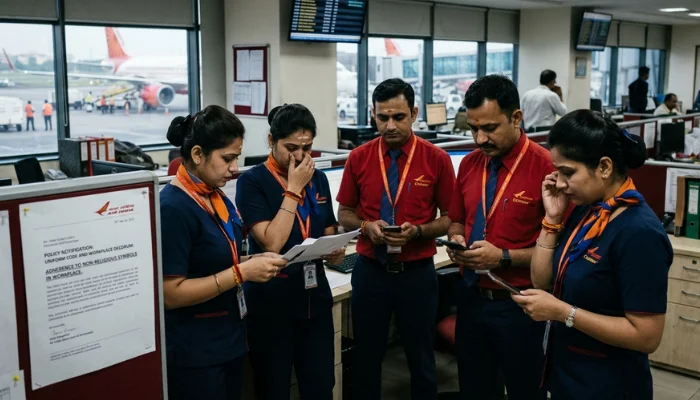
Case Summary
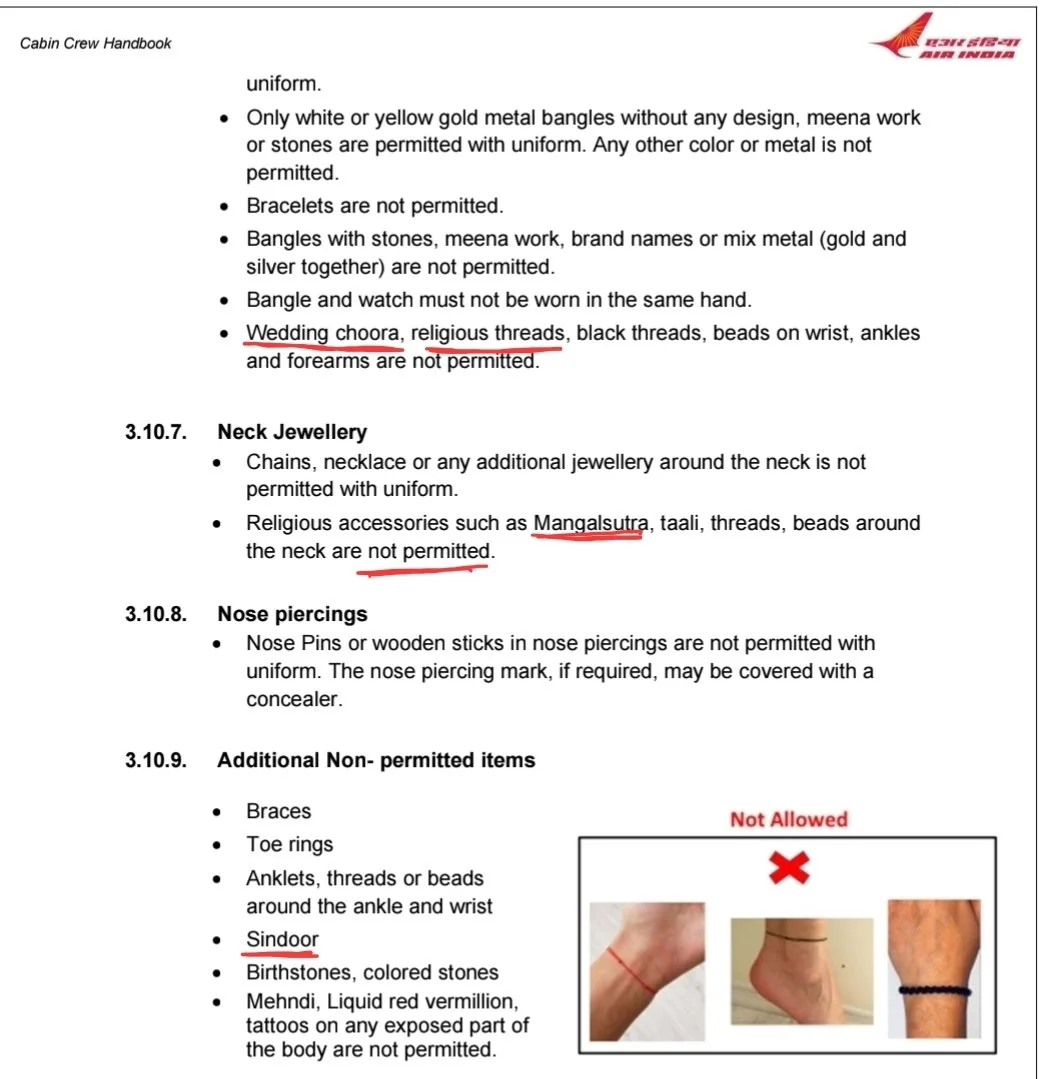
Hindu employees working at Air India, an Indian airline company, were targeted and restricted from wearing their sacred religious symbols. According to media reports, this incident first came to light when a social media handle on X (formerly Twitter) named Pranav Mahajan shared a tweet and screenshots of Air India's grooming policy document, which strictly banned Hindu religious symbols like bindi, sindoor, tilak, and kalava. This sparked a heated debate online, with many calling it an attack on Hindu employees' faith and religious expression. Many people subsequently questioned why an Indian airline restricted the religious identity of its Hindu employees. Some users attributed this to Western standards, while others pointed out that most corporate entities had such rules banning Hindu religious symbols. However, Air India came forward to deny these claims. They claimed that their employees could wear bindis and that the viral images were from an old manual no longer in effect. Despite this, the debate continued on social media, where Hindus expressed their opinions on issues such as religious freedom, corporate rules, and equality. It is important to note that this came to light after the previous targeting of Hindu employees at Lenskart, an Indian multinational company. Hindu employees were barred from visibly wearing religious symbols such as bindi, kalava, and sindoor, while Muslim employees were allowed to wear the hijab. As earlier documented by the Hinduphobia Tracker, the issue emerged when a customer shared a video in which a store employee confirmed that wearing a bindi and kalava was not permitted, yet the hijab was allowed, sparking public criticism over unequal treatment. It later came to light that these instructions formed part of an official training document, which prohibited Hindu religious markers while permitting the hijab (worn by Muslims) and turban (worn by Sikhs) under certain conditions. Following backlash, Lenskart initially dismissed the document as outdated, but later the founder apologised and claimed that such policies had existed in the past and had since been amended.
Case Images

Why it is Hate Crime ?
This case has been documented under the primary category: Restriction/ban on Hindu practices. Within this, the subcategory selected is: Restriction on expression of Hindu identity. An example of the state-affected prejudicial and targeted orders against the Hindu community would be a government denying the right of a Hindu or a group of Hindus to hold a religious procession owing to the animosity of non-Hindu groups. Denial of the religious right of the Hindus to assuage the non-Hindu group, which harbours animosity to a point where it could lead to violence against Hindus, is not only a failure of law and order but is a prejudicial order against Hindus, denying them their fundamental rights to express their religious identity. An example of a hate crime against Hindus by a non-Hindu would be a non-Hindu institution forcing its Hindu employees to abandon religious symbols that a Hindu would wear as an expression of faith owing to inherent prejudice against the faith professed by the victim or a non-Hindu group of people restricting a Hindu group from constructing a place of worship simply because the demography of the area in which the temple is being built is dominated by non-Hindus. Such actions are driven by religious animosity and/or prejudice against Hindus and their faith and would therefore be categorised as a hate crime. This case stood as a clear example of a religiously motivated hate crime because Hindu employees at Air India were targeted and restricted from wearing sacred religious symbols like bindi, sindoor, tilak, and kalava under the company's grooming policy. The company's decision was not a neutral personnel action but targeted punishment for Hindu religious identity, as it directly violated employees' religious autonomy and right to express faith through everyday markers central to Hindu practice. This went beyond enforcing uniformity; it selectively restricted visible Hindu symbols that form part of how Hindu devotees live and present themselves, making it a deliberate act of discrimination against Hindu religious identity. To understand the depth of this case, it is necessary to know the significance of these religious symbols. In Hindu tradition, the tilak worn on the forehead is not a casual ornament but a sacred mark applied during daily worship, representing the divine presence and devotee's commitment to dharma. The bindi and sindoor hold similar religious importance for Hindu women, symbolising marital status, auspiciousness, and devotion, while the kalava (sacred thread) signifies protection and vows. Forcing Hindu employees to remove these stripped them of visible links to their faith during work hours, when they should be free to practise religion without fear. The Air India grooming policy's selective enforcement targeting Hindu symbols showcased institutional bias. The policy banned these markers outright, equating them with unprofessionalism, while not banning religious symbols of other faiths. This placed a unique burden on Hindu expression, demanding concealment of integral faith elements as a condition of employment. Such compulsion to erase sacred Hindu symbols amounted to religious discrimination and clear suppression of Hindu identity in the workplace. The act of Air India requiring Hindu employees to remove their sacred symbols amounted to religious discrimination. The company did not merely regulate appearance under a neutral dress code; it demanded concealment of religious symbols integral to the Hindu faith and public expression. This was not an incidental rule but a direct intervention into Hindu religious practice, making it a clear restriction on Hindu identity rather than an impartial guideline. The compulsion to conceal Hindu religious identity as a condition of employment exposed the discriminatory nature of this act. Hindu employees were effectively told they must remove such symbols or face professional repercussions, presenting a choice that was not a general standard but a demand to suppress Hindu identity to keep jobs. This transformed a purported routine rule into coercion, where employees could only continue working if they diluted visible faith expression. Such expectation revealed deliberate institutional attempts to suppress Hindu religious identity, making it a clear case of a religiously motivated hate crime. In this case, the discriminatory logic was applied to all affected Hindu employees at Air India. They faced grooming rules targeting the tilak, bindi, sindoor, and kalava specifically, not due to safety needs but to suppress the visibility of the Hindu faith and identity. Non-compliance risked professional penalties, showing employment hinged on erasing religious markers rather than performance. This demonstrated deliberate suppression of the Hindu faith using workplace rules as leverage, confirming it as a religiously motivated hate crime. The fact that these rules operated at an institutional level across Air India strengthened the anti-Hindu hate crime case. Hindu religious symbols were systematically excluded from the workplace, while other faith markers were not banned, giving restrictions a formal character. This institutionalisation sent a message that Hindu identity must be hidden in professional spaces, normalising demands for Hindus to modify their faith for economic opportunities. The grooming policy showcased institutionalised discrimination, not isolated errors. Hindu employees were singled out and restricted specifically for religious symbols, with livelihoods threatened for maintaining faith markers. This was not neutral oversight but targeted suppression of Hindu identity using employment as a tool, linked to unequal treatment compared to other faiths, qualifying as a religiously motivated hate crime. Given that this case met the parameters of an anti-Hindu offence, it was added to the hate crime database of the Hinduphobia Tracker. Disclaimer: The Hinduphobia Tracker records the dates of incidents based on when the crime occurred, rather than when it was reported by the media. In this case, media reports did not state the exact date when the victims' ordeal began. A social media user posted screenshots of Air India's grooming policy on 18 April 2026, so that date was selected as the indicative incident date. This was recorded for documentation purposes only.


Case Status
Unknown


Perpetrators Details
Perpetrators
Others
Perpetrators Range
Unknown
Perpetrators Gender
unknown
 Sources




