Hindu organisations mocked and denigrated in resurfaced social media posts by wife of major Indian eyewear company founder
 New Delhi, Delhi, India
  17 April, 2013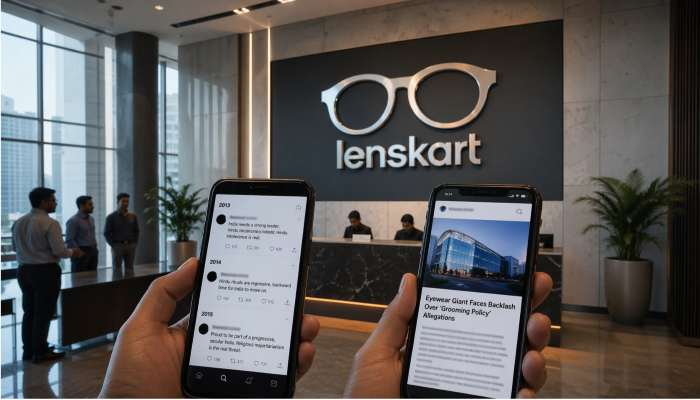
Case Summary
Hindus across India were confronted with evidence of sustained anti-Hindu hostility at the highest levels of a major Indian corporate family when old social media posts by Nidhi Mittal Bansal, wife of Lenskart founder and Chief Executive Officer [CEO] Peyush Bansal and Chairperson of the Lenskart Foundation, resurfaced and went viral during the Lenskart grooming policy controversy. The posts, dating to 2013 to 2015, revealed a documented pattern of contempt for Hindu organisations and political formations associated with Hindu identity. Her account was deactivated amid mounting public backlash. The resurfacing of Nidhi Mittal Bansal's posts was triggered by the viral circulation of a 23-page internal Lenskart Staff Uniform and Grooming Guide, dated 2 February 2026, which had explicitly banned Hindu sacred symbols including bindi [devotional forehead marks worn by Hindu women], kalava [sacred red threads tied on the wrist], and tilak [sacred forehead marks expressing Hindu devotional identity] while simultaneously accommodating the wearing of hijab [Islamic head covering] and turban. The asymmetric treatment of Hindu and Islamic religious symbols in an internal corporate document authored under the leadership of the Bansal family prompted public scrutiny of the ideological orientation of those at the top of the company toward Hindu religious identity. As the Lenskart grooming policy controversy intensified, screenshots of Nidhi Mittal Bansal's old X account posts began circulating widely. The posts, written between 2013 and 2015, showed her expressing sharp criticism of Hindu organisations including the Hindu Mahasabha and political formations associated with Hindu identity. Several posts carried hashtags including vote4mufflerman and DelhiDecides, reflecting her support for political formations opposed to Hindu nationalist politics. Other posts made disparaging references to the Bharatiya Janata Party [BJP] and Hindu organisations more broadly. The resurfacing of Nidhi Mittal Bansal's posts in the context of the Lenskart grooming policy controversy drew widespread public attention to the ideological orientation of the company's founding family toward Hindu organisations and Hindu identity. Her X account, operating under the handle @nidhimittal13, was deactivated amid the mounting backlash that followed the viral circulation of the screenshots. No public statement addressing the resurfaced posts was issued by Nidhi Mittal Bansal or the Lenskart Foundation as of the source date.
Why it is Hate Crime ?
The primary category for this case is "Hate speech against Hindus". The sub-category for this case is "Anti Hindu subversion and prejudice". Hate speech is defined as any speech, gesture, conduct, writing, or display that is prejudicial against a specific individual and/or group of people, which is leading to or may lead to violence, prejudicial action or hate against that individual and/or group. Media plays a specific and overarching reach in perpetuating prejudicial attitudes towards a community owing to unfair, untrue coverage and/or misrepresentation/misinterpretation, selective coverage and/or omission of facts of/pertaining to issues affecting a specific religious group. This type of bias can dehumanise the victim group, making it easier for others to justify harmful actions against them, which aligns with the objectives of hate speech laws aimed at preventing such harm. It is often observed that the media takes a prejudicial stand against the Hindu community driven by their need to shield the aggressor community which happens to be a numeric minority, however, is the one perpetrating violence against Hindus. For example, the media is often quick to contextualise religiously motivated crimes against Hindus, omit or misrepresent facts that point towards religiously motivated hate crimes, justify and/or downplay religiously motivated hate crimes or simply present fake news to stereotype Hindus. Such media bias leads to the denial of persecution and is often used to dehumanise Hindus, leading to justification for violence against them. For example, the media covered several fake allegations of Hindus targeting Muslims and forcing them to chant Jai Shree Ram. Most of these cases were proved false and fabricated after police investigation. These fake news reports were subsequently never retracted or clarified. Such fake news led to the justification of violence and dehumanisation of Hindus based on the argument that since Hindus targeted Muslims and forced them to chant Jai Shree Ram, the dehumanisation of Hindus and violence against them was par for the course and merely a retaliation. Such media bias leads to prejudicial portrayal of Hindus and offers a justification for violence against them and therefore, is considered hate speech under this category. This case qualifies as a religiously motivated hate speech incident in which Nidhi Mittal Bansal, Chairperson of the Lenskart Foundation and wife of Lenskart's founder and Chief Executive Officer [CEO], expressed sustained and documented hostility toward Hindu organisations through her social media posts. That personal ideological hostility was subsequently reflected in a corporate grooming policy that discriminated against Hindu employees. The case is significant not merely because of the posts themselves but because of the institutional position from which they were made and the institutional consequences they produced. The expression of hostility toward Hindu organisations from a position of corporate and institutional influence is the primary religious marker of this case. Nidhi Mittal Bansal was not a private individual expressing personal political opinions in a vacuum. She was the Chairperson of the Lenskart Foundation and the wife of the founder and CEO of one of India's largest eyewear companies. Speech expressing prejudice toward Hindu organisations and Hindu identity from a person in this position of institutional influence carries significantly greater potential for harm than the same speech from a private citizen. It signals to the institutional culture of the company the ideological orientation of those at its highest levels, and it creates an environment in which anti-Hindu prejudice is normalised and protected at the top of the organisation. The perpetrator chose to express her hostility toward Hindu organisations publicly and repeatedly, confirming that the prejudice was not a momentary lapse but a sustained and deliberate expression of her ideological position toward Hindu identity. The targeting of Hindu organisations as the specific object of hostility is the second religious marker. Nidhi Mittal Bansal's posts did not express generalised political opinions. They specifically targeted Hindu organisations including the Hindu Mahasabha and political formations associated with Hindu nationalist identity. The deliberate selection of Hindu organisations as the object of her public contempt reflects a specific and directed hostility toward organised Hindu religious and political identity rather than a neutral political commentary. By publicly denigrating Hindu organisations on social media, she contributed to the normalisation of anti-Hindu prejudice within the broader public discourse and within the specific institutional culture of the company over which her family presided. The connection between her personal posts and the Lenskart grooming policy is the third and most significant religious marker. The discriminatory Lenskart grooming policy that banned Hindu sacred symbols while accommodating Islamic religious attire did not emerge from an ideologically neutral corporate culture. It emerged from a company whose founding family had a documented and publicly expressed history of hostility toward Hindu organisations and Hindu identity stretching back over a decade. The resurfacing of Nidhi Mittal Bansal's posts in the context of the grooming policy controversy established this connection explicitly for the public. The posts were not isolated historical opinions. They were evidence that the anti-Hindu prejudice reflected in the grooming policy was rooted in the personal ideological orientation of those at the highest levels of the company, confirming that the institutional discrimination against Hindu employees was not an administrative accident but an expression of a deeper and sustained hostility toward Hindu religious identity. The deactivation of her social media account amid public backlash is the fourth religious marker. Rather than addressing the resurfaced posts publicly, acknowledging their content, or issuing a statement explaining her current position, Nidhi Mittal Bansal deactivated her X account. This response reflects an awareness that the posts were indefensible in the context of the simultaneous Lenskart grooming policy controversy and an attempt to limit the reputational damage by removing the evidence from public view rather than engaging with it honestly. The decision to delete rather than address confirms that the posts represented a genuine expression of her ideological orientation toward Hindu identity rather than opinions she was prepared to defend or contextualise publicly. The broader impact of anti-Hindu prejudice expressed from positions of corporate and institutional influence is the fifth religious marker. As defined under the anti-Hindu subversion and prejudice framework, speech that is prejudicial against Hindus and may lead to prejudicial action or hate against them qualifies as hate speech regardless of the platform from which it is delivered. Nidhi Mittal Bansal's posts, expressed from the position of a senior figure in one of India's most prominent consumer brands, carried the potential to normalise anti-Hindu sentiment among the company's employees, partners, and consumers. The subsequent emergence of a corporate policy that discriminated against Hindu employees confirms that this potential was realised in institutional form. Her speech did not merely express personal prejudice. It contributed to an institutional environment in which discrimination against Hindu religious identity was treated as an acceptable and enforceable policy. By publicly and repeatedly expressing hostility toward Hindu organisations and Hindu identity from a position of significant corporate and institutional influence, and by doing so over an extended period that preceded and contextualised a corporate policy that discriminated against Hindu employees, her actions demonstrated a clear and sustained prejudice toward Hindu religious identity that had real institutional consequences for Hindu people. The Hindu community was the specific and deliberate target of her expressed hostility, and the institutional culture her family's leadership created was the mechanism through which that hostility translated into documented harm against Hindu employees. This reflects an underlying anti-Hindu bias that cannot be characterised as anything other than religiously motivated hate speech. Given that this case met the criteria for a religiously motivated hate speech incident, it was added to the tracker's hate speech database. Disclaimer: The Hinduphobia Tracker records incident dates based on when the crime occurred, not when it was reported or published. Though the exact date is not known, the report suggests that the posts at the centre of this case were originally made in 2013, the year Nidhi Mittal Bansal first published anti-Hindu content on social media. Therefore, the date selected- 18 April, refers to the publication date, when the source article was published, while 2013 indicates the year the original posts were made. As the primary criminal act occurred in 2013, the date 18 April 2013 has been used as the indicative incident date for documentation purposes.


Case Status
Complaint not filed


Perpetrators Details
Perpetrators
Others
Perpetrators Range
One Person
Perpetrators Gender
female
 Sources




