Hindu victims’ sidelined in Nashik TCS case as leftist media outlet and journalist amplify accused-side narrative
 Delhi, India
  14 April, 2026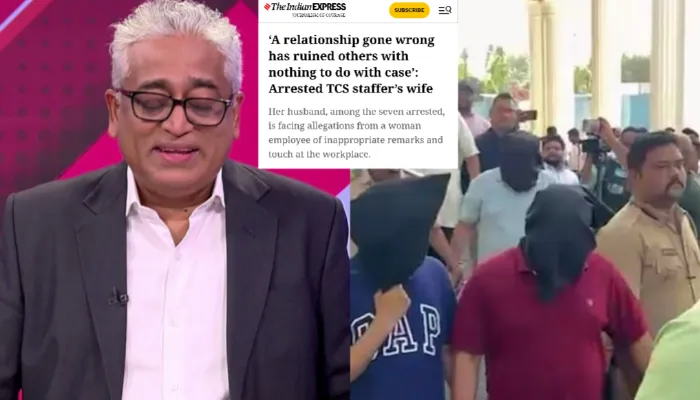
Case Summary
An anti-Hindu rhetoric targeting the Hindu victims of the TCS Nashik Muslim grooming and conversion gang was run by leftist media outlet The Indian Express and journalist Rajdeep Sardesai. They attempted to cast doubt on the victim's account, attempted to run a narrative in the perpetrator's support and police investigation into serious offences, including sexual harassment, coercion, and religious targeting of Hindu women employees. At the backdrop of this lies the grooming and conversion gang case at Nashik TCS, where Hindu employees were targeted by a coordinated conversion racket operating within the workplace, where victims were coerced into religious practices, pressured to change their faith, forced to consume beef, sexually exploited, and subjected to repeated derogatory remarks against Hindu beliefs between 2022 and 2026. The case came to light the case after a woman employee filed a complaint, following which multiple victims came forward describing a consistent pattern of harassment, intimidation, inappropriate behaviour, and psychological pressure linked to religious targeting; several accused employees, some in positions of authority, used influence and manipulation, including false promises of marriage and career support, to exploit victims, while also attempting to impose religious practices and belittle Hindu deities; complaints further indicated coordinated actions, intrusive conduct, stalking, and threats, alongside inaction from internal mechanisms that allowed the situation to persist. On 15 April 2026, The Indian Express published a report authored by Mohamed Thaver featuring statements from the wife of one of the accused, who attributed the case to a “relationship gone wrong” between the victim and the primary accused, Danish Shaikh, and claimed that multiple accused individuals had been falsely implicated. The accused's wife portrayed the case as the fallout of a failed personal relationship between the primary accused, Danish Shaikh, and one of the complainants. She said, "It was a relationship gone wrong between Danish Shaikh and one of the complainants that has ruined the lives of all the others. … Everyone in the office knew about Danish and the woman being in a relationship,” thereby casting doubt on the character of the victim. The report focused on the accused spouse’s version of events and was written to portray the accused as innocent. She claimed that multiple FIRs registered in the matter were unrelated and had been improperly combined, and maintained that several of the accused, including her husband, had no involvement in the incidents described by the complainants. By centring the account of a close family member of an accused and presenting it in detail, the report subtly insinuated that the victims were at fault, framing the case as a personal dispute rather than a matter involving multiple complaints of serious misconduct like sexual harassment and religious persecution. Additionally, she also claimed that the complainant’s family had approached political figures following the end of the relationship, which then led to the filing of the police complaint and the subsequent expansion of the case to include other individuals. The article further amplified this perspective by including detailed claims regarding the circumstances of arrests, the professional standing of the accused, and personal attributes intended to cast doubt on the allegations. She highlighted her husband’s dietary preferences, claiming that he consumed only vegetarian food and was considerate of colleagues’ sensitivities, and used this to question the plausibility of accusations involving derogatory conduct towards another religion. The report also underscored her claim that some of the accused had only recently joined the organisation and had limited interaction with the primary accused, thereby casting further doubt on the interconnected nature of the allegations. The narrative introduced by the report was subsequently reinforced by Rajdeep Sardesai, who shared and endorsed the article as a significant development in the case. By amplifying the report and calling for scrutiny of the investigation in light of it, he lent further weight to a perspective that cast doubt on the victims and echoed the framing presented in the article. This endorsement functioned as part of a broader narrative-building exercise in which the focus shifted from the documented testimonies of multiple complainants to a defence constructed around the claims of an accused’s family member. The combined effect of the report and its amplification shaped public discourse in a way that questioned the legitimacy of the complaints while implicitly placing responsibility on the victims.
Why it is Hate Crime ?
This case has been added to the tracker under the primary category of - Hate speech against Hindus. The sub-category selected here is- Anti-Hindu subversion and prejudice. The tertiary category selected under it is: Anti-Hindu Fake news or Downplaying Hate speech is defined as any speech, gesture, conduct, writing, or display that is prejudicial against a specific individual and/or group of people, which leads to or may lead to violence, prejudicial action or hate against that individual and/or group. Media plays a specific and overarching role in perpetuating prejudicial attitudes towards a community owing to unfair, untrue coverage and/or misrepresentation/misinterpretation, selective coverage and/or omission of facts of/about issues affecting a specific religious group. This type of bias can dehumanise the victim group, making it easier for others to justify harmful actions against them, which aligns with the objectives of hate speech laws aimed at preventing such harm. It is often observed that the media takes a prejudicial stand against the Hindu community, driven by their need to shield the aggressor community, which happens to be a numeric minority; however, that is the one perpetrating violence against Hindus. For example, the media is often quick to contextualise religiously motivated crimes against Hindus, omit or misrepresent facts that point towards religiously motivated hate crimes, justify and/or downplay religiously motivated hate crimes, or simply present fake news to stereotype Hindus. Such media bias leads to the denial of persecution and is often used to dehumanise Hindus, leading to justification for violence against them. For example, the media covered several fake allegations of Hindus targeting Muslims and forcing them to chant Jai Shree Ram. Most of these cases were proved false and fabricated after police investigation. These fake news reports were subsequently never retracted or clarified. Such fake news led to the justification of violence and dehumanisation of Hindus based on the argument that since Hindus targeted Muslims and forced them to chant Jai Shree Ram, the dehumanisation of Hindus and violence against them was par for the course and merely a retaliation. Such media bias leads to prejudicial portrayals of Hindus and offers a justification for violence against them and, therefore, is considered hate speech under this category. This case has been added to the tracker because the Indian Express and Rajdeep Sardesai attempted to cast doubt on the victim's account and police investigation into serious offences, including sexual harassment, coercion, and religious targeting of Hindu employees. Their conduct in question did not merely involve routine reporting or commentary but reflected a pattern of narrative construction that diluted, deflected, and redirected attention away from Hindu victims while amplifying perspectives that undermined their credibility. In this instance, the report by The Indian Express centred the account of the wife of an accused individual as the primary explanatory lens for a case involving multiple complaints of sexual harassment, coercion, and religious targeting of Hindu individuals. It is normal for families of the accused to defend their family member in criminal cases. Despite knowing this, by foregrounding an unverified personal narrative that attributed the case to a failed relationship, the report shifted the interpretive frame from one of systemic misconduct affecting multiple Hindu victims to one of interpersonal dispute. This reframing had the effect of casting doubt on the Hindu victims as a group, implying ulterior motives such as personal vendetta or external influence, and thereby weakening the legitimacy of their testimonies, despite overwhelming evidence. Such a shift is not neutral; it was intended to operate to erode the credibility of victims belonging to the Hindu community while elevating a defence narrative aligned with the accused. The selective emphasis within the report further reinforced this effect. Details such as the accused’s dietary habits, professional background, or limited interaction with others were highlighted to suggest the improbability of wrongdoing, despite overwhelming evidence and multiple FIRs. The report gave comparatively limited weight to the existence of multiple FIRs, statements recorded before a magistrate, and the consistency of complaints across individuals. This imbalance contributed to a skewed representation in which the burden of doubt was implicitly shifted onto the victims rather than the accused. By doing so, the coverage functioned to subtly delegitimise the experiences of Hindu women who reported abuse, thereby constituting a form of prejudice through narrative framing. The subsequent amplification of this report by Rajdeep Sardesai intensified the impact of this framing. By presenting the article as a significant development and using it to question the direction of the investigation, he elevated a single, uncorroborated account to a position of prominence in public discourse. This endorsement did not merely circulate information but contributed to shaping perception, reinforcing the idea that the complaints themselves were suspect. When influential voices amplify such narratives, the effect extends beyond individual opinion and enters the realm of public framing, where it can influence how entire incidents are understood by a wider audience. What makes this pattern significant is not merely the distortion of facts but the selective direction in which that distortion operates. The scepticism, reframing, and dilution seen in this case are not applied uniformly but disproportionately affect Hindu victims. Allegations made by Hindu complainants are subjected to heightened scrutiny, alternative explanations, and narrative dilution, even in the presence of multiple FIRs and consistent testimonies. At the same time, accounts favourable to the accused are amplified and presented as credible counter-narratives. This asymmetry indicates that the issue is not simply flawed reporting but a pattern of selective scepticism, where the credibility of Hindu victims is more readily questioned and their grievances more easily minimised. Such differential treatment reflects an underlying bias in narrative construction, where harm faced by Hindus is not accorded the same seriousness or legitimacy. Taken together, the report and its amplification formed part of a broader pattern of anti-Hindu subversion and prejudice, wherein the suffering of Hindu victims was minimised, reframed, or cast into doubt through selective storytelling. The emphasis on alternative explanations that implicitly blamed victims, combined with the downplaying of documented allegations, aligns with the category of anti-Hindu fake news or downplaying. It represents a form of discursive harm in which the credibility of a targeted group is systematically undermined, and their experiences are rendered secondary to narratives that protect or normalise the actions of the accused. In this sense, the case qualifies as a hate crime within the defined framework because it involves not only the distortion of facts but also the propagation of a narrative that prejudices and marginalises Hindu victims in the public sphere.


Case Status
Unknown


Perpetrators Details
Perpetrators
Others
Perpetrators Range
From 2 To 5
Perpetrators Gender
male
 Sources




