Sacred Hindu religious symbol desecrated by anti-Hindu politician in Tamil Nadu
 Tamil Nadu, India
  7 April, 2026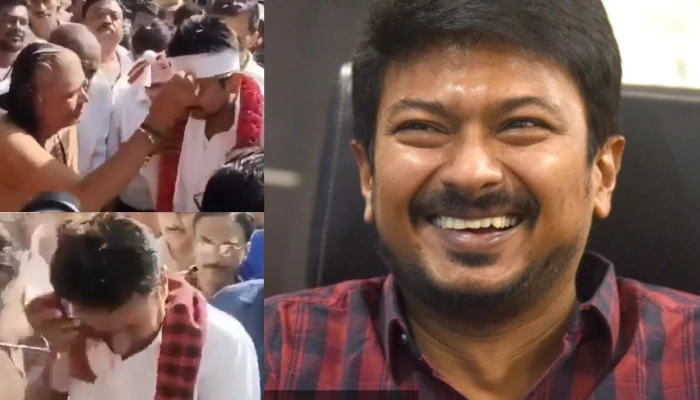
Case Summary
In Tamil Nadu, a Hindu religious symbol, a tilak, was desecrated by the ruling Dravida Munnetra Kazhagam (DMK) leader and Deputy Chief Minister Udhayanidhi Stalin. A video of the accused went viral on social media on 8 April 2026. In the video, he was seen wiping off vibhuti (tilak made of ashes) from his forehead immediately after it was applied by a temple priest during a temple visit. The incident took place during election campaign activities ahead of the 2026 Tamil Nadu Assembly elections. As part of the campaign, Udhayanidhi Stalin visited a temple, where the priest applied a tilak of kumkum and vibhuti on his forehead in accordance with customary temple practice. The visit took place in the course of canvassing for votes in the Chepauk-Thiruvallikeni Assembly constituency, from where he was seeking re-election. Immediately after the tilak was applied, the video footage showed Udhayanidhi Stalin wiping it off his forehead almost instantaneously while still within the temple premises. The clip was recorded and subsequently circulated across social media platforms, where it drew significant public attention and reactions. This incident did not arise in isolation. As earlier recorded by Hinduphobia Tracker, on 2 April 2026, in Ramanathapuram, Tamil Nadu, Udhayanidhi Stalin refused to accept vel, a divine javelin or spear associated with Lord Murugan, offered by a party functionary in an election campaign event. But he accepted a Buddha statue presented shortly thereafter. On 2 September 2023, during a speech delivered by Udhayanidhi Stalin, Deputy Chief Minister of Tamil Nadu, the DMK leader called for 'eradication' of Sanatan Dharma (Hinduism) and compared it with mosquitoes and diseases. This incident was also previously documented by the Hinduphobia Tracker.
Why it is Hate Crime ?
The primary category selected for the case is- Attack on Hindu religious representations. The subcategory selected is- Desecration of a Hindu religious symbol. Icons and symbols, or a religious representation of a spiritual ideal, are widely revered in Hinduism. Iconography is of vital significance in the Hindu milieu. It helps connect people’s spiritual beliefs with the real world. Iconography within the Hindu faith takes several shapes and forms. Murtis are of most significance to Hindus, to which daily rituals, prayers and offerings are done. Besides the murtis, there are several other symbols which have deep significance in the Hindu faith – the Om and Swastika, for example. Since these Hindu religious symbols hold paramount importance in Hinduism, any desecration of symbols, icons, murtis, religious representations and manifestations, is driven by animosity towards the faith itself, which manifests itself through these murtis, icons and symbols. Therefore, any desecration of these Hindu religious symbols and representations is considered a religiously motivated hate crime under this category. The other sub- category selected is- Defiling religious customs. Sanatan Dharma is not a religion of one book, which is to say that while it has religious scriptures that form the central tenets of the faith, there are several traditions followed through thousands of years, mostly passed from generation to generation orally. Several such customs and traditions are followed by various Hindus and Hindu sects. Defiling of these traditions and customs is a breach of an individual or group’s religious practices. Such practices can range from dietary restrictions like not eating non-vegetarian food for a certain period of the year, not eating non-vegetarian food at all, not eating beef since the cow is considered holy in Hinduism, the sanctity of religious customs followed in the house (like many ISCKON devotees), etc. Any malicious action leading to the breach of such traditions or defilement of these traditions owing to animosity towards the faith or for the sake of activism stems not only from the lack of faith in the religion itself but also from disregard for the faith of the devotees who follow the customs/traditions and implicit bias against the faith, the tradition itself. Since these specific traditions are central to the faith of the devotees of that specific sect of Hindus, any non-compliance with these traditional rules would be considered a religiously motivated hate crime. This case was added to the tracker as it involved a direct act of disrespect towards a sacred Hindu religious symbol and a long-standing religious custom. At the outset, the kumkum or tilak applied by a priest is not an ordinary mark. In Hindu tradition, a tilak is a sacred symbol of blessings, auspiciousness, and divine grace. When a priest applies it during or immediately after a temple visit, it signifies that the individual has received the blessings of the deity. It is also regarded as a mark of spiritual victory and reverence, carrying deep religious and cultural significance for Hindu devotees. In the present case, the application of sacred kumkum/vibhuti on the forehead of the accused was in accordance with the temple's customary practice. The act of wiping it off within seconds, and doing so in full public view, turned the moment into a visible rejection of that sacred blessing and also a desecration of a Hindu religious symbol. The immediacy of the gesture conveyed disregard for the religious significance of the tilak and for the custom through which it had been conferred. The gravity of the act became further aggravated when viewed alongside Udhayanidhi Stalin’s own prior statements and conduct towards Hindu identity markers. His earlier remarks calling for the “eradication” of Sanatana Dharma were judicially described as hate speech by the Madras High Court, which noted that the remarks amounted to a clear attack on Hinduism. Further, the tracker had already recorded another prior incident in which he declined to accept the sacred Vel, as well as earlier instances within the DMK ecosystem where its leaders have denigrated and desecrated the Hindu faith, its temples and its sacred symbols, all amounting to religiously motivated crimes. Against that background, the accused's act of wiping off the priest-applied kumkum within seconds assumed a significance beyond the physical gesture itself. When a public figure who has already made hostile remarks towards Sanatana Dharma and visible Hindu identity markers himself performs the very act of removing a sacred mark in full public view, it reinforces and gives physical expression to that earlier hate rhetoric. In effect, the conduct became a continuation of the same anti-Hindu hostility, transforming speech into visible public action. Importantly, this went beyond a mere personal preference. Once the sacred mark had been applied by the priest, its immediate removal before a large public gathering carried a symbolic message of aversion towards a visible Hindu religious symbol. Such conduct naturally caused hurt to Hindu religious sentiments, particularly because the tilak is widely regarded as an auspicious mark of honour and blessing. Thus, seen in continuity, the present act reinforced an existing pattern of public disrespect towards Hindu customs and sacred symbols, making it a hate-driven offence. Given that this case meets the parameters of a hate crime, it is added to the hate crime database of the Hinduphobia Tracker. Disclaimer: The Hinduphobia tracker records the date of incidents based on when the crime occurs, rather than when it is reported by the media. In this case, media reports did not state the exact date when the crime occurred. Therefore, 8 April 2026, the date when the media reported the incident, is selected as the indicative incident date. This is recorded for documentation purposes only.


Case Status
Unknown


Perpetrators Details
Perpetrators
State and Establishment
Perpetrators Range
One Person
Perpetrators Gender
male
 Sources




