Hindu man brutally assaulted by Muslim mob over minor dispute while his wife begs for mercy in Arsikere, Karnataka
 Arsikere, Karnataka, India
  3 April, 2026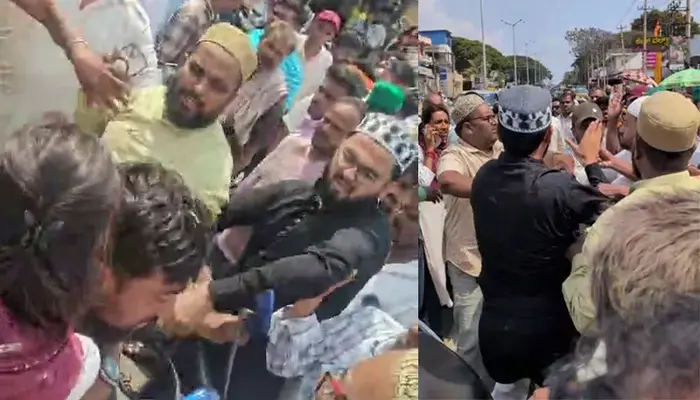
Case Summary
In the Arsikere area of Hassan district, Karnataka, a Hindu couple was violently assaulted by a Muslim mob over a minor dispute with a Muslim man. The incident occurred near the APMC area in Arsikere on 4 April 2026, when the Hindu couple, who had travelled to attend the annual Rathotsava at the Sri Jenukallu Siddeshwaraswamy Temple, were returning on a two-wheeler after offering prayers. During their journey back, they were confronted by a Muslim man named Sufiyan Samivulla, who was riding at high speed and brushed against their vehicle, leading to a verbal altercation. The situation escalated rapidly as Samivulla stopped the couple, forcibly pulled the Hindu man off the vehicle and began assaulting him in full public view. Despite repeated pleas from the victim’s wife, who folded her hands and begged for mercy, the assault continued unabated. The brutality intensified further when the accused contacted his friends, who arrived at the scene within minutes and joined in the attack. The victim was beaten repeatedly by the Muslim group, sustaining visible injuries and bleeding heavily, while bystanders watched the incident unfold. The assault, which stemmed from a trivial dispute, shocked local residents and drew sharp reactions after videos recorded by onlookers circulated widely on social media. The visuals, showing the victim being brutally attacked while his wife pleaded helplessly, amplified public anger and condemnation. The case also took on a political dimension after reports linked the accused to the circle of K. M. Shivalinge Gowda, prompting concerns among residents that such associations could foster a sense of impunity. In the aftermath, hundreds of locals gathered outside the Arsikere police station, staging protests and demanding the immediate arrest of all those involved. Demonstrators raised slogans and warned of intensified agitation if swift action was not taken, reflecting growing frustration over recurring incidents of violence and perceived delays in enforcement. Police registered a case and initiated efforts to identify and apprehend the perpetrators, though the lack of immediate arrests further fuelled public discontent.
Why it is Hate Crime ?
This case has been added to the tracker under the primary category of - Attack not resulting in death. Within it, the sub-category selected is - Communal clash/attack. Communal clash is a form of collective violence that involves clashes between groups belonging to different religious identities. For a communal clash between Hindus and non-Hindus to qualify as a religiously motivated hate crime, the trigger of the violence itself would have to be anti-Hindu in essence. For example, if there is a Hindu religious procession that comes under attack from a non-Hindu mob and after the initial attack, Hindus retaliate in self-defence, leading to a communal clash between the two religious communities. While at a later stage, both communities are involved in the clash/violence, the initial trigger of the violence was by the non-Hindu mob against the Hindus and therefore, it could safely be termed as an anti-Hindu violence. Further, the trigger would also have to be religiously motivated. In the cited example, the attack by the non-Hindu mob was against religious processions and therefore, can be concluded to be religiously motivated. In some cases, the trigger may be non-religious, however, it develops into religious violence against Hindus at a later stage. In such cases too, the foundational animosity towards Hindus becomes the motivating factor of the crime and therefore, it would be classified as a religiously motivated hate crime against Hindus under this category. The incident in Arsikere reflected a clear pattern of targeted and disproportionate violence against a Hindu individual following a minor and non-religious trigger. The couple had been returning after offering prayers at the Sri Jenukallu Siddeshwaraswamy Temple when a trivial road-related disagreement escalated into a brutal assault. What began as a routine exchange over reckless driving quickly transformed into a sustained and coordinated attack, indicating that the incident went far beyond a spontaneous altercation. The sequence of events demonstrated a pattern of escalation that was neither immediate nor limited. After the initial confrontation, the primary accused, identified as Sufiyan Samivulla, did not disengage but instead intensified the situation by physically assaulting the victim in public. The violence escalated further when Sufiyaan called his friends, who then joined in the assault. This act of summoning a group and continuing the attack collectively highlighted a level of coordination and intent that exceeded the bounds of a personal dispute. The victim was beaten repeatedly while his wife’s pleas for mercy were ignored, underscoring both the severity and the collective nature of the violence. Such a disproportionate response to a minor altercation highlights the underlying animosity the members of the Muslim community hold against Hindus. These actions reflect a dangerous mindset of religious supremacy that demands dominance and submission through violence. In such cases, even minor, non-religious provocations are met with aggressive retaliation when the victim is Hindu, revealing an alarming pattern of identity-driven hostility that defines such hate crimes. This pattern of disproportionate retaliation, driven by identity-based hostility, is what qualifies the incident as a hate crime. This violent overreach stems from an Islamic supremacist ideology within Muslim extremist circles, which views Hindus as socially and religiously inferior. This toxic belief breeds contempt and aggression, especially when Hindus resist submission or refuse to yield in disputes. The readiness to use violence under the pretext of minor issues exposes the continuing threat Hindu communities face, as these incidents are not isolated or spontaneous but part of an ongoing pattern of religiously motivated violence. The public nature of the assault, coupled with the circulation of video footage, contributed to widespread outrage and highlighted the severity of the incident. The visuals of the victim being beaten while his wife pleaded for help underscored the vulnerability of the victims and the absence of restraint among the attackers. The fact that the violence continued despite public attention further demonstrated the extent to which the perpetrators had hatred towards the Hindu victims over the minor issue. This pattern has been observed repeatedly: during the Delhi anti-Hindu riots of 2020, when Hindu homes and temples were attacked, during the Karauli violence in Rajasthan in 2022, when Hindu shops were set ablaze, and during the Jahangirpuri riots in Delhi, where Muslim mobs assaulted Hindu processions while chanting the same slogan, Allah Hu Akbar. Similarly, the Hinduphobia Tracker has previously documented numerous instances where non-religious triggers sparked communal violence against Hindus by Muslims. For example, on 30th May 2025, in Dewran Garhiya village, Farrukhabad, Uttar Pradesh, a minor verbal altercation between two Hindu men and a Muslim man escalated into a violent assault by a large Muslim mob, inflaming communal tensions. In another incident on 7th July 2025 in Bhavna Nagar, Raipur, Chhattisgarh, a Hindu family was brutally attacked by a Muslim mob of nearly 80 people following a simple dispute over garbage disposal. Victims suffered severe injuries from sharp weapons. Similarly, on 22nd June 2025 in Ghongade Basti, Solapur, Maharashtra, a minor road dispute led to a targeted communal assault on Hindus by a large Muslim mob, sparking widespread clashes. Taken together, the elements of disproportionate violence over a minor trigger, the summoning and participation of multiple Muslim men in the assault, and the sustained nature of the violence established a pattern consistent with religion-driven hostility. The incident could not be reduced to a simple road dispute, as the response far exceeded the circumstances of the trigger and reflected a broader pattern of aggressive group behaviour, rooted in religious animosity. Therefore, this case has been added to the tracker.
Victim Details
Total Victim
2
Deceased
0
Gender
- Male 1
- Female 1
- Third Gender 0
- Unknown 0
Caste
- SC/ST 0
- OBC 0
- General 0
- Unknown 2
Age Group
- Minor 0
- Adult 2
- Senior Citizen 0
- Unknown 0


Case Status
Complaint registered


Perpetrators Details
Perpetrators
Muslim Extremists
Perpetrators Range
Unknown
Perpetrators Gender
unknown
 Sources




