Hindus targeted, threatened and intimidated; their leaders defamed by Khalistani supporters
 Ontario, Canada
  29 March, 2026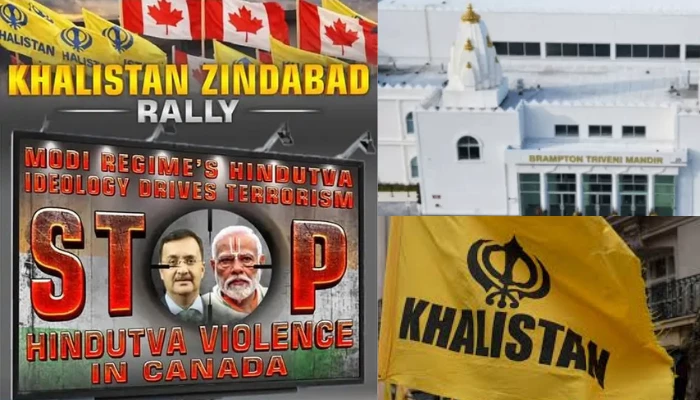
Case Summary
A group of Khalistan supporters in Canada have issued violent threats and warnings against Hindus, their temples and their leaders on social media. As per a report dated 30th March, 2026, published in Ludhiana, Punjab, Khalistan supporters in Canada issued open threats against Hindus and Hindu temples, with calls circulating on social media in connection with protests planned outside temples. According to the report, Khalistani extremist organisations (CBKE) announced that on 5 April 2026, they would hold “Khalistan Zindabad” rallies and demonstrations outside two major Hindu temples. The two temples specifically targeted were the Triveni Temple in Brampton and the Shri Lakshmi Narayan Temple in Surrey. The report states that Khalistan supporters formally announced on social media that protests would be held directly at the gates of these temples. Further, the poster used by the Khalistan Supporters branded Indian Prime Minister Narendra Modi as a Hindutva regime carrying out terrorism and violence in Canada. Following this, the Hindu Canadian Foundation (HCF) immediately issued a strong statement. It said, “हमारे मंदिर पूजा के पवित्र स्थान हैं, ये प्रदर्शन के मैदान नहीं हैं। हम धमकी के आगे नहीं झुकेंगे।” (“Our temples are sacred places of worship. They are not grounds for protest. We will not bow before threats.”) HCF had warned police and security agencies across Canada and stated that these extremists must be stopped, failing which the Hindu community’s trust in the Canadian police and government would be broken. The report stated that CBKE made a clear declaration on social media that on 5 April, “खालिस्तान जिंदाबाद रैली” (Khalistan Zindabad rally) would be taken out outside the Triveni Temple in Brampton and the Lakshmi Narayan Temple in Surrey, and that these rallies would take place directly at the temple gates. The report further recorded that Khalistan supporters issued threats stating, “हिंदू जब पूजा करने आएंगे तो उन्हें नारे सुनने पड़ेंगे, धक्का-मुक्की हो सकती है।” (“When Hindus come for worship, they will have to hear the slogans, and there could be pushing and shoving.”) It was also stated that Khalistan supporters had previously attempted to disturb the atmosphere outside temples in Canada. Following these threats, HCF stated that this was not a peaceful protest, but a deliberate conspiracy to provoke Hindus. According to HCF, an attempt was being made to turn the temple into a political stage. As per the report, this was not an isolated incident; earlier on 3 November 2024, Khalistan supporters had attacked the Hindu Sabha Mandir in Brampton in broad daylight. According to HCF, women, children, and elderly persons were beaten with sticks, solely because they were worshipping peacefully. HCF further stated that the 2024 incident was not an isolated attack and that temples were being continuously targeted, devotees were being intimidated, and women and children were being threatened. In its latest statement, HCF responded in clear terms and stated, “हमारे मंदिर पवित्र हैं। ये विरोध प्रदर्शन के स्थल नहीं, न ही राजनीतिक मंच हैं। अगर इस बार कोई हरकत हुई तो हम डरकर पीछे नहीं हटेंगे।” (“Our temples are sacred. They are not sites of protest, nor political platforms. If anything happens this time, we will not step back out of fear.”) HCF further stated, “हम चुप नहीं रहेंगे। हम डरेंगे नहीं। हम अपने मंदिरों से नहीं भागेंगे।” (“We will not remain silent. We will not be afraid. We will not run away from our temples.”) The organisation further said that the Hindu community is an integral part of Canada and that Hindus are peace-loving and believe in democracy and pluralism, but “अब काफी हो चुका” (“enough is enough”). It demanded that the government ensure the safety of Hindus. The report further states that the Canadian Parliament had already passed Bill C-9, which provides for strict punishment in cases involving hatred, threats, and obstruction at places of worship. It was also stated that in Brampton, “bubble zones” had already been created around temples, where demonstrations are prohibited. HCF further stated that targeting temples was not a protest but a threat, and that disrupting worship was not free speech but coercion. According to the organisation, Khalistan supporters were attempting to silence the Hindu community. HCF additionally warned that this was not merely an issue concerning Hindus but posed a threat to Canada’s security, law and order, and social harmony as a whole. The organisation tagged police departments from different Canadian cities on social media and demanded strict action against Khalistan supporters. HCF stated that Canada’s intelligence agency had on several occasions warned that Canada-based Khalistani extremists had become a major domestic security threat. It demanded that those inciting violence be identified and made accountable.
Why it is Hate Crime ?
This case has been added to the tracker under the primary category of - Hate speech against Hindus. The sub-category selected here is- "Violent threats" Violent threats, explicit, implicit or implied, are the most dangerous form of hate speech since they go beyond discriminatory and prejudicial language to express the intent of causing harm to an individual or a group of people based on their religious identity and faith. There could be several different kinds of threats that are issued to Hindus based on religious animosity. An explicit threat would mean the direct threat of violence towards an individual Hindu, a group of Hindus or Hindus at large. Physical violence, death threats, threats of destruction of property belonging to Hindus and threats of genocide would mean explicit threats against Hindus for their religious identity. Implicit threats may not be a direct threat but implied through the use of symbols of actions – for example, in the Nupur Sharma case, other than explicit threats, there were also implicit threats when Islamists took to the streets to burn and beat her effigies. It implies that they want to do the same to Nupur Sharma, which is considered an implicit threat. Violent threats can be delivered in person, through letters, phone calls, graffiti, or increasingly through social media and other online platforms. It would be important to understand that a threat – explicit or implicit, online or offline – to an individual who happens to be a Hindu does not qualify as a religiously motivated threat. Such a threat, while vile and dangerous, could be owing to non-religious reasons and/or personal animosity. To qualify as a religiously motivated threat, it would need to exhibit an indication that the individual is being targeted for religious reasons and/or owing to his/her religious identity as a Hindu. The other sub-category selected is: Anti-Hindu subversion and prejudice. Hate speech is defined as any speech, gesture, conduct, writing, or display that is prejudicial against a specific individual and/or group of people, which leads to or may lead to violence, prejudicial action or hate against that individual and/or group. Media plays a specific and overarching role in perpetuating prejudicial attitudes towards a community owing to unfair, untrue coverage and/or misrepresentation/misinterpretation, selective coverage and/or omission of facts of/about issues affecting a specific religious group. This type of bias can dehumanise the victim group, making it easier for others to justify harmful actions against them, which aligns with the objectives of hate speech laws aimed at preventing such harm. It is often observed that the media takes a prejudicial stand against the Hindu community, driven by their need to shield the aggressor community, which happens to be a numeric minority; however, that is the one perpetrating violence against Hindus. For example, the media is often quick to contextualise religiously motivated crimes against Hindus, omit or misrepresent facts that point towards religiously motivated hate crimes, justify and/or downplay religiously motivated hate crimes, or simply present fake news to stereotype Hindus. Such media bias leads to the denial of persecution and is often used to dehumanise Hindus, leading to justification for violence against them. For example, the media covered several fake allegations of Hindus targeting Muslims and forcing them to chant Jai Shree Ram. Most of these cases were proved false and fabricated after police investigation. These fake news reports were subsequently never retracted or clarified. Such fake news led to the justification of violence and dehumanisation of Hindus based on the argument that since Hindus targeted Muslims and forced them to chant Jai Shree Ram, the dehumanisation of Hindus and violence against them was par for the course and merely a retaliation. Such media bias leads to prejudicial portrayals of Hindus and offers a justification for violence against them and, therefore, is considered hate speech under this category. The other sub- category is - Mocking/denigrating Hindu leaders. Hate speech is defined as any speech, gesture, conduct, writing, or display that is prejudicial against a specific individual and/or group of people, which leads to or may lead to violence, prejudicial action or hate against that individual and/or group. Religious leaders are often seen as representatives of the community, especially the community’s religious faith and beliefs. Mocking or denigrating a religious leader specifically owing to his religious identity and/or the religious rituals he observes can be considered hate speech because the motivating factor of the speech is animosity and/or dislike for what he represents – the religious beliefs and faith of the community. It is important to note that mere insulting words against an individual do not constitute hate speech. Insulting words may be used for an individual; however, the specific speech is not the result of religious hate and/or animosity towards the professed faith of the religious leader, but the individual himself. For the speech to be considered hate speech, the speech itself or the motivating factor behind the speech has to be religious in nature. Such speech, which denigrates Hindu religious leaders specifically owing to animosity towards the faith they profess and the community faith they represent, will be treated as hate speech under this category. This case qualified as a hate crime because the immediate trigger for inclusion lay in the deliberate targeting of Hindu temples and Hindu worshippers through open threats, provocative sloganeering, and organised intimidation. At the outset, the announcement of “Khalistan Zindabad” rallies specifically at the gates of two major Hindu temples was not an ordinary political protest. The deliberate choice of Hindu temples as the site of these rallies amounted to an act of sacrilege and intentional religious provocation. It was a conscious act directed specifically at the Hindu community, thereby giving the incident a clear anti-Hindu and religiously hostile character. A temple is a sacred place where devotees gather for prayer, peace, and the expression of faith. By choosing the temple gates as the site for separatist slogans and demonstrations, the actors had intentionally intruded upon the sanctity of the religious space. This was designed to hurt Hindu religious sentiments and convert a place of worship into a site of confrontation and fear. Further, the warning that Hindus coming for worship “will have to hear slogans” and that “pushing and shoving could happen” turned the act into direct intimidation. The message was not only that worshippers would be confronted, but that their entry into the temple itself could be obstructed. This carried an implied threat of physical interference and possible violence directed specifically at Hindus because they were attending worship. More importantly, the conduct appeared intended to send a larger message to the Hindu community that even their temples and their religion were vulnerable to Khalistani interference. It conveyed that whenever they wished, they could disrupt these sacred spaces and take away the community’s sense of safety in its own places of worship. This was meant to instil fear and remind Hindus that their right to worship could be challenged at the will of hostile actors. The derogatory targeting of Prime Minister Narendra Modi further aggravated the hateful nature of the incident. In the context of the slogans and messaging used by Khalistani supporters, he was invoked not merely as a political office-holder but as a symbol of the Indian and Hindu collective identity they sought to demonise. Labelling him a “terrorist” in the same breath as issuing threats against Hindu temples transformed the speech into targeted denigration of a leader perceived to represent the Hindu community. Moreover, the repeated branding of Hindus and their leaders as “terrorists” had a wider dehumanising effect. Such speech sought to invert the victimhood narrative by portraying an entire religious community as inherently suspect or violent. This form of labelling is especially dangerous because it normalises prejudice, legitimises future aggression, and creates a social climate in which hostility against Hindus can be justified as retaliation rather than recognised as persecution. This was not an isolated incident; the Hinduphobia Tracker had previously recorded several cases involving anti-Hindu acts by Khalistani groups. For example, on 27 December 2025, in London, United Kingdom, the Hindu community were targeted with anti-Hindu and anti-India slogans by the Khalistanis during the protest outside the Bangladesh High Commission against anti-Hindu violence. A protest was organised by the Bengali Hindu Adarsha Saangha (UK) to condemn the lynching of a Hindu man named Dipu Chandra Das, who was brutally lynched by a Muslim mob in Bangladesh, and to draw attention to the wider persecution of Hindus in the country. More than 500 members from the Hindu community gathered peacefully behind police barriers, chanted slogans such as “Hindus Lives Matter,” and carried placards demanding justice for Dipu Das, protection for Hindu minorities in Bangladesh, and the release of Hindu monk Chinmoy Krishna Das, who was in jail. During the protest, around ten Khalistani supporters carrying yellow flags arrived and positioned themselves directly in front of the high commission and began shouting anti-India and anti-Hindu slogans. They also praised slain extremist Sharif Osman Hadi, whose death led to renewed violence against Hindus in Bangladesh. In another case, on 22 January 2026, the Indian Embassy in Zagreb, Croatia, was targeted in a late-night act of trespass and vandalism in which intruders entered the mission premises, removed India’s national flag, and hoisted a Khalistani flag in its place. The embassy building and its boundary wall were defaced with spray-painted slogans, including “Khalistan Zindabad, Hindustan Murdabad,” and the embassy signage was also vandalised. Taken together, the deliberate targeting of sacred Hindu spaces, the express and implied threats against devotees, the prior pattern of violence, and the defamatory portrayal of Hindu leaders and the community clearly established that the conduct was motivated by hostility towards Hindu identity and faith. It therefore squarely met the threshold of a hate crime and was included in the tracker.


Case Status
Unknown


Perpetrators Details
Perpetrators
Sikh Extremists
Perpetrators Range
Unknown
Perpetrators Gender
unknown
 Sources




