Indian Embassy in Croatia defaced with anti-India grafitti, national flag removed and replaced with Khalistani flag
 Zagreb, Zagreb, Croatia (Hrvatska)
  21 January, 2026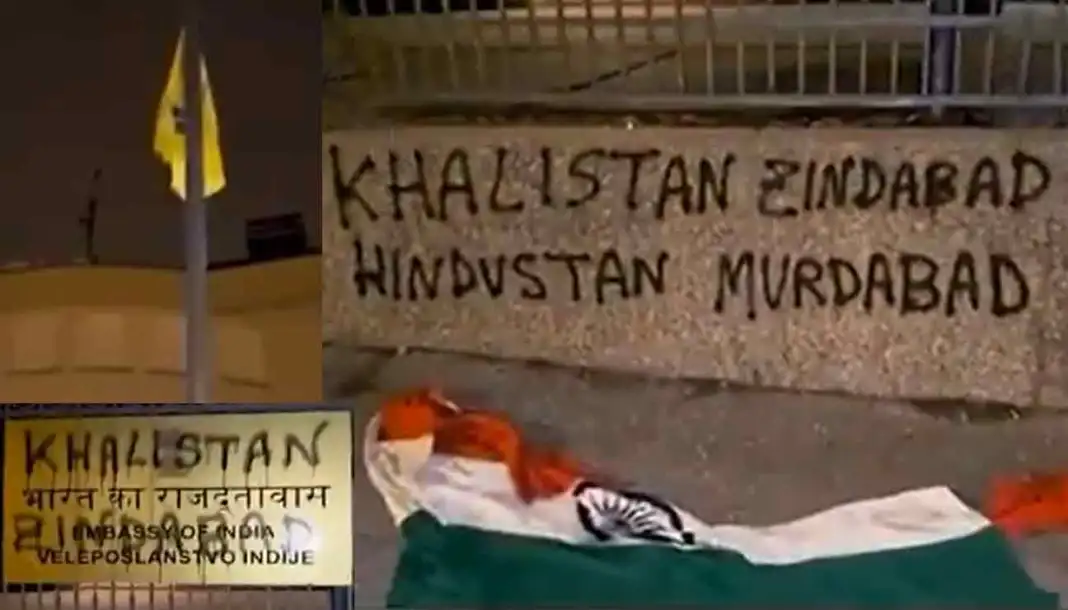
Case Summary
The Indian Embassy in Zagreb, Croatia, was targeted in a late-night act of trespass and vandalism in which intruders entered the mission premises, removed India’s national flag, and hoisted a Khalistani flag in its place. The embassy building and its boundary wall were defaced with spray-painted slogans, including “Khalistan Zindabad, Hindustan Murdabad,” and the embassy signage was also vandalised. The attack reportedly occurred around midnight and was described as the first such breach at the Indian mission in Croatia in decades. The graffiti included “26/01,” which was presented as a threat linked to India’s Republic Day. Visuals circulating on social media showed the flag being taken down at night and replaced, and the walls and signboard being marked with pro-Khalistan messaging. The banned pro-Khalistan group Sikhs for Justice (SFJ) claimed responsibility for the act. Its leader, Gurpatwant Singh Pannun, issued a video statement describing the incident as part of a campaign intended to send a political message on European soil. He also linked it to past grievances and made statements about repurposing Indian embassies in the future. India’s Ministry of External Affairs condemned the trespass and vandalism and said the matter was raised strongly with Croatian authorities in New Delhi and Zagreb. The MEA urged Croatian authorities to identify those responsible and hold them accountable for what it described as illegal actions. The embassy also issued a statement saying that such acts reflect on the character and motives of those behind them and called on law enforcement authorities to take note. The incident drew attention because there had been limited public reporting of pro-Khalistan activity in Croatia before this, and it occurred at a time when India is expanding engagement with European partners, with Croatia being a member of both the European Union and NATO.
Why it is Hate Crime ?
This incident has been added to the tracker under the category- Hate speech against Hindus. Within this, the subcategory selected is- Violent threats. Violent threats, explicit, implicit or implied, is the most dangerous form of hate speech since it goes beyond discriminatory and prejudicial language to express the intent of causing harm to an individual or a group of people based on their religious identity and faith. There could be several different kinds of threats that are issued to Hindus based on religious animosity. An explicit threat would mean the direct threat of violence towards an individual Hindu, a group of Hindus or Hindus at large. Physical violence, death threats, threats of destruction of property belonging to Hindus and threats of genocide would mean explicit threats against Hindus for their religious identity. Implicit threats may not be a direct threat but implied through the use of symbols of actions – for example – in the Nupur Sharma case, other than explicit threats, there were also implicit threats when Islamists took to the streets to burn and beat her effigies. It implies that they want to do the same to Nupur Sharma – thereby is considered an implicit threat. Violent threats can be delivered in person, through letters, phone calls, graffiti, or increasingly through social media and other online platforms. It would be important to understand that a threat – explicit or implicit, online or offline – to an individual who happens to be a Hindu does not qualify as a religiously motivated threat. Such a threat, while vile and dangerous, could be owing to non-religious reasons and/or personal animosity. To qualify as a religiously motivated threat, it would need to exhibit an indication that the individual is being targeted for religious reasons and/or owing to his/her religious identity as a Hindu. This incident is recorded under violent threats because the trespass and vandalism were accompanied by messaging that went beyond political dissent and entered the realm of intimidation and threat signalling. The slogan “Khalistan Zindabad, Hindustan Murdabad” was painted on the embassy boundary wall, and the marking “26/01” indicated an intent to threaten disruption or attack linked to India’s Republic Day. Paired with the midnight breach, removal of the Indian flag, and defacement of the embassy signboard, the act functioned as a warning meant to instil fear and project the capacity to strike again. It can be argued that because the slogans are framed as anti-India, the incident does not belong in a Hindu hate tracker. However, Khalistani extremist rhetoric commonly frames India as a Hindu collectivity and treats hostility to India as hostility to that Hindu civilisational identity. The separatist narrative rests on portraying Sikh identity as fundamentally separate from, and in opposition to, what it depicts as a Hindu national and cultural entity. In that framing, “Hindustan” is not a neutral geographic term but a proxy for a Hindu civilisational presence that the extremists position as the enemy. Seen through this lens, the violent threat messaging is not merely anti-state. It is a hate-coded threat against what the perpetrators portray as a Hindu collective, delivered through intimidation, desecration, and the suggestion of a timed attack. The act, therefore, constitutes violent threat-oriented hate speech, using symbolic violence and menacing slogans to intimidate and signal potential harm, and is recorded accordingly.


Case Status
Unknown


Perpetrators Details
Perpetrators
Sikh Extremists
Perpetrators Range
Unknown
Perpetrators Gender
unknown
 Sources




