Ram Navami procession attacked and stone-pelted while passing near mosque in Nawada, Bihar
 Nawada, Bihar, India
  27 March, 2026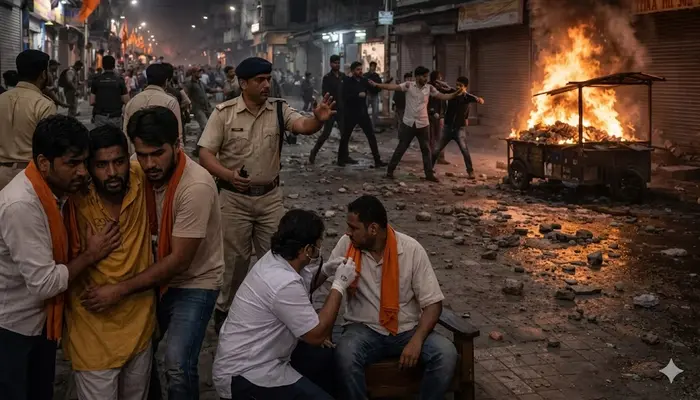
Case Summary
In the Purani Bazaar area of Nawada district, Bihar, a Ram Navami procession was targeted and stone-pelted while it was passing near a mosque by a Muslim mob. The incident occurred on the night of 28 March 2026, when the religious procession organised to mark the festival of Ram Navami was moving along its designated route from Lower Market to Durga Sthan. As the procession passed through the market, a Muslim mob began pelting stones at the procession from a street near the Jama Masjid. As stones were hurled at the procession, chaos ensued, and several devotees were injured. Despite the presence of police personnel, including Station House Officer Rahul Abhishek, the situation escalated rapidly and became difficult to control. Although the police initially managed to bring the situation under control and resume the procession, a second round of stone-pelting and arson soon followed, once again injuring Hindu devotees, heightening tensions in the area. The three injured were taken to the primary health centre in Roh, where they received first aid before being discharged. The violence further escalated when rioters set fire to a roadside cart, intensifying the disorder before the fire brigade intervened and extinguished the blaze. Senior officials, including SDPO Hulas Kumar, reached the spot upon receiving information and assessed the situation while directing measures to restore order. Following the incident, police initiated an investigation, questioning local residents and examining CCTV footage to identify those responsible for the attack. Additional forces were deployed in the area as a precautionary measure, and authorities stated that strict action would be taken against those involved. The situation was later brought under control, with officials urging residents to maintain peace and refrain from spreading rumours. As of the date of writing this report, ten people have been detained, fifty-one people have been named as accused, and a case has been filed against more than 100 unidentified individuals.
Why it is Hate Crime ?
This case has been added to the tracker under the primary category of - Attack not resulting in death. Within it, the sub-category selected is - Attack on religious procession. The outward celebration and display of religious symbols is an intrinsic part of Hinduism. Religious processions on various festivals are age-old traditions and a way to manifest faith and form a part of the religious practices of Hindus. On several occasions, such religious processions come under attack by non-Hindu mobs, in a manifestation of their animosity towards Hinduism and its practices. The reasons cited for such violent attacks are many and range from crossing a non-Hindu resident-dominated area to playing loud music, crossing from an area where there is a religious structure of another faith, etc. The violent attacks are triggered by the outward display of religiosity by Hindus. The attacks are mainly a manifestation of religious supremacist doctrine, which believes that idolatry, essentially the Hindu faith, deserves to be annihilated since the very tenets of Hinduism, its practices and traditions, are considered a sin in those doctrines. Since these attacks emanate from intrinsic and doctrinal animosity towards Hindus and Hinduism, it is considered a religiously motivated hate crime under this category. The other sub-category selected is - Attack against Hindu devotees. Hindu devotees are a few of the easiest targets of religiously motivated hate crimes because, during the festival/procession/puja, etc., for non-Hindus, it is easy to profile their victims based on religion. Hindu devotees come under attack on several occasions by individual non-Hindus or mobs of non-Hindus owing to their animosity against Hinduism, its symbols and tradition/practices. There are several instances of Hindu devotees being attacked while they worship in temples or temporary religious structures, during religious processions, doing bhajan/kirtan/puja in their own homes, in the residential society, etc. These attacks are perpetrated by non-Hindus primarily because of their animosity towards Hindus and their faith. In some cases, the trigger for the violence may be non-religious; however, two elements make these hate crimes. First, the Hindus who come under attack are attacked violently while indulging in religious activity. Whether they are in a place of worship or not is immaterial to the crime. When individuals are attacked while indulging in religious practices, the attack in itself is a hindrance to their freedom to practice religion and therefore constitutes a hate crime. Secondly, religious supremacist doctrines and ideologies deem religious practices of Hindus to be offensive ab initio since they are considered “sinful” by these ideologies, worthy to be annihilated by force or coercion. Driven by these religious supremacist ideologies and doctrines, the attacks against Hindu devotees stem from intrinsic animosity towards Hinduism. In some cases, the trigger for the violence may be non-religious; however, it develops into a religiously motivated crime during the course of the violence. Since these attacks stem from animosity towards Hindus and Hinduism, they are considered religiously motivated hate crimes under this category. The other sub-category selected is - Attacked for crossing 'Muslim area'. One of the reasons that Hindus get attacked unprovoked specifically by Islamists is for crossing ‘Muslim areas’. Essentially, Muslim mobs often attack Hindus crossing or present in certain areas which have a majority Muslim population. It has often been cited as one of the reasons to blame Hindus for attacks against themselves, signalling that Hindus displaying religious symbols, taking our religious processions or crossing any area which is dominated by Muslim residents is a provocation in and of itself. These areas are mostly ghettoized areas where mobs mobilize quickly to attack Hindus for a variety of reasons like playing music during a religious procession, crossing a mosque, wearing a tilak or any other religious symbol in a Muslim-dominated area, praying at a local temple in that area etc. There have been cases where the few local Hindus of that area have been attacked on their way to the Temple for prayers as well, simply because the area is considered a Muslim-dominated area. Several times, it is entirely possible that the immediate trigger for the violence against Hindus was non-religious in nature, however, the violence became religiously motivated in nature because the area was Muslim dominated and the residents on the whole harboured animosity towards Hindus, evidenced from the actions of the mob, the slogans, and the nature of the attack. Such crimes are motivated by the religious identity of the victims and are therefore classified as hate crimes under this category. The other sub-category selected here is - Attacked for Hindu identity. In several cases, Hindus are attacked merely for their Hindu identity without any perceived provocation. A classic example of this category of religiously motivated hate crime is a murder in 2016. 7 ISIS terrorists were convicted for shooting a school principal in Kanpur because they got ‘triggered’ seeing the Kalava on his wrist and tilak that he had put. In this, the Hindu victim had offered no provocation except for his Hindu religious identity. The motivation for the murder was purely religious, driven by religious supremacy. Such cases where Hindus are targeted merely for their religious identity would be documented as a hate crime under this category. The other subcategory selected is- Communal Clash/Attack. Communal clash is a form of collective violence involving conflicts between groups with different religious identities. For a communal clash between Hindus and non-Hindus to qualify as a religiously motivated hate crime, the trigger of the violence itself would have to be anti-Hindu in essence. For example, if there is a Hindu religious procession that comes under attack from a non-Hindu mob and after the initial attack, Hindus retaliate in self-defence, leading to a communal clash between the two religious communities. While at a later stage, both communities are involved in the clash/violence, the initial trigger of the violence was by the non-Hindu mob against the Hindus, and therefore, it could safely be termed as an anti-Hindu violence. Further, the trigger would also have to be religiously motivated. In the cited example, the attack by the non-Hindu mob was against religious processions and therefore can be concluded to be religiously motivated. In some cases, the trigger may be non-religious; however, it develops into religious violence against Hindus at a later stage. In such cases, too, the foundational animosity towards Hindus becomes the motivating factor of the crime, and therefore, it would be classified as a religiously motivated hate crime against Hindus under this category This case has been added to the tracker as a religiously motivated hate crime because the Ram Navami religious procession was deliberately targeted with stone-pelting and arson by a Muslim mob while it was proceeding along its designated route. The procession, which was a public and visible expression of Hindu religious devotion, was attacked when it passed near the Jama Masjid, where stones were hurled at the procession. The timing, location, and nature of the assault demonstrate that the violence was directed at the participants because they were visibly identifiable as Hindus engaged in a religious observance, thereby establishing a clear religious dimension to the incident. Ram Navami holds deep religious significance for Hindus as it commemorates the birth of Lord Ram, a central deity revered as a symbol of righteousness, dharma, and ideal kingship. Processions conducted on this occasion are not merely public gatherings but sacred expressions of collective devotion, involving chants, devotional songs, and symbolic displays of faith. The act of targeting such a procession, particularly at a moment when devotees were engaged in religious observance, amounts to a direct assault on the community’s right to practise and express its faith freely. The disruption of the procession transformed a sacred religious event into a site of violence, causing both physical harm and emotional distress to the participants. The manner of the attack further reinforces its targeted nature. Stones were hurled at the procession not once but in repeated instances, even after the police had temporarily brought the situation under control and allowed the procession to move forward. This recurrence demonstrates an intent to intimidate and disrupt the religious procession, rooted in religious animosity, rather than a one-off spontaneous altercation. The victims were identifiable solely by their participation in the procession, meaning their religious identity was the primary factor in their selection as targets. They were not engaged in any provocation but were attacked while exercising their right to religious expression. The Hindu devotees were attacked not for any personal actions but because they were Hindus and were visibly expressing their Hindu identity in public. The escalation of violence through arson, including the burning of a roadside cart, further highlights the hostile and intimidatory character of the incident. Such acts go beyond mere disruption and serve to create an atmosphere of fear and instability, amplifying the impact of the initial attack. Collective acts of violence of this nature are often intended not only to harm immediate victims but also to send a broader message of intimidation to the community, discouraging public expressions of faith. The fact that this attack occurred near a mosque revealed a disturbing sense of Islamic supremacy held by the attackers, who viewed the area near the mosque as an exclusive Muslim zone where non-Muslims, particularly Hindus, were unwelcome. Muslims often consider areas near mosques, dargahs, or where their community is in the majority as "Muslim areas," reflecting this entitlement. The attackers looked down upon Hindus and believed they had the right to control who could move freely in their perceived territory. This Islamic supremacist ideology motivated the assault on Hindu victims, rooted in prejudice and an attempt to assert religious dominance over public spaces. Such exclusionary intolerance exemplifies a dangerous mindset, marking this as a prime case of religiously motivated animosity. It was not merely an act of physical aggression; it was an attempt to disrupt a deeply revered ritual and instil fear among the Hindu participants. The timing and context of the incident are significant. Such processions are public affirmations of Hindu identity and collective devotion, and attacks on them strike at the core of religious freedom. The use of stone pelting as a means of assault indicates a deliberate attempt to cause harm and disrupt the procession rather than resolve any perceived grievance through lawful or peaceful means. Such actions are not spontaneous but reflect a willingness to use violence to assert dominance and suppress the religious practices of another community. Moreover, the location, near a mosque, adds a communal dimension that cannot be overlooked, given the consistent pattern in which religious violence tends to erupt around Hindu festivals, particularly during processions. It represents an assertion of dominance through religious intimidation and must be recognised as part of a continuing pattern of Hinduphobic aggression witnessed in various parts of India during the Hindu festival. The incident, therefore, cannot be viewed as a routine law-and-order disturbance. The deliberate targeting of a religious procession, the repeated nature of the assault, the violence inflicted on devotees, and the escalation into arson collectively demonstrate actions rooted in religious animosity. The violence was not random but was aimed at disrupting a sacred occasion and instilling fear among participants engaged in a visible act of faith. Taken together, the circumstances of the attack demonstrate that the victims were targeted because they were Hindus participating in a religious procession. The combination of religious targeting, public setting, collective violence, and intent to intimidate establishes that this incident meets the criteria of a religiously motivated hate crime. It reflects group-based hostility aimed at curtailing the free expression of Hindu religious identity and therefore warrants classification and documentation as a hate crime against Hindus. Disclaimer - The Hinduphobia Tracker acknowledges that multiple Hindu devotees were attacked during the incident. However, media reports state that three individuals were injured. Therefore, for documentation purposes, the victim count has been recorded as three. Disclaimer - The identity of the perpetrators remains unknown based on the available information. However, the nature of the incident, an unprovoked attack on a Hindu religious procession, indicates underlying religious hostility. Therefore, this case has been added to the tracker as a religiously motivated incident.
Victim Details
Total Victim
3
Deceased
0
Gender
- Male 0
- Female 0
- Third Gender 0
- Unknown 3
Caste
- SC/ST 0
- OBC 0
- General 0
- Unknown 3
Age Group
- Minor 0
- Adult 0
- Senior Citizen 0
- Unknown 3


Case Status
Case sub-judice


Perpetrators Details
Perpetrators
Muslim Extremists
Perpetrators Range
From 10 to 100
Perpetrators Gender
unknown
 Sources




