Hindu religious procession disrupted and opposed by Muslims as route passes by mosque in Tamil Nadu
 Theni, Tamil Nadu, India
  24 February, 2026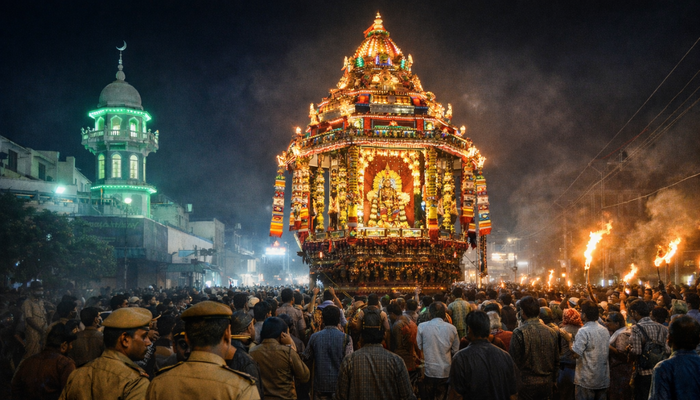
Case Summary
In Uthamapalayam, in the Theni district of Tamil Nadu, a Hindu religious procession connected with the Masimagam chariot festival of the Kalatheeswarar Gnanambigai Temple was disrupted and opposed by members of the Muslim community as the procession passed through a route with a mosque. According to media reports, on 25 February 2026, the members of the Okkaliga Gounder community, a Hindu community, took out a procession of the deity to the Indira Nagar area of the town as part of the preparatory mandagapadi events, which had been going on since 19 February 2026. The events precede the Masimagam chariot festival of the Kalatheeswarar Gnanambigai Temple, scheduled to take place on 2 March 2026. Until the festival, the deity is hosted by different communities on different days. As arrangements were being made for the return of the procession, members of the Muslim community opposed the procession passing through the chosen route, stating that it would disrupt prayers in a mosque located along the route. They demanded that the procession be delayed or diverted to a different route. This led to tension erupting between the Hindu devotees and Muslims. Soon, local members of the Bharatiya Janata Party and Hindu Munnani, a Hindu organisation, reached the spot to take stock of the situation. Uthamapalayam Revenue Divisional Officer Syed Mohammed and Deputy Superintendent of Police Ponnarasu spoke to members of the Muslim community. After negotiations, it was decided that the procession would proceed through the same route after the completion of prayers at the mosque. Eventually, the procession passed through the route after 10:30 pm. However, the devotees were not allowed to light firecrackers or beat drums in front of the mosque to maintain law and order.
Why it is Hate Crime ?
The primary category selected in this case is- Restriction/ban on Hindu religious practices. The subcategory selected is- Restriction on expression of Hindu identity. An example of the state-affected prejudicial and targeted orders against the Hindu community would be a government denying the right of a Hindu or a group of Hindus to hold a religious procession owing to the animosity of non-Hindu groups. Denial of the religious right of the Hindus to assuage the non-Hindu group which harbours animosity to a point where it could lead to violence against Hindus is not only a failure of law and order but is a prejudicial order against Hindus, denying them their fundamental rights to express their religious identity. An example of a hate crime against Hindus by a non-Hindu would be a non-Hindu institution forcing its Hindu employees to abandon religious symbols that a Hindu would wear as an expression of faith owing to inherent prejudice against the faith professed by the victim or a non-Hindu group of people restricting a Hindu group from constructing a place of worship simply because the demography of the area in which the temple is being built is dominated by non-Hindus. Such actions are driven by religious animosity and/or prejudice against Hindus and their faith and would therefore be categorized as a hate crime. Another primary category selected is- Attack not resulting in death. The subcategory selected is- Attack on religious procession. The outward celebration and display of religious symbols in an intrinsic part of Hinduism. Religious processions on various festivals are age-old traditions and a way to manifest faith and form a part of the religious practices of Hindus. On several occasions, such religious processions come under attack by non-Hindu mobs, in a manifestation of their animosity towards Hinduism and their practices. The reasons cited for such violent attacks are many and range from crossing a non-Hindu resident-dominated area to playing loud music, crossing from an area where there is a religious structure of another faith etc. The violent attacks are triggered by the outward display of religiosity by Hindus. The attacks are mainly a manifestation of religious supremacist doctrine which believes that idolatry, essentially the Hindu faith, is one that deserves to be annihilated since the very tenets of Hinduism, its practices and traditions are considered a sin in those doctrines. Since these attacks emanate from intrinsic and doctrinal animosity towards Hindus and Hinduism, it is considered a religiously motivated hate crime under this category. The other subcategory selected is- Attacked for crossing 'Muslim area'. One of the reasons that Hindus get attacked unprovoked specifically by Islamists is for crossing ‘Muslim areas’. Essentially, Muslim mobs often attack Hindus crossing or present in certain areas which have a majority Muslim population. It has often been cited as one of the reasons to blame Hindus for attacks against themselves, signalling that Hindus displaying religious symbols, taking our religious processions or crossing any area which is dominated by Muslim residents is a provocation in and of itself. These areas are mostly ghettoized areas where mobs mobilize quickly to attack Hindus for a variety of reasons like playing music during a religious procession, crossing a mosque, wearing a tilak or any other religious symbol in a Muslim-dominated area, praying at a local temple in that area etc. There have been cases where the few local Hindus of that area have been attacked on their way to the Temple for prayers as well, simply because the area is considered a Muslim-dominated area. Several times, it is entirely possible that the immediate trigger for the violence against Hindus was non-religious in nature, however, the violence became religiously motivated in nature because the area was Muslim dominated and the residents on the whole harboured animosity towards Hindus, evidenced from the actions of the mob, the slogans, and the nature of the attack. Such crimes are motivated by the religious identity of the victims and are therefore classified as hate crimes under this category. This case is a clear instance of a religiously motivated hate crime, as a Hindu religious procession was disrupted and opposed by Muslims since the route passed by a mosque. This factor overall showcases the religious motivations of the Muslim perpetrators. For Hindus, a religious procession, or yatra, is far more than a public march; it is a sacred act of devotion and a community expression of their faith. These processions, such as the mandagapadi events leading to the Masimagam chariot festival, involve the deity "travelling" among the people, sanctifying the streets and allowing devotees to receive darshan (divine sight) outside the temple walls. For the Okkaliga Gounder community and other Hindu groups, these traditions are ancient, identity-affirming rituals that transform public spaces into temporary outdoor sanctums, making the freedom to traverse a chosen route a fundamental aspect of their religious practice. The actions taken by members of the Muslim community in Uthamapalayam to block or divert this procession amount to a direct restriction on Hindu religious expression. By demanding that the deity’s path be altered or delayed based on the proximity of a mosque, the agitators effectively claimed a "veto power" over the constitutional rights of the Hindu community to practise their faith in public. This obstruction forced a compromise, such as the silencing of drums and the banning of firecrackers, which stripped the Hindu devotees of the traditional celebratory elements of their ritual, turning a moment of joy into a negotiated and restricted movement. The disruption of the procession showcases a deep-seated religious animosity, characterised by an intolerance for the visibility of non-Islamic faith in shared spaces. By specifically targeting a temple event and framing it as an "intrusion" or a "disruption" to mosque prayers, the agitators demonstrated a deliberate intent to suppress Hindu traditions. This targeting is not merely a logistical disagreement; it is an act of hostility that seeks to establish religious dominance by dictating when and how Hindus can celebrate their festivals. Such actions highlight a refusal to coexist with the vibrant and public nature of Hindu worship, choosing instead to create a confrontational environment fuelled by religious bias. The fact that this occurred since the procession's route passed by the mosque sharpened the religiously motivated nature of the incident to a glaring point. In many instances, Muslim groups treat areas around mosques or madrasas as exclusive zones reserved solely for their community, labelling them "Muslim areas" where non-Muslims face exclusion and control over public movement. This disturbing assertion of religious supremacy allows the Muslim perpetrators to dictate how Hindus can pass through, viewing a traditional procession as an intolerable intrusion on their perceived turf. Thus, even a sacred temple event in a public area is treated as an affront in what is claimed as exclusive Muslim space, leading to a frenzy of religious exclusion and the forced silencing of Hindu religious cultural markers to appease Muslim demands. The forced restrictions placed on the Hindu devotees, specifically the banning of traditional firecrackers and the silencing of drums, further solidify the nature of this act as a hate crime rooted in religious intolerance. In Hindu tradition, these elements are not mere noise but are sacred components of the vadyam (musical offering) intended to herald the presence of the deity and celebrate the divine. By targeting these specific cultural markers and making their removal a condition for passage, the agitators effectively coerced the state and the devotees into a lopsided compromise that diminished the sanctity of the ritual. This targeted suppression of Hindu religious joy, under the guise of maintaining "order" near a mosque, serves as a clear example of how religious animosity is used to strip a community of its heritage and religious dignity in the public square. Given that this case meets the parameters of a hate-driven offence, it is being added to the hate crime database of the Hinduphobia Tracker.


Case Status
Unknown


Perpetrators Details
Perpetrators
Muslim Extremists
Perpetrators Range
Unknown
Perpetrators Gender
unknown
 Sources




