Ram Navami celebrations banned at Kolkata's government-run university amidst protests by leftist groups; no similar restrictions placed on Muslim religious observances
 Kolkata, West Bengal, India
  25 March, 2026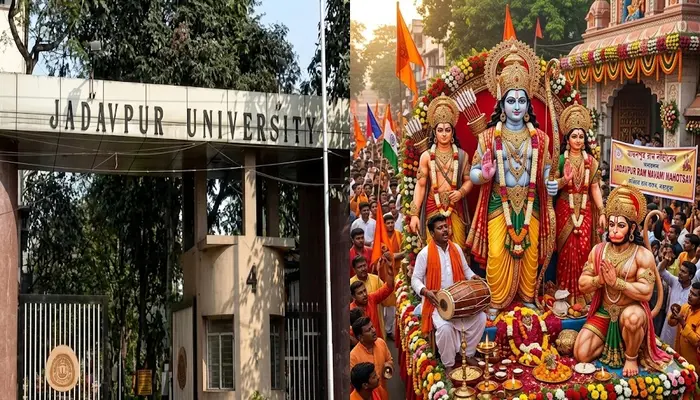
Case Summary
In Kolkata, West Bengal, Ram Navami celebrations and puja were prohibited by the state-funded Jadavpur University and the Vice Chancellor. At the same time, no similar restrictions were placed on observances such as Eid, Ramadan, or Iftar gatherings. Leftist organisations also confronted Hindu activists for organising such festivities. The incident unfolded on 26 March 2026, when ABVP (Akhil Bharatiya Vidyarthi Parishad) activists (Hindu activists) organised a religious programme on the occasion of Ram Navami, involving prayers and rituals. The event was met with protests from Left-wing student organisations, who opposed the holding of religious activities on campus, claiming that formal approval had not been granted for such an event. Both sides raised slogans, intensifying the situation and creating a charged atmosphere within the campus. Meanwhile, the Vice Chancellor declared that no official permission had been granted for the event/puja, and Left-wing student groups maintained that university premises should remain free from religious activities conducted without authorisation, claiming that such events politicise and communalise the academic environment. In response, Hindu activists questioned the denial of permission for a Hindu religious observance while highlighting the differential treatment of religious practices in the state of West Bengal, stating that “namaz is offered everywhere in this state and traffic is disrupted, and no one needs permission.” They further stated that in West Bengal, during Durga Puja, motorcyclists are stopped and fined, whereas during Eid and Muharram, even those without helmets are not penalised. They emphasised that permission is required to hold any puja at the university, including Ram Navami celebrations, and stated that Hindus in the state face difficulties in celebrating their festivals. This was not an isolated incident. Jadavpur University has a documented history of passing anti-Hindu diktats. Previously, too, the varsity has restricted Hindu religious festivals while allowing Islamic religious observances to proceed. In 2025, the university denied permission for Ram Navami celebrations, citing the absence of a Vice Chancellor, even as Iftar observances had been permitted on campus days earlier. During that time, Hindu student groups, including the Hindu Students’ Union, condemned the move as selective appeasement and asserted that if Iftar could be organised, there was no justification to deny Ram Navami. Similar tensions were reported in 2024, when initial permission for Ram Navami was later withdrawn following protests, with the administration claiming concerns over communal harmony. This pattern of hostility towards Hindu expression at Jadavpur University extended beyond festival restrictions and reflected a broader environment of ideological targeting against Hindus on the campus. In January 2026, a controversy erupted when a Hindu female professor, Saswati Halder, was compelled to go on leave following protests led by Left-affiliated student groups over a hijab-related incident during an examination. The professor had conducted routine invigilation checks on students suspected of cheating, yet was accused of “Islamophobia” by student organisations. Despite performing standard academic duties applicable to all students, she faced sustained pressure, protests, and institutional action, culminating in her removal from responsibilities. Even though she apologised and clarified that similar checks were carried out irrespective of religious identity, the administration proceeded with action against her. This incident reinforced the entrenched anti-Hindu bias within the university, where the enforcement of neutral institutional norms against members of the Muslim community was met with backlash. This incident must also be viewed within the broader pattern of systemic bias against Hindus in West Bengal, where expressions of Hindu religious identity are frequently restricted, contested, or portrayed as provocative. There are increasing instances where the state actively suppresses Hindu religious expression. Hindus have been arrested simply for chanting “Jai Shri Ram”, a phrase vilified by sections of the administration and ruling party. Permission for Hindu processions, especially during festivals like Ram Navami or Hanuman Jayanti, is routinely denied on grounds of "law and order concerns", while Muslim religious gatherings face no such hurdles. Moreover, over the years, the Mamata-led government has issued numerous prejudicial directives, like orders restricting Durga Puja immersions, citing Muharram processions. Inaction on anti-Hindu mob violence in areas like Dhulian, Islampur, and Kaliachak. Public endorsements and appeasement of radical clerics and Islamist leaders, while dismissing concerns raised by Hindu groups as “communal provocation”. The systematic suppression of Hindu voices, the denial of communal violence, and the criminalisation of Hindu identity expressions such as “Jai Shri Ram” reflect not just administrative failure but a deeper ideological hostility toward the Hindu community. This sustained pattern of differential treatment has contributed to an atmosphere in which Hindu religious assertion is not treated on equal footing, and where opposition to such expression is normalised. The incident at Jadavpur University reflects this larger trend, where attempts to observe a Hindu festival were met not only with administrative denial but also organised resistance, reinforcing concerns of an entrenched anti-Hindu bias within the state.
Why it is Hate Crime ?
This case is being added to the tracker under the primary category- Restriction/ban on Hindu practices. The subcategory selected is- Administration restricting religious practice. In several cases, it is seen that the administration/state disallows a religious practice owing to prejudicial orders and concerns, targeted specifically against the Hindu community. Such restriction/prohibition would be considered documented as a hate crime because the orders are often a result of pressure by groups that harbour animosity towards Hinduism and Hindus. Often, the restriction by the authorities is driven by bias, hostility, or prejudice against the specific community being stopped from holding a religious practice, by pressure groups that harbour animosity towards Hindus, intrinsic to their faith. Since practices are intrinsic to the faith of the Hindus, such prejudicial restriction is considered a curtailing of the fundamental rights of the Hindu community. In several cases, for example, the authorities ban a Hindu religious practice due to pressure from groups opposed to the religion. In other instances the prohibition is selectively enforced against one religious group (Hindus) while others are allowed to proceed. There are still other cases where the authorities preemptively restrict a religious practice by Hindus because those who hold animosity towards Hindus may get “provoked” leading to them being violent, thereby assuaging the sentiments of those who hold animosity towards Hindus by curtailing the religious rights of Hindus. Such acts and orders are prejudiced, indicating discriminatory motives owing to the capitulation to groups that harbour animosity towards Hindus and therefore, would be categorized as a religiously motivated hate crime since the original pressure leading to the order itself is a result of hatred/bias/prejudice/religious hate against Hindus. The other sub-category selected here is - Restriction on expression of Hindu identity. An example of the state-affected prejudicial and targeted orders against the Hindu community would be a government denying the right of a Hindu or a group of Hindus to hold a religious procession owing to the animosity of non-Hindu groups. Denial of the religious right of the Hindus to assuage the non-Hindu group which harbours animosity to a point where it could lead to violence against Hindus is not only a failure of law and order but is a prejudicial order against Hindus, denying them their fundamental rights to express their religious identity. An example of a hate crime against Hindus by a non-Hindu would be a non-Hindu institution forcing its Hindu employees to abandon religious symbols that a Hindu would wear as an expression of faith owing to inherent prejudice against the faith professed by the victim or a non-Hindu group of people restricting a Hindu group from constructing a place of worship simply because the demography of the area in which the temple is being built is dominated by non-Hindus. Such actions are driven by religious animosity and/or prejudice against Hindus and their faith and would therefore be categorized as a hate crime. The second primary category selected here is - Attack not resulting in death. Within it, the sub-category selected here is - Attacked for Hindu identity. In several cases, Hindus are attacked merely for their Hindu identity without any perceived provocation. A classic example of this category of religiously motivated hate crime is a murder in 2016. 7 ISIS terrorists were convicted for shooting a school principal in Kanpur because they got ‘triggered’ seeing the Kalava on his wrist and tilak that he had put. In this, the Hindu victim had offered no provocation except for his Hindu religious identity. The motivation for the murder was purely religious, driven by religious supremacy. Such cases where Hindus are targeted merely for their religious identity would be documented as a hate crime under this category. This case has been added to the tracker because at Jadavpur University in Kolkata, permission for the celebration of Ram Navami was denied, while Muslim religious observances, such as Iftar gatherings, had been permitted on campus, constituted a clear instance of discriminatory and exclusionary conduct targeting Hindu religious expression. Ram Navami is one of the most significant festivals in the Hindu tradition, commemorating the birth of Bhagwan Ram, who is revered as an embodiment of dharma and righteousness. Celebrating this festival is not merely a cultural expression but a vital aspect of the spiritual and religious identity of Hindus. Denying permission for its celebration, especially in a public institution that has previously allowed similar observances for other faiths, constitutes not only a glaring double standard but also a prejudicial order that infringes upon the fundamental rights guaranteed to every citizen under the Indian Constitution. As a publicly funded state institution, Jadavpur University is bound by constitutional principles that prohibit discrimination on the basis of religion. Any administrative decision that selectively restricts the religious practices of one community while permitting those of another constitutes a violation of these principles. In this case, the denial of permission for Ram Navami celebrations, especially in the backdrop of previously organised Iftar gatherings, demonstrated a clear pattern of differential treatment. Such selective enforcement cannot be viewed as a neutral administrative act but instead reflected deliberate and targeted exclusion of Hindu religious identity from institutional spaces. Such arbitrary and selective restrictions are deeply concerning as they reflect institutionalised animosity and prejudice specifically targeted at Hindu beliefs and practices. When an administration curtails the expression of a community’s faith while allowing space for another, it signals not mere administrative bias but a deeper, systemic animosity towards that community’s beliefs and practices. By permitting the observance of Iftar, a religious gathering specific to the Muslim community, while denying Ram Navami celebrations, the administration exposed a glaring double standard that signals preferential treatment based on religious identity. Furthermore, the confrontation that followed, where Hindu students affiliated with the Akhil Bharatiya Vidyarthi Parishad were met with organised resistance and protests from Left-wing student groups, further underscored the hostile environment surrounding Hindu religious assertion on campus. The act of opposing a peaceful religious observance, combined with administrative denial, effectively marginalised Hindu students and delegitimised their right to celebrate their festival within an academic space. Notably, the protesting Left-wing organisations justified their opposition by claiming that such events would “communalise” the campus, thereby portraying Hindu religious expression as inherently divisive. This framing revealed an evident religious bias, wherein Hindu observances were treated as sources of discord, while similar concerns were not raised in the context of Islamic religious gatherings. Such a selective standard pointed towards underlying religious animosity, where Hindu identity was singled out for scrutiny and restriction. This was a flimsy attempt to delegitimise and erase Hindu cultural presence from shared university spaces. Rather than functioning as a genuine effort to preserve neutrality or promote social harmony, the protests operated as an exercise in targeting and diminishing Hindu religious and civilisational identity. The selective opposition to Hindu practices indicated that the goal of preventing communalisation was merely a pretext, while the intent was hostility towards Hinduism and its public expression. Moreover, this incident aligned with a broader, recurring pattern in West Bengal, where Hindu religious practices, particularly festivals such as Ram Navami and Hanuman Jayanti, have frequently faced restrictions, cancellations, or heightened scrutiny, often justified on the pretext of maintaining law and order. At the same time, similar constraints have not been uniformly imposed on other religious gatherings, reinforcing a perception of systemic bias and unequal treatment. The state's bias has extended beyond inaction. There are increasing instances where the state actively suppresses Hindu religious expression. Hindus have been arrested simply for chanting “Jai Shri Ram”, a phrase vilified by sections of the administration and ruling party. Permission for Hindu processions—especially during festivals like Ram Navami or Hanuman Jayanti—is routinely denied on grounds of "law and order concerns", while Muslim religious gatherings face no such hurdles. Moreover, over the years, the Mamata-led government has issued numerous prejudicial directives, like orders restricting Durga Puja immersions, citing Muharram processions. Inaction on anti-Hindu mob violence in areas like Dhulian, Islampur, and Kaliachak. Public endorsements and appeasement of radical clerics and Islamist leaders, while dismissing concerns raised by Hindu groups as “communal provocation”. The systematic suppression of Hindu voices, the denial of communal violence, and the criminalisation of Hindu identity expressions such as “Jai Shri Ram” reflect not just administrative failure but a deeper ideological hostility toward the Hindu community. Such actions collectively contribute to the marginalisation of Hindu identity within public institutions and create an environment where expressions of Hindu faith are treated as contentious or undesirable. The deliberate denial of permission for a significant Hindu festival, the selective application of administrative rules, and the organised opposition to its observance together demonstrate a pattern of targeted discrimination. This establishes the incident not merely as an administrative dispute but as a religiously motivated act of exclusion. Therefore, this case has been added to the tracker as a religiously motivated hate crime, as it was a conscious and discriminatory restriction on the religious rights of Hindus in a state-funded institution. The actions of the university administration, in conjunction with the hostile response from ideological groups, demonstrated clear and deliberate animosity towards Hindu religious practices.


Case Status
Unknown


Perpetrators Details
Perpetrators
State and Establishment
Perpetrators Range
Unknown
Perpetrators Gender
unknown
 Sources




