Jadavpur University revokes Ram Navami celebration permission citing 'communal threat' after protests claiming it would 'disrupt harmony'
 Kolkata, West Bengal, India
  15 April, 2024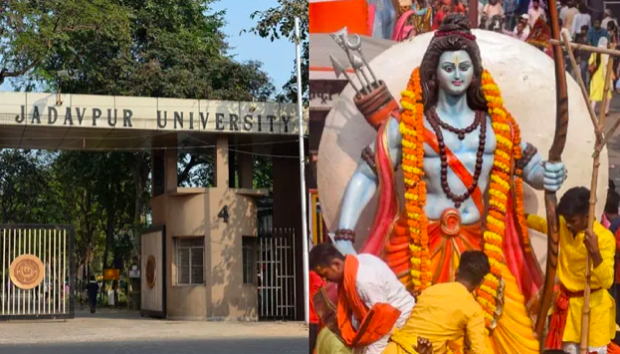
Case Summary
On April 16, 2024, Jadavpur University revoked the permission granted on April 15 for students to celebrate Ram Navami on campus, citing pressure from protesting students. The decision came after students staged a late-night protest, claiming the celebration would disrupt campus harmony and promote divisive politics. The University's registrar issued a notice citing three reasons for the revocation: fraudulent use of student names in applications, communal threats, and the need to comply with the Model Code of Conduct for the General Lok Sabha Elections 2024. An official clarified that while permission was initially granted, it was later withdrawn due to these concerns. Aditya Palley, a member of ABVP, stated that they would proceed with the puja and prasad distribution as planned, depending on the situation. The BJP criticised the decision, alleging that it resulted from pressure from left-leaning student organizations, accusing both TMC and CPIM of lacking reliability in standing up for Bengal.It is pertinent to note that Jadavpur University is a govt funded institute and therefore, the restriction on Hindu practices is essentially by the state.
Why it is Hate Crime ?
This case has been placed under the sub-category 'Restriction on expression of Hindu identity' under the prime category, 'Restriction/ban on Hindu practices' of the hate tracker. An example of the state-affected prejudicial and targeted orders against the Hindu community would be a government denying the right of a Hindu or a group of Hindus to hold a religious procession owing to the animosity of non-Hindu groups. Denial of the religious right of the Hindus to assuage the non-Hindu group which harbours animosity to a point where it could lead to violence against Hindus is not only a failure of law and order but is a prejudicial order against Hindus, denying them their fundamental rights to express their religious identity. An example of a hate crime against Hindus by a non-Hindu would be a non-Hindu institution forcing its Hindu employees to abandon religious symbols that a Hindu would wear as an expression of faith owing to inherent prejudice against the faith professed by the victim or a non-Hindu group of people restricting a Hindu group from constructing a place of worship simply because the demography of the area in which the temple is being built is dominated by non-Hindus. Such actions are driven by religious animosity and/or prejudice against Hindus and their faith and would therefore be categorized as a hate crime. In this case, the Jadavpur University in West Bengal's Kolkata city revoked the permission granted to Hindu students to celebrate the festival of Ram Navami. The permission was revoked citing communal harmony, which also means that the festival was restricted to placade those groups that harbour animosity towards Hinduism since they could indulge in violence had the festival been observed by Hindus. Ram Navami is a significant Hindu festival celebrating the birth of Lord Rama, a revered deity in Hinduism. Here, the university caved into the non-Hindu student's demands and forbade Hindus from celebrating their festival, which in itself is deemed bigoted and hinduphobic. Given the initial motivation for the imposition of this anti-Hindu diktat was hatred for Hindu religious practices, this can be called a religiously motivated hate crime and has been added to the tracker.


Case Status
Unknown


Perpetrators Details
Perpetrators
State and Establishment
Perpetrators Range
N/A
Perpetrators Gender
unknown
 Sources




