Sacred Hindu site defiled as Muslim youths hold non-veg Iftar party near its premises, throwing bones into water body used for religious activities
 Shrawasti, Uttar Pradesh, India
  16 March, 2026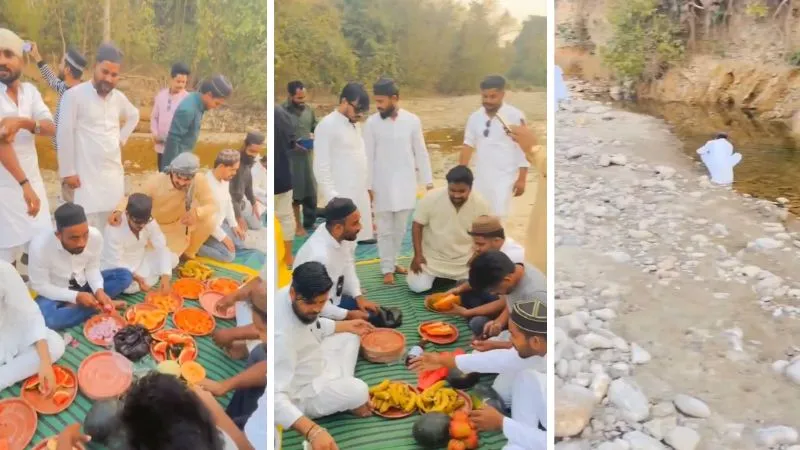
Case Summary
In Shravasti, Uttar Pradesh, a Hindu Ashram (hermitage) and a water drain near it were defiled when Muslim youths organised a non-vegetarian Iftar party near its premises. During this party, they ate meat and dumped its bones into the drain, whose water was used by the ashram for sacred Hindu religious activities. This occurred near the Sonpathri Ashram in Shravasti on 17 March 2026. The Muslim perpetrators organised a non-vegetarian Iftar party near a drain located by the ashram. Here, the perpetrators ate non-vegetarian food and threw its bones into the water. This water was used for religious activities at the ashram and its temples, and also for devotees to drink. A video of this entire incident went viral on social media, causing severe outrage from Hindus. Mahant Harisharanand Maharaj of the Sonpathri Ashram expressed strong objection to this matter and filed a police complaint. He explained that this mountain stream was extremely important and sacred to the ashram. This water was used for the anointment of idols in the temple, their cleaning, and for preparing food for the feast (bhandara). Furthermore, a large number of devotees who visited the site bathed in this stream and drank its water. Throwing meat bones into the sacred water violated the temple's sanctity. In his complaint, the Mahant stated that this act was not unintentional, but intentional, intended to hurt the religious sentiments of Hindus and disrupt the harmony of the area. After the video surfaced, a tense situation developed in the area, prompting police to take immediate action. Considering the seriousness of the case, the Sirsia police station registered a First Information Report against several Muslim individuals. Based on the evidence and video, the police arrested four main accused, namely, Jamal Ahmed, Irfan Ahmed, Imran Ahmed alias Immy, and Zaheer Khan. The police administration stated that the four accused were sent to jail in judicial custody. The viral video on social media was being closely examined to identify other individuals involved in the incident and to take strict legal action against them. Notably, this was not the first such incident. The Hinduphobia Tracker previously documented a similar case. On 16 March 2025, in Varanasi, Uttar Pradesh, the Hindu sacred sites of Bindu Madhav Temple and the Kashi ghats were defiled when Muslim youths held a non-vegetarian Iftar party on a boat in the Ganga River near the temple and ghats. The accused ate chicken biryani and threw chicken bones into the Ganga, violating the sanctity of the river held sacred by Hindus.
Why it is Hate Crime ?
This case is being added to the tracker under the primary category- Attack on Hindu religious representations. The subcategory selected is- Desecration of religious symbols. Icons and symbols or a religious representation of a spiritual ideal are widely revered in Hinduism. Iconography is of vital significance in the Hindu milieu. It helps connect people’s spiritual beliefs with the real world. Iconography within the Hindu faith takes several shapes and forms. Murtis are of most significance to Hindus, to which daily rituals, prayers and offerings are done. Besides the murtis, there are several other symbols which have deep significance in the Hindu faith – the Om and Swastika for example. Since these Hindu religious symbols hold paramount importance in Hinduism, any desecration of symbols, icons, murtis, religious representations and manifestations, is driven by animosity towards the faith itself which manifests itself through these murtis, icons and symbols. Therefore, any desecration of these Hindu religious symbols and representations is considered religiously motivated hate crimes under this category. The other subcategory selected is- Defiling religious customs. Sanatan Dharma is not a religion of one book, which is to say that while it has religious scriptures that form the central tenets of the faith, there are several traditions followed through thousands of years, mostly passed from generation to generation orally. There are several such customs and traditions that are followed by various Hindus and Hindu sects. Defiling of these traditions and customs is a breach of an individual or group’s religious practices. Such practices can range from dietary restrictions like not eating non-vegetarian food for a certain period of the year, not eating non-vegetarian food at all, not eating beef since the cow is considered holy in Hinduism, the sanctity of religious customs followed in the house (like many ISCKON devotees), etc. Any malicious action leading to the breach of such traditions or defilement of these traditions owing to animosity towards the faith or for the sake of activism stems not only from the lack of faith in the religion itself but also from disregard for the faith of the devotees who follow the customs/traditions and implicit bias against the faith, the tradition itself. Since these specific traditions are central to the faith of the devotees of that specific sect of Hindus, any non-compliance with these traditional rules would be considered a religiously motivated hate crime. This case represents a clear instance of a religiously motivated hate crime, as Muslim youths desecrated the sacred Sonpathri Ashram, the temples inside the Ashram, and the adjoining water drain in Shravasti. They achieved this by organising a non-vegetarian Iftar party near these sites, consuming meat and throwing bones into the drain, whose water was used for vital Hindu rituals, thereby defiling core elements of Hindu sanctity. Hindu hermitages or ashrams represent sacred abodes of learning and asceticism, where gurus guide disciples through disciplined practices like meditation, scriptural study, yoga, and karma yoga, fostering inner transformation and detachment from worldly desires while serving as vibrant centres for community worship and moral education. Within these ashrams, temples house living deities through consecrated idols, acting as focal points for daily rituals, bhajans, and festivals that channel divine grace and reinforce devotees' connection to eternal truths. The Sonpathri Ashram functions as a living spiritual hermitage, a place of ascetic discipline and divine communion where purity governs every aspect of life, from worship of deities through idols to community feasts (bhandara). Hindu temples and ashrams like this demand rigorous adherence to vegetarianism and ritual cleanliness, prohibiting meat or impurities in their vicinity to safeguard the spiritual potency of worship spaces and water sources integral to anointment, purification, and sustenance. Any act of introducing non-vegetarian food or similar impurities directly assaults this site's sanctity, making it a hate crime. The water drain adjacent to the ashram serves as a vital lifeline for religious life, its waters employed for anointing temple idols, cleansing sacred objects, preparing prasad for devotees, bathing pilgrims, and even drinking during rituals and daily observance. Devotees view this water stream as a pure conduit of divine grace, akin to smaller sacred flows that mirror the Ganga's cleansing power in Hindu cosmology, where water symbolises life's renewal and sin's dissolution across generations. These elements, the ashram, temple, and stream, form an interconnected sacred ecosystem for Hindus, embedding faith, ritual purity, and community identity in everyday practice. The defilement of the Sonpathri Ashram's sanctity unfolded through staging a non-vegetarian Iftar near the hermitage, temple, and sacred stream. This desecrated the sacred Hindu sites by associating them with meat consumption and introducing impure elements in their vicinity. It also polluted the stream by turning a source for ritual anointment, pilgrim bathing, and devotional sustenance into a dumping ground for bones. These acts collectively constitute a clear instance of religiously motivated hate crime, deliberately targeting and violating core symbols and practices of the Hindu faith while treating them as arenas for humiliation and subordination rather than sites of reverence. Introducing Iftar, an exclusively Islamic religious practice, near the Hindu ashram, its temples, and sacred stream constitutes forced religious dominance and the imposition of Islamic themes onto Hindu sacred sites. Such intrusion transforms spaces reserved for Hindu rituals into venues for alien religious observance, undermining the exclusivity of Hindu worship and sanctity. This act showcases further desecration of the Hindu hermitage, temple, and stream by challenging their inviolable religious character. The fact that the perpetrators recorded a video of their desecration, complete with background music featuring Islamic slogans, starkly reveals their utter lack of guilt and instead brims with religious zeal and unbridled pride in violating the sanctity of the Hindu ashram and its sacred stream. Rather than concealing their actions out of shame, they deliberately captured every moment of consuming non-vegetarian food near this holy site and discarding meat bones into waters vital for idol anointment, ritual bathing, pilgrim purification, and devotional sustenance, turning a profane act into a celebrated trophy. This brazen documentation, infused with triumphant Islamic audio that drowns out the sanctity of the Hindu space, broadcasts their exhilaration in defiling core symbols of Hindu purity and faith, as if the pollution of a stream revered for its divine cleansing power represents a conquest worth proclaiming to the world. By sharing such footage, they amplify the emotional devastation for devotees who hold this ashram as a beacon of spiritual discipline and selfless service, parading their religious animosity as a badge of honour and ensuring the wound to Hindu sentiments festers across communities, which unequivocally elevates this to a deliberate, pride-fuelled, religiously motivated hate crime. After consuming the non-vegetarian food, the perpetrators discarded bones into the sacred stream, an act of blatant religious defilement that wounds Hindu sentiments at their core. In Hindu tradition, this stream's waters parallel holy rivers, believed to purify body and soul through immersion, anointment, and ingestion, with scriptures emphasising water's role in dissolving impurities and honouring ancestors. Introducing meat bones, classified as tamasic and ritually polluting, directly contravenes these prohibitions, contaminating a source tied to temple rituals, feasts, and pilgrim faith, and inflicting visceral pain on devotees who see it as an assault on their spiritual heritage and daily worship. This incident mirrors a strikingly similar case in Varanasi, Uttar Pradesh, on 16 March 2025, where Muslim youths organised a non-vegetarian Iftar party on a boat in the sacred Ganga River near Bindu Madhav Temple and Kashi ghats, eating chicken biryani and discarding bones into the holy waters. That deliberate pollution of Hinduism's most revered river, used for ritual purification and moksha, provoked massive outrage and arrests, underscoring identical contempt for Hindu sanctity. These repeated acts of targeting sacred sites and water bodies central to Hindu rituals reveal not an isolated lapse but a brazen pattern of religiously motivated desecration aimed at humiliating devotees and eroding their spiritual heritage. Such consistent aggression against core symbols of the Hindu faith cements both cases as undeniable instances of hate crime. All these actions, holding the meat-based Iftar near the ashram and temple, eating non-vegetarian food in an area demanding ritual purity, and polluting the sacred water stream with bones, demonstrate unambiguous desecration of Hindu symbols and sites. Therefore, this case is being added to the hate crime database of the Hinduphobia Tracker. Disclaimer: In this case, the perpetrator count has been conservatively recorded as "4". Although several Muslim perpetrators were involved, only four individuals have been specifically identified without mention of the total number. Thus, four serves as a conservative estimate for documentation purposes.


Case Status
Case sub-judice


Perpetrators Details
Perpetrators
Muslim Extremists
Perpetrators Range
From 2 To 5
Perpetrators Gender
male
 Sources




