Hindus threatened with mass genocide in Bangladesh by radical Islamist leader Osman Hadi's sister
 Bangladesh
  20 December, 2025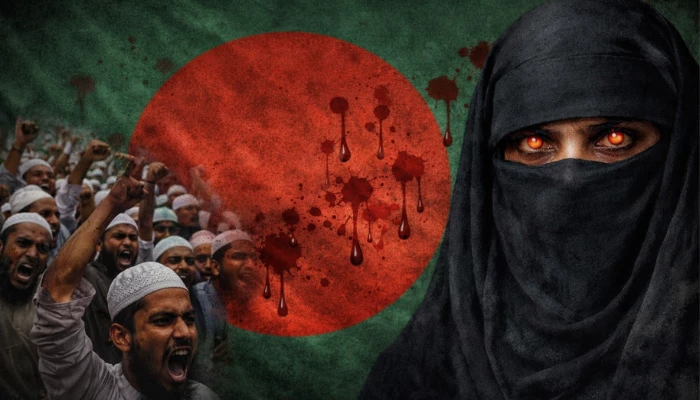
Case Summary
Amidst the ongoing protests in Bangladesh, a call for mass genocide of Hindus was raised by radical islamist Osman Hadis sister on 31st December, 2025 This incident occurred on 21st December 2025 in Bangladesh where a muslim woman is heard saying “200-Year-Old War Must Be Finished, Wipe Out Indian Dogs”. According to the video, the woman is heard raising slogans against India saying that a “war” against India began 200 years ago. She calls for every Muslim in Bangladesh, irrespective of gender or age, to be made a “jihadi,” including children. She urged households across the country to provide jihadi training to all members in order to “fight India.” Furthermore, she asked Bangladeshis to raise their voices and act against those who support India. References were also made in the video to remarks attributed to former Pakistani leader Zulfikar Ali Bhutto during the 1971 war, with similar language echoed in her statements. She is heard saying that the 200-year-old war must be completed and asserting that India is attempting to delay Bangladesh’s elections, while insisting that elections would be held under any circumstances. She also stated that those who support India have no right to live in Bangladesh. Notably, Sharif Osman Bin Hadi was a Muslim political activist and student leader known for his anti-Hindu and anti-India stance. He was actively involved in the political unrest that followed the fall of Sheikh Hasina’s government and was killed in Dhaka in December 2025 during clashes, after which Hindus were blamed and subsequently targeted. A fresh wave of anti-Hindu violence prevailed across Bangladesh following the death of Sharif Osman Bin Hadi. This escalation occurred against the backdrop of ongoing anti-Hindu violence that had persisted since the ouster of the Sheikh Hasina government in August 2024, during which Hindu homes, temples, and religious spaces were repeatedly attacked, and the Hindu community faced intimidation, arson, and mob attacks. In the aftermath of Hadi’s death, Hindu homes were selectively targeted and set ablaze in multiple localities by Muslim mobs, forcing families to flee and rendering many homeless. The violence was not sporadic but patterned, with Muslim mobs targeting Hindu neighbourhoods, properties, and religious symbols with impunity. One of the many victims of this wave of violence was a Hindu man named Dipu Chandra Das, who was brutally lynched by a Muslim mob over false allegations of blasphemy. Such targeting of innocent Hindus over fabricated charges illustrated the vulnerability of the Hindu minority under conditions of rising communal hostility.
Why it is Hate Crime ?
The primary category selected in this case is: Hate speech against Hindus, the sub-category thereunder is : Call for Genocide/Violence against Hindus/specific sects of Hindus Hate speech is defined as any speech, gesture, conduct, writing, or display that is prejudicial against a specific individual and/or group of people, which is leading to or may lead to violence, prejudicial action or hate against that individual and/or group. Often, animosity against Hindus or a specific panth/sampradaya/group of Hindus or a specific ideology they hold manifests itself into hate speech and calls for genocide/violence against that specific section of Hindus. For example, it has often been seen that those who hold animosity against the Hindu faith use specific sects/sampradaya/pant of Hindus as a proxy to express hate against Hindus as a whole. It has been seen that the word ‘Hindutva’ has been used to call for violence against those who say they believe in ‘Hindutva’. It is observed that ‘Hindutva’ is only used as a proxy to call for violence against Hindus as a whole, as seen in the Dismantling Global Hindutva conference where speakers admitted that ‘Hindutva’ cannot be eradicated till ‘Hinduism’ is eradicated. The eradication of an entire faith, in turn, is a genocidal call against the entire community that practices that faith. Further, it is also observed that violence against a specific section of Hindus is made, justifying these calls by weaving exaggerated tales of historical injustices. Often, those who hold animosity towards Hindus and their faith attempt to make their animosity more palatable by justifying their hate for a specific section, claiming that they are against that particular section because of their faith in the broader community and the religion they process. Such calls for violence against specific sections of Hindus, as mentioned, is a proxy for their animosity against the entire community and the faith they profess, and therefore, would be considered hate speech under this category. In this case, the Muslim woman raised a genocidal call against Hindus. This is deliberate incitement, asking Muslims to be violent towards the Hindu community. Her speech was not merely provocative but a direct call to wage jihad against all Hindus in Bangladesh. The accused’s hateful and violent rhetoric clearly reflects entrenched religious hostility towards Hindus as a collectivity. It contributes to a growing climate of fear among the Hindu community in the Islamic state of Bangladesh. In a Muslim-majority country like Bangladesh, where incidents of temple desecration, idol destruction, mob violence, and targeted killings of Hindu minorities are recurrent, such incitement is dangerous and intolerable. By urging her Muslim brethren to commit mass genocide, the perpetrator displayed unmistakable religious animosity, making this a clear and grave instance of an anti-Hindu hate crime. Her remarks, "Those who support India have no right to live in Bangladesh", revealed profound hostility towards not only India but the Hindu community on the whole, as Muslim extremists often harbour deep-seated animosity towards Hindus and view India as a Hindu collectivity that must be dismantled or subdued. The ideological roots of this mindset go back to the very basis of the Partition of India, which was that the Muslims believed that Islam was a nation unto itself, which could not survive with a Hindu collectivity like India. Historically, Islamic conquests have not always relied solely on military force; they have also operated through psychological coercion, forced conversions, and cultural erasure. This case reflects the continuation of that same mindset in modern forms. Suggesting that Bangladeshi Hindus are loyal to India rather than their own country is a false and discriminatory attempt to portray them as outsiders. This narrative has long been used as a scapegoating tool to justify violence and marginalisation against Hindus in Bangladesh. In other words, the accussed muslim woman also means that those who live in Bangladesh must be anti-India, denying the legitimate and centuries-old presence of Bengali Hindus. Such rhetoric promotes exclusion and forced assimilation, effectively suggesting that Hindus must either adopt Islam or be driven out. This is not merely prejudice; it is an incitement to erase the existence of an entire faith community. Notably, this is not the first time the Hindu community in Bangladesh has been subjected to religious hostility from the Muslim majority. The Hinduphobia Tracker has previously documented multiple instances of anti-Hindu hatred, violence, and discrimination faced by Hindus in the country. In particular, numerous cases of anti-Hindu hate speech have been recorded, showing an alarming pattern of incitement and intolerance. For example, in May 2025, a Muslim man publicly issued threats of mass violence and genocide against Hindus in Bangladesh. A video of his verbal assault surfaced on social media, where he declared, “Pakistan is a Muslim country. We, Muslims, will obviously support Muslim countries like Pakistan,” and went on to state, “We will kill all Hindus living in this country. If you kill my Indian Muslim brothers, then we will not allow Hindus to exist here.” Statements like these reveal the explicit genocidal intent harboured by extremists against the Hindu population. In another instance, in February 2025, Muslims in Bangladesh threatened to slaughter one hundred cows on the occasion of Pohela Boishakh, a revered Hindu festival, with the deliberate intention of hurting Hindu religious sentiments. Such threats were deeply provocative, as the cow holds immense sanctity in Hinduism, symbolising purity, life, and reverence. Acts or threats of this nature are designed to humiliate and intimidate the Hindu community. Similarly, in yet another case, Hindus in Bangladesh were subjected to explicit calls for genocide by a Muslim woman named Papeya Nasrin, an assistant professor at Daulatpur College in Khulna district. Under a social media post related to Durga Puja celebrations, she commented, “Go to India and worship as much as you want. This is a Muslim country. If you overdo it, then what happened in Noakhali in 1946 will repeat again.” Her reference to the Noakhali massacre carried a chilling historical resonance. The Noakhali genocide of 1946, which began during the festival of Kojagari Lakshmi Puja on 10th October, saw armed Muslim mobs unleash extreme violence against Hindus. Historical accounts documented that around 50,000 Hindus were killed, approximately 75,000 women were raped, and many were forcibly converted. Entire villages were burned to the ground, erasing centuries-old communities. The survivors were left displaced, with thousands seeking refuge in temporary camps across Comilla, Chandpur, and Agartala. Given that this case meets the parameters of a religiously motivated hate speech, it is being added to the hate crime database of the Hinduphobia Tracker. Disclaimer: The Hinduphobia Tracker records the date of each incident based on when the act or offence actually occurs, rather than when it is later reported by media outlets. However, in this particular case, the viral video showing the Muslim accused making anti-Hindu remarks was undated and did not specify when the hate speech originally took place. Therefore, for documentation purposes, the date of 21st December 2025, when the video began circulating widely on social media, has been selected as the indicative date of the incident in the Hinduphobia Tracker database.


Case Status
Unknown


Perpetrators Details
Perpetrators
Muslim Extremists
Perpetrators Range
One Person
Perpetrators Gender
female
 Sources




