Hindu community threatened as minor Muslim boys raise ‘Sar Tan Se Juda’ slogans while marching with "I Love Muhammad" posters in Varanasi, Uttar Pradesh
 Varanasi, Uttar Pradesh, India
  25 September, 2025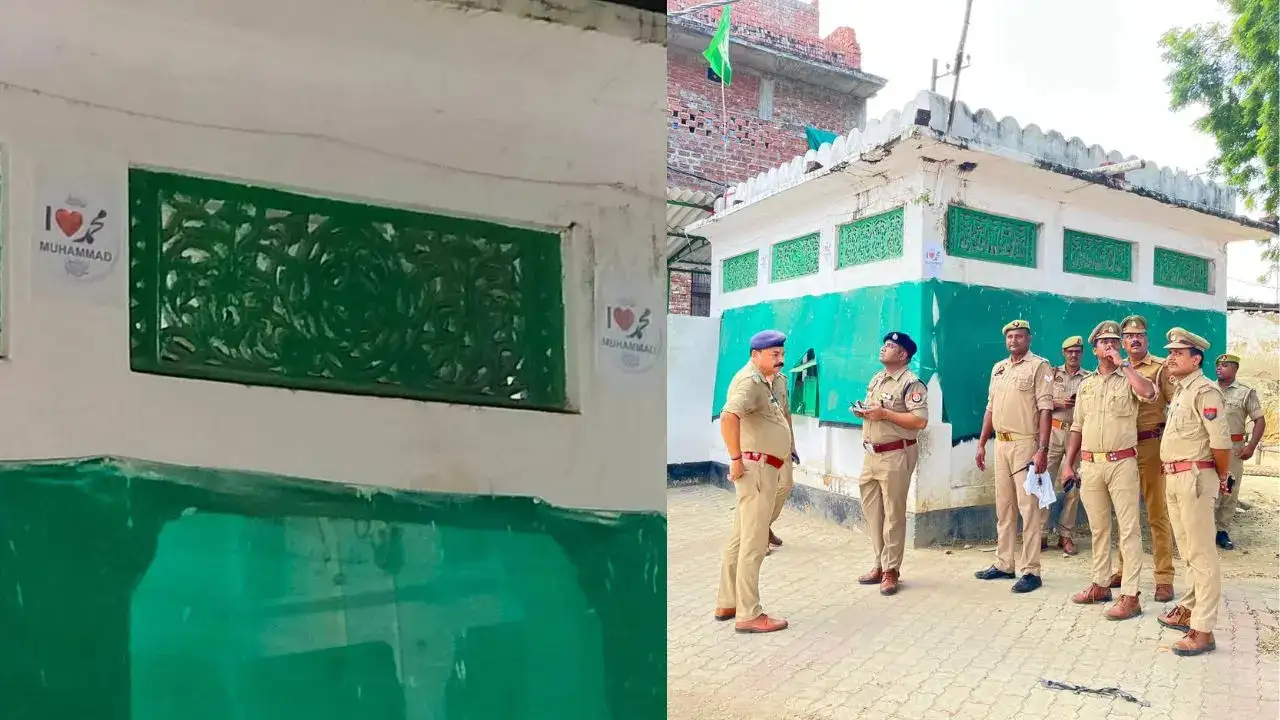
Case Summary
Hindus faced intimidation in Lohata, Varanasi, on 26 September 2025, when minor Muslim boys raised Sar Tan Se Juda (beheading) slogans during a procession carrying “I Love Muhammad” posters. The incident, captured in a viral video, showed the boys shouting violent slogans alongside religious chants, causing alarm among local Hindu residents. The controversy, which began in Kanpur over “I Love Muhammad” hoardings, had already spread to several cities, including Kolkata and Varanasi. In Lohata, the situation escalated further as nearly two hundred houses in Kotwa, a Muslim-dominated area, displayed the posters. Similar posters were also pasted outside mosques and madrasas, prompting police action. Authorities removed the posters, patrolled the locality, and initiated an investigation into those responsible for raising the violent slogans. Special police units, including DCP-rank officers, were deployed, with drones monitoring sensitive areas. Security was tightened around Gyanvapi and in Muslim-majority localities such as Dalmandi, Bajardiha, Rewari Talab, Khojwa, and Lohata to prevent escalation. Police confirmed that efforts were underway to identify those seen in the video, particularly the minors involved in shouting the slogans.
Why it is Hate Crime ?
The primary category in this case is: Hate speech against Hindus. The subcategory under this is: Violent threats. Violent threats, explicit, implicit or implied, is the most dangerous form of hate speech since it goes beyond discriminatory and prejudicial language to express the intent of causing harm to an individual or a group of people based on their religious identity and faith. There could be several different kinds of threats that are issued to Hindus based on religious animosity. An explicit threat would mean the direct threat of violence towards an individual Hindu, a group of Hindus or Hindus at large. Physical violence, death threats, threats of destruction of property belonging to Hindus and threats of genocide would mean explicit threats against Hindus for their religious identity. Implicit threats may not be a direct threat but implied through the use of symbols of actions – for example – in the Nupur Sharma case, other than explicit threats, there were also implicit threats when Islamists took to the streets to burn and beat her effigies. It implies that they want to do the same to Nupur Sharma – thereby is considered an implicit threat. Violent threats can be delivered in person, through letters, phone calls, graffiti, or increasingly through social media and other online platforms. It would be important to understand that a threat – explicit or implicit, online or offline – to an individual who happens to be a Hindu does not qualify as a religiously motivated threat. Such a threat, while vile and dangerous, could be owing to non-religious reasons and/or personal animosity. To qualify as a religiously motivated threat, it would need to exhibit an indication that the individual is being targeted for religious reasons and/or owing to his/her religious identity as a Hindu. This case has been included in the Hinduphobia Tracker because it demonstrates the most lethal form of hate speech directed against Hindus: violent threats issued in public, in this instance through the slogan “Sar Tan Se Juda” raised during a Muslim procession in Lohata, Varanasi. The choice of slogan, its historical resonance, and its deliberate use in a communal context convert this incident from a matter of street-level disorder into a direct hate crime that weaponises words as instruments of violence. The danger of this case lies first in the content of the slogan itself. “Sar Tan Se Juda” is not a vague or symbolic expression; it is a direct call for beheading. Across South Asia, including India, this slogan has repeatedly preceded acts of real-world murder against individuals accused of blasphemy, whether teachers, activists, or political leaders. Its utterance in public space collapses the distance between speech and action, translating verbal incitement into a tangible threat of religiously motivated killing. In this sense, it is not merely hate speech but a blueprint for violence against Hindus, an instruction and a warning simultaneously. Though a radical Muslim outfit in Pakistan coined this slogan, it has gained popularity among Islamists in regions beyond its geographical origins. Over the years, we have seen large crowds of Islamists chanting the “Sar Tan Se Juda” slogan, which is nothing but a direct incitement to violence against Hindus, leading to murders committed in the name of blasphemy. The second reason this incident qualifies as a hate crime against Hindus is its religiously targeted nature. The slogans were raised not in an abstract political rally, but alongside a mobilisation that presented itself as a defence of Islam and its symbols. The context was already inflamed by the “I Love Muhammad” controversy, which had spread from Kanpur to Varanasi. Here, the addition of beheading chants signalled that Hindus in particular — those perceived as critics or even those simply affirming their own identity — could be killed for supposed blasphemy. By turning a religious slogan into a threat, the perpetrators aimed to intimidate Hindus collectively, not just a single individual, thereby attacking their right to security, belief, and expression. A further layer of significance comes from the way misinformation was used as a weapon. The immediate pretext for this mobilisation was the rumour that an FIR had been filed in Kanpur against a “Love Muhammad” banner. In reality, the FIR was against the destruction of Hindu posters. The deliberate distortion of facts acted as a trigger, creating outrage in the Muslim community and allowing extremist actors to justify violent slogans as a form of protest. This pattern — twisting facts to stir communal anger, then directing that anger through chants of execution — demonstrates how propaganda and deceit are harnessed to legitimise violence against Hindus. The result is not accidental mob behaviour but a structured mechanism of incitement, designed to intimidate, destabilise, and silence. The raising of “Sar Tan Se Juda” chants by minors, as captured in the viral video, is particularly chilling. It shows the degree to which communal hatred is transmitted intergenerationally, grooming children into normalising calls for execution as part of community pride. This normalisation not only entrenches hostility but ensures that future acts of violence will find new recruits already indoctrinated in the rhetoric of elimination. The presence of posters outside two hundred houses in Kotwa, a Muslim-majority area, amplifies this threat further, creating an atmosphere where intimidation is reinforced visually as well as verbally. The slogan cannot be dismissed as empty rhetoric or youthful bravado. In the Indian context, every time “Sar Tan Se Juda” has been raised, it has been followed by actual violence, from the murder of Kanhaiya Lal in Udaipur to assaults in other states. It is a bridge that links speech to killing, chilling expression and silencing Hindu voices through fear of death. Its raising in Varanasi was therefore not a community expression but an outright call for the killing of Hindus, motivated by religious animosity and justified through misrepresentation. For these reasons, the case is included in the tracker as a textbook example of hate speech against Hindus under the subcategory of violent threats. It embodies the intersection of incitement, misinformation, and communal hostility, weaponised to suppress Hindu identity and faith. By documenting this case, the tracker underscores how such slogans are not isolated incidents but part of a continuing pattern of Hinduphobic mobilisation that threatens both individual lives and the collective security of the Hindu community.


Case Status
Complaint filed


Perpetrators Details
Perpetrators
Muslim Extremists
Perpetrators Range
Unknown
Perpetrators Gender
male
 Sources




