Revered Hindu festival targeted: Chief Justice BR Gavai's mother denigrates Dussehra, calls it "harm to social conciousness"
 Maharashtra, India
  27 September, 2025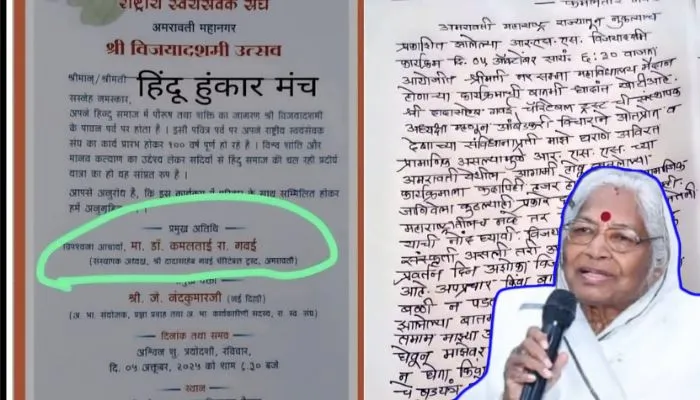
Case Summary
An anti-Hindu remark was made by Kamaltai Gavai, the mother of Chief Justice of India B R Gavai. She stated that celebrating the Hindu festival of Dussehra would “harm social consciousness” as she rejected an invitation from the Rashtriya Swayamsevak Sangh (RSS) to its Vijayadashami and centenary programme in Amravati, Maharashtra, scheduled for 5th October 2025. In a letter written in Marathi, she distanced herself from Hindu traditions, identified herself as an Ambedkarite, a follower of Dr BR Ambedkar, and made her opposition clear. She asserted that she would never attend an RSS programme “under any circumstances”, describing media reports of her presence as “RSS propaganda” and dismissing them as misinformation. She reaffirmed her family’s loyalty to Ambedkarite ideology and the Indian Constitution. Kamaltai Gavai further stressed that while Vijayadashami holds importance in Hindu culture, for Buddhists like her, the principal occasion is ‘Ashok Vijayadashami’, which commemorates Emperor Ashoka’s adoption of Buddhism. She urged Ambedkarites to ignore reports of her invitation, calling them a conspiracy by the RSS. Earlier, an explicitly anti-Hindu statement was issued by the Chief Justice of India, B.R. Gavai, a Buddhist by faith, during court proceedings, reflecting a departure from judicial reasoning and instead resorting to sarcasm directed at Hindu beliefs. The incident took place on 16th September 2025, when the Supreme Court of India dismissed a petition seeking the restoration of a seven-foot beheaded idol of Lord Vishnu at the Javari Temple in Khajuraho, Madhya Pradesh. The petition, filed by Hindu devotee Rakesh Dalal and argued by Senior Advocate Sanjay M. Nuli, emphasised that restoration of the idol was not merely an archaeological concern but a matter of religious faith, dignity, and the fundamental right of Hindus to worship their deities in wholeness. Dalal argued that the state’s refusal to undertake restoration constituted a violation of these rights. In response, the bench led by Chief Justice Gavai dismissed the plea with overt sarcasm rather than legal engagement. The Chief Justice stated, “This is purely publicity interest litigation. Go and ask the deity itself to do something now. You say you are a staunch devotee of Lord Vishnu. So go and pray now. It’s an archaeological site, and the ASI needs to give permission, etc. Sorry.” Saying this, BR Gavai asked the petitioner to approach the ASI (Archaeological Survey of India).
Why it is Hate Crime ?
The primary category in this case is: Hate speech against Hindus. The subcategory under this is: Anti-Hindu slurs, mocking faith. Anti-Hindu slurs and the deliberate mocking of the Hindu faith owing to religious animosity involve the usage of derogatory terms, stereotypes, or offensive references to religious practices, symbols, or figures. One of the common anti-Hindu slurs used against Hindus is “cow-worshipper” and “cow piss drinker”. The intention of using this term is to demean and mock Hindus as a group and their religious beliefs since Hindus consider the cow holy. Additionally, some symbols and the slurs attached to them have a historical context that exacerbates the insult, hate, stereotyping, dehumanisation and oppression against Hindus. Cow worship has been used for centuries to denigrate Hindus, insult their faith and oppress Hindus specifically as a religious group. There has been overwhelming documentation about how cow slaughter has been used to persecute Hindus with cow meat being thrown in temples and places of worship. There has also been overwhelming documentation where cow meat (beef) has been force-fed to Hindus to either forcefully convert them to Islam or denigrate their faith. Apart from cow worship, the Swastika – which holds deep religious significance for the Hindus – has also been misinterpreted and distorted to use as a slur against Hindus. Similarly, the worship of the Shivling has been used by supremacist ideologies and religions to denigrate Hindus owing to religious animosity. Such slurs and denigration stem out of inherent animosity and hate towards Hindus and their faith, therefore, it is categorised as hate speech targeted at Hindus specifically owing to their religious identity. This case has been included in the Hinduphobia Tracker because it exemplifies a form of hate speech and systemic animosity directed against Hindus by targeting their religious identity and sacred festivals. The refusal of Kamaltai Gavai, mother of the Chief Justice of India B.R. Gavai, to participate in the RSS Vijayadashami programme on the grounds that celebrating Dussehra would “harm social consciousness” is not merely a personal choice or ideological statement. By framing a major Hindu festival as socially harmful, she delegitimises centuries-old religious customs and, in effect, casts a moral and social judgment on the faith of millions. The deliberate characterisation of a foundational and revered Hindu festival as inherently problematic amounts to an assault on the collective dignity of Hindus and is indicative of Hinduphobic intent. Labelling a prominent Hindu festival such as Dussehra—an occasion celebrating the victory of good over evil, the worship of Goddess Durga and Lord Ram, and deeply embedded ritual and cultural practices—as “harmful” or socially damaging is a targeted denigration of Hindu identity. Festivals like Dussehra and Vijayadashami are not merely cultural events; they are religiously consecrated occasions that sustain communal cohesion, transmit spiritual teachings, and affirm the continuity of Hindu religious practice. Declaring these celebrations socially harmful seeks to undermine their spiritual and cultural significance, creating a narrative in which adherence to Hindu rituals is portrayed as a moral or societal fault. This constitutes psychological and symbolic harm, as it attacks the legitimacy of Hindu beliefs and rituals in the public sphere, and pressures Hindus to view their faith as inferior, outdated, or socially objectionable. The inclusion of this case in the tracker is further reinforced by the broader context involving B.R. Gavai, the Chief Justice of India. His dismissal of a petition to restore a beheaded Lord Vishnu idol at the Javari Temple in Khajuraho using overt sarcasm, rather than engaging with the legal and religious merits of the plea, represents an institutional and judicial dimension of anti-Hindu bias. By trivialising the concerns of a devotee and reducing a matter of faith, religious dignity, and constitutional rights to what he described as “publicity interest litigation,” the Chief Justice not only mocked the petitioner but also delegitimised the collective faith of the Hindu community. The combination of Kamaltai Gavai’s public statements and the Chief Justice’s court conduct reflects both social and institutional expressions of prejudice, targeting Hindus’ religious practices and symbols. Hate crimes do not necessarily require physical violence; they can be expressed through verbal, symbolic, and institutional channels that marginalise, demean, or intimidate a specific community based on identity. In this case, the public labelling of a sacred Hindu festival as socially detrimental, the promotion of alternative narratives that elevate non-Hindu religious frameworks while denigrating Hindu rituals, and the judicial mockery of devotees’ concerns collectively constitute a hate crime against Hindus. The intent and effect of these acts are to demean Hindu practices, erode confidence in public recognition of Hindu rituals, and delegitimise the faith of a community through public and authoritative channels. Moreover, this incident highlights the intersection of religious prejudice and social influence. Kamaltai Gavai’s statements are positioned to reach followers of Ambedkarite ideology and the general public, implying that adherence to Hindu festivals is socially regressive or harmful. This framing not only insults the Hindu faith but also encourages social ostracism or moral condemnation of those who celebrate Dussehra. By recording this case in the Hinduphobia Tracker, the goal is to document how social and institutional actors can weaponise ideology to delegitimise Hindu faith, undermine the sanctity of religious festivals, and contribute to a broader environment of fear, marginalisation, and denigration for Hindus in India. In essence, the case exemplifies hate speech, social denigration, and institutional bias. It targets Hindus’ religious identity, mocks their core practices, and frames adherence to sacred traditions as socially harmful. The coordinated effect of public statements and judicial mockery demonstrates the harm inflicted on Hindus both symbolically and socially, making this a significant incident to track in the context of Hinduphobia. Disclaimer: The Hinduphobia Tracker records the date of each incident based on when the accused made their anti-Hindu remarks, rather than when it is reported in the media. However, in this case, the media report did not specify the exact date of the crime. Therefore, for the purpose of documentation, the date when the incident was reported in the media, 28th September 2025, is being used as the indicative date of the incident.


Case Status
Unknown


Perpetrators Details
Perpetrators
Others
Perpetrators Range
One Person
Perpetrators Gender
female
 Sources




